Uzbekistan
- Capital
- Tashkent
- Population
- 35.6M
- Currency
- UZS
- Languages
- Uzbek
Overview
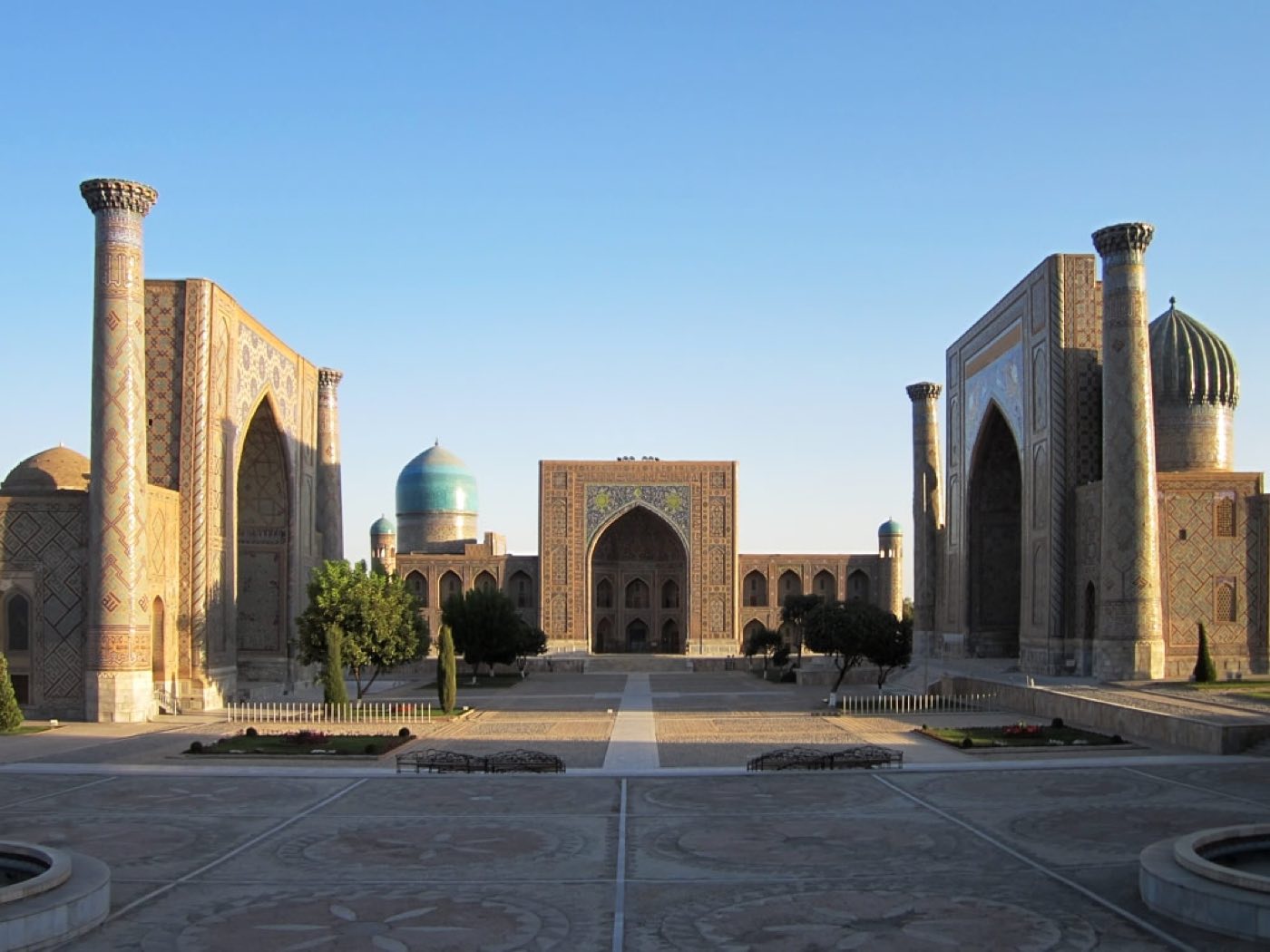
The heartland of the old Silk Road, Uzbekistan is where caravans coming out of China split into the branches that would reach Persia, the Levant, and Europe. What they left behind is the most concentrated cluster of Islamic architecture in Central Asia: three cities — Samarkand, Bukhara, and Khiva — where turquoise domes and tilework madrasas sit on streets that have been market streets for a thousand years. Travel here became genuinely easy around 2018, when the country dropped visas for most Western nationalities and opened up after decades of Soviet and post-Soviet closure. The high-speed Afrosiyob train now connects Tashkent, Samarkand, and Bukhara in a few hours; the Silk Road triangle has become one of the best-value cultural itineraries in the world. English is still limited outside hotels but signage in the main cities has improved, and the younger generation working in the tourism economy is sharp and curious. What you'll remember is the tilework. Registan Square at sunset, when the blues of the three madrasas deepen against a warm ochre sky; the spiral of the Kalyan Minaret in Bukhara, which Genghis Khan spared in 1220 when he took the city; the walled inner city of Khiva at night, when the tourist coaches have gone and you have the lanes to yourself. Pair it with good food — plov, samsa, round non bread straight out of a clay oven — and a population that welcomes visitors with visible warmth.
Things to Do
Registan Square in Samarkand
The former public square of medieval Samarkand is bounded on three sides by three tile-covered madrasas — Ulugh Beg (1420), Sher-Dor (1636), and Tilya-Kori (1660) — each a masterwork of Timurid and post-Timurid architecture. Come twice: once in the late afternoon when the low sun throws the facades into relief, and once at night when the square is lit and you can sit on the steps with half the city. Pay the small extra for the sunset climb up one of the minarets; the view over the square and the old town is worth the wobble.
Bukhara's Kalyan Minaret and Ark Fortress
Bukhara's old town is more of a piece than Samarkand's — a dense warren of madrasas, caravanserais, and covered bazaars you can walk end to end in a morning. The Kalyan Minaret (1127) is the city's signature, a 47-meter brick tower that Genghis Khan famously left standing when he levelled everything else. The Ark Fortress, a walled citadel facing it, was the residence of the emirs until the 20th century and is now a ragged, atmospheric museum. Stop for tea on the shady plaza at Lyabi-Hauz between sights.
Khiva's Ichon-Qala walled inner city
Khiva is the westernmost and smallest of the Silk Road three, a walled desert city of brown mud brick and blue-tiled minarets that was once the capital of the Khwarezm dynasty. The Ichon-Qala is the inner citadel — about 26 hectares of madrasas, palaces, and mausoleums, all walkable in a full day. Stay inside the walls at one of the small boutique hotels. After dark, when the day-trippers head back to Urgench, the tiled facades glow under sparse lanterns and the whole city feels dropped in from another century.
Shah-i-Zinda necropolis in Samarkand
A narrow corridor of turquoise-tiled mausoleums built between the 11th and 19th centuries, climbing a low hill on the edge of old Samarkand. Shah-i-Zinda means 'living king' — the site holds a shrine to Kusam ibn Abbas, cousin of the Prophet Muhammad, whose tomb pilgrims still visit. The intensity of colour and pattern is on a different level than the bigger sites. Come early in the morning before the tour groups. Dress modestly (cover shoulders and knees); a scarf is a good idea for women at the active shrine.
Tashkent's Chorsu Bazaar and metro stations
The capital is Soviet-era and modern, not ancient — most travellers give it a day before moving on. Spend that day at Chorsu Bazaar, a huge domed market in the old quarter where you'll find spices by the sack, rows of plov cooks, bread stalls, and the serious business of Uzbek commerce. Pair with a ride through two or three of the old Tashkent metro stations — once military-secret and only recently reopened to photography — where each station's mosaics and chandeliers tell a different Soviet-realist story.
Gur-e-Amir — Tamerlane's mausoleum
Timur — Tamerlane to Europeans — conquered most of the known world from his base in Samarkand in the late 14th century, and his tomb sits under a ribbed turquoise dome a few blocks south of the Registan. Inside, a single jade tombstone marks his grave beneath gilded muqarnas vaulting that's one of the most intricate in the Islamic world. It's a small building, easy to overlook, and arguably the finest Timurid interior in Uzbekistan. Thirty minutes here will repay you for months.
Aral Sea ship graveyard at Moynaq
In the far northwest, the former fishing port of Moynaq sits on what was the fourth-largest lake in the world before Soviet irrigation projects drained the Aral Sea. The former shoreline is now 150 kilometres away and a dozen rusting trawlers sit stranded on sand where boats used to dock. It's a sobering, strange, difficult place to reach — a long drive or internal flight from Tashkent plus a second road leg from Nukus — and not a normal tourist stop. If you go, go with a tour operator who knows the region.
When to Go
April to early June and September to early November are the best months — warm days, cool evenings, and the light that makes the tilework sing. Summer (late June through August) is intensely hot, with 40°C common in Bukhara and Khiva; possible but tiring. Winter (December to February) brings cold, clear days with occasional snow on the domes, which is photogenic and far less crowded, though some sites have reduced hours. The Navruz festival on the spring equinox (around March 21) is a major cultural event across the country — fires, feasting, and family visits — and a memorable time to be there.
Getting Around
The Afrosiyob high-speed train is the backbone of a Silk Road trip: Tashkent to Samarkand in 2 hours, Samarkand to Bukhara in 1.5, with comfortable reserved seating. Book a few days ahead in peak season on the Uzbekistan Railways website. For Khiva, the overnight train from Bukhara or a 1-hour flight to Urgench are the two options — the flight is cheap and saves a day. Within cities, taxis and ride-hailing (Yandex Go works across Uzbekistan) are inexpensive; agree a fare before getting in or use the app. Samarkand and Bukhara's old quarters are compact and walkable. For the Aral Sea or the Fergana Valley, hire a car with driver through a local agency.
Cost & Currency
The currency is the Uzbekistani som (UZS), which inflated heavily in the past and still prints mostly in 1,000 and 10,000 notes — you'll carry thick wads. Uzbekistan is inexpensive: a mid-range hotel in Samarkand runs $40–$80 a night, a restaurant dinner with drinks $10–$15, a plov lunch at a local teahouse under $5, and the Afrosiyob train Tashkent to Samarkand about $20–$25 second class. ATMs in big cities dispense som reliably; cards are accepted at larger hotels and tourist restaurants but cash is king everywhere else. Bring USD or EUR in new, clean bills to exchange if your card doesn't cooperate. Tipping is not expected; rounding up a restaurant bill is generous.
Frequently Asked Questions
- Do I need a visa to visit Uzbekistan?
- Most Western travelers — US, UK, EU, Canadian, Australian, and Japanese citizens among many others — can enter visa-free for 30 days under reforms introduced in 2018 and 2019. A passport valid six months beyond arrival is required. Other nationalities can apply online for an e-visa; the process takes 2–3 business days and costs US$20 for a 30-day single-entry. Check the latest rules before booking as the list has been expanding.
- Is Uzbekistan safe for travelers?
- Yes — Uzbekistan is a safe destination with very low violent crime and a strong police presence in tourist areas. The most common issues are overcharging by taxi drivers and occasional pickpocketing in Tashkent's Chorsu Bazaar and busy train stations. The border regions with Afghanistan and Tajikistan have historically been sensitive; the main tourist triangle is far from them and not a concern.
- How many days do I need for the Silk Road cities?
- A tight trip works in 7 days: 1 in Tashkent, 2 in Samarkand, 2 in Bukhara, 2 in Khiva. Ten days is more comfortable and lets you enjoy the cities at the pace they deserve, with an extra night in Bukhara and a day in the Fergana Valley. Don't try to compress this into a long weekend — you'll regret it when you see how much there is in each city.
- What should I wear, especially at religious sites?
- Uzbekistan is a Muslim-majority country but relatively relaxed about dress — jeans, t-shirts, and dresses are fine for day-to-day. At active mosques and shrines (Shah-i-Zinda in Samarkand, the Kalyan Mosque in Bukhara), women should cover shoulders, knees, and ideally hair; men should avoid shorts. Bring a light scarf in your bag and you'll be ready for any site you walk past.
- Do people speak English?
- English is limited outside hotels, established tour operators, and some younger staff in main tourist areas. Uzbek (in Latin script) and Russian are the working languages, and Russian is still widely understood by anyone over 40. A few phrases in either goes a long way, as does a translation app on your phone. Locals are patient and helpful with visitors making the effort.
Plan a Trip to Uzbekistan
Have you been to Uzbekistan?
Track 195 countries, 50 states & 63 national parks on your map