Kazakhstan
- Capital
- Astana
- Population
- 19.8M
- Currency
- KZT
- Languages
- Kazakh, Russian
Overview
The world's ninth-largest country, Kazakhstan spans a thousand miles of Central Asian steppe, the Tian Shan mountains along its southern edge, and the eerie, fenced-off legacy of Soviet nuclear tests on the plains near Semey. It is a country most travelers first hear about and then, if they come, cannot stop talking about — because the scale of the place rearranges what you thought a landscape could be. You'll feel it most outside Almaty, when the city thins and the Tian Shan rise on the southern horizon, snow-capped even in July. Drive three hours east and the land breaks open into Charyn Canyon, a smaller Colorado carved into red sandstone with nobody else there. Drive another day and the Altyn-Emel dunes hum a low resonant note in a steady wind — an acoustic phenomenon you have to stand on to believe. The steppe between is emptier than you expect, and faster — eagles on thermals, horses loose on the shoulder, the road running flat to a horizon you can see the curve of. Kazakhstan rewards travelers with patience for distance and an appetite for places that have not been sanded down for tourism. Cities feel Soviet in layout and Kazakh in texture — bazaars selling horse sausage and honey next to gleaming new mosques, old women in embroidered headscarves beside twenty-somethings in streetwear. English is thin outside Almaty hotels; a few words of Russian or Kazakh open doors. Come for a week and you'll see Almaty and a corner of the mountains; come for three and the country starts to make sense.
Things to Do
Charyn Canyon — Central Asia's Grand Canyon
Three hours east of Almaty, the Charyn River has cut a twelve-kilometer gorge into red sandstone that photographs like a miniature version of its Arizona cousin. The most visited stretch is the Valley of Castles, where wind-carved pillars line a walkable trail that drops to the river in about forty minutes. Go at sunrise or late afternoon — the color is the whole point, and midday sun flattens it. Most people come as a day trip, but a night at the canyon-floor yurt camp is worth the extra logistics: the stars over the rim are the kind you remember.
Almaty's Green Bazaar and Medeu skating rink
The old capital sits against the Tian Shan and feels more Kazakh than Astana does — treelined, walkable, unshowy. Start at the Zelyony Bazaar (Green Bazaar), where the dairy aisle alone is an education in kumis and shubat, and vendors press halves of apricot and dried melon on you to try. Then take a shared taxi up to Medeu, a Soviet-era high-altitude speed-skating rink set in a mountain bowl at 1,700 meters. Rent skates for a few hundred tenge and spend an hour circling with locals against a wall of fir forest.
Big Almaty Lake in the Tian Shan mountains
Forty minutes' drive above the city, a reservoir sits at 2,500 meters in a mountain bowl so symmetrical it looks computer-rendered. The water shifts between turquoise and deep green with the light; in July the surrounding ridges still hold snow. Swimming is forbidden (it's a drinking supply) and the road is paved but steep, so take a registered taxi or a tour. Come prepared for twenty degrees cooler than Almaty — the altitude does the work — and bring something to eat. The overlook above the lake is the photograph everyone chases.
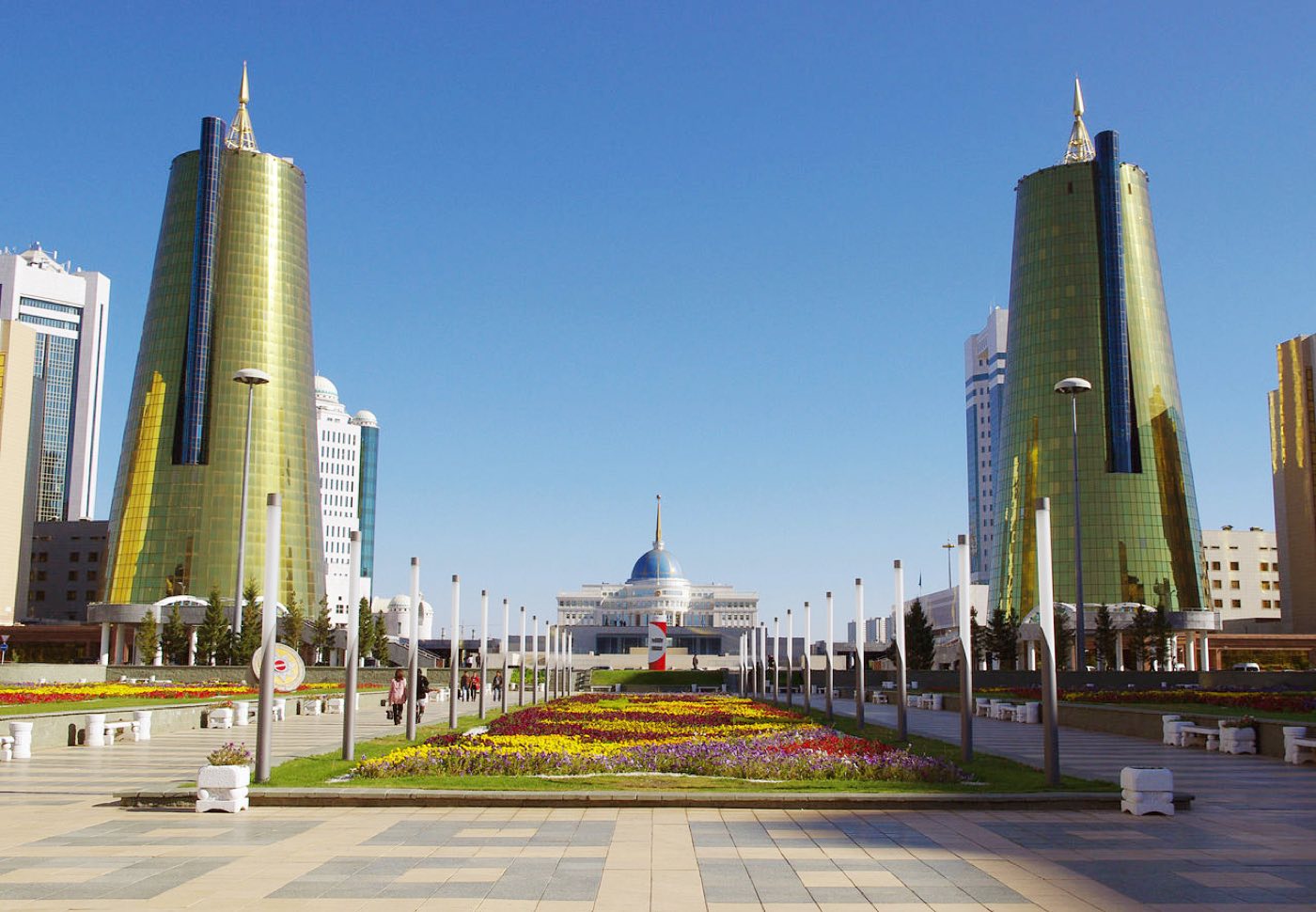
Astana's futuristic architecture and Baiterek Tower
The purpose-built capital on the northern steppe is a showcase of starchitect ambition — Norman Foster's Khan Shatyr tent, the Palace of Peace pyramid, and the 97-meter Baiterek Tower topped with a golden egg that references a Kazakh folktale. Ride the Baiterek elevator for the city panorama and the chance to place your palm in a handprint mold of the country's first president. The whole city reads as architecture fair more than organic urbanism, which makes for a striking day but a short stay.
Altyn-Emel Singing Dunes
In Altyn-Emel National Park, a 150-meter sand dune sits improbably in the middle of a stony desert valley, and when a strong wind crosses its slip face the whole dune emits a low humming note — a phenomenon you can feel underfoot as well as hear. Climb it at sunrise for the acoustics and the view down the Ili River valley toward the Tian Shan. The park also protects wild kulan (Asiatic wild ass) and gazelles across an enormous area, and the chalk cliffs of Aktau in its eastern section are a separate and equally strange landscape.
Kolsai Lakes alpine chain
Three glacial lakes staircase up the Kungey Alatau range near the Kyrgyz border, set in spruce forest at 1,800 to 2,800 meters. The first lake is reachable by road and drawn around by an easy two-kilometer walk; the second is three hours on foot up a forested trail and infinitely quieter; the third is a full-day trek best attempted with a guide and decent altitude legs. Combine with the turquoise bowl of Kaindy Lake nearby, where drowned spruce trunks still stand in the water a century after an earthquake dammed the valley.
Baikonur Cosmodrome rocket launches
The world's first and largest operational spaceport sits on the steppe in south-central Kazakhstan — leased to Russia, still the main departure point for Soyuz crews heading to the International Space Station. Visiting requires booking months ahead through a licensed operator who handles permits, and launch days carry the obvious risk that schedules slip. When it works, you stand on a remote viewing platform a few kilometers from the pad and feel the sound rearrange your ribcage. Not a casual add-on — a dedicated trip for people who care.
When to Go
May through September is the window — warm days on the steppe, accessible mountain trails in the Tian Shan, and wildflower blooms in the lower valleys in May and June. July and August are peak for the mountains, when snow has cleared off the Kolsai and Charyn approaches and nights stay mild. Astana's winters are famously severe, dropping to -40°C in January, while Almaty stays milder but gray. September brings clear air and fewer tour groups at Charyn and Altyn-Emel, and is arguably the best single month of the year. Avoid April and November, when roads to the national parks can be muddy and unreliable.
Getting Around
Domestic flights are the practical way to cover the country's distances — Almaty to Astana in under two hours, Almaty to Shymkent or Aktau in about the same, with Air Astana and SCAT flying most routes daily. Trains are a cheaper alternative and a proper Kazakh experience on overnight journeys; the Almaty–Astana sleeper takes about 14 hours in a platzkart or kupe compartment. Within cities, Yandex Go works well for taxis in Almaty, Astana, and Shymkent, and metro lines cover central Almaty. For Charyn, Altyn-Emel, and the mountain lakes, hiring a car with driver for a multi-day loop is the realistic choice — self-driving is legal but the distances and occasional checkpoints make a local driver more comfortable.
Cost & Currency
Kazakhstan uses the tenge (KZT), typically running around 450–500 to the US dollar — a favorable rate for most visitors. Costs are moderate by regional standards: a sit-down lunch in Almaty runs 3,000–6,000 KZT ($7–$13), a comfortable mid-range hotel 25,000–50,000 KZT a night, and a shared taxi across the city 1,500–2,500 KZT. Domestic flights start around 20,000 KZT for short hops. Cards are widely accepted in Almaty and Astana; carry cash outside the big cities and in national parks, where ATMs thin out. Tipping is light — round up a restaurant bill and hand drivers a few hundred tenge at the end of a long day.
Frequently Asked Questions
- Do I need a visa to visit Kazakhstan?
- Citizens of the US, UK, EU, Canada, Australia, and about 70 other countries can enter visa-free for stays up to 30 days. Check current rules before you travel, and note that if you arrive overland you may need to register with migration police within a few days — most hotels handle this for you if you ask.
- Is Kazakhstan safe for travelers?
- Yes — Kazakhstan is one of the safer countries in Central Asia, with low violent crime and a large, visible police presence in Almaty and Astana. Watch for petty theft in bazaars and on the Almaty metro at rush hour, and avoid unofficial taxis at the airport in favor of Yandex Go or a prearranged driver.
- What language should I learn some of before going?
- Russian is more widely spoken than Kazakh among older and urban residents, and a few phrases go a long way with taxi drivers, market vendors, and anyone outside tourist hotels. Younger Kazakhs increasingly speak English, especially in Almaty, but do not count on it once you leave the cities.
- Can I visit Charyn Canyon and the mountain lakes on a day trip?
- Yes for Charyn and Big Almaty Lake, both doable as long single days from Almaty. Kolsai and Kaindy Lakes deserve an overnight in a local guesthouse in Saty village — the drive is four to five hours each way and you'll want time on the trails rather than in the car.
- Is the tap water safe to drink?
- Stick to bottled water, particularly outside Almaty and Astana. Tap water is treated in the major cities and generally considered safe for brushing teeth, but locals themselves mostly drink bottled or filtered, and travelers unfamiliar with the mineral profile may find it upsets their stomach.
Plan a Trip to Kazakhstan
Have you been to Kazakhstan?
Track 195 countries, 50 states & 63 national parks on your map