Azerbaijan
- Capital
- Baku
- Population
- 10.2M
- Currency
- AZN
- Languages
- Azerbaijani
Overview
A South Caucasus country where medieval silk road bazaars meet ultramodern flame-shaped towers on the Caspian Sea. Travelers come for Baku's walled Old City, fire-worshipping temples, and the surreal mud volcanoes of the Absheron Peninsula. The first thing that hits you is the wind off the Caspian. Baku sits on a peninsula that juts out into the sea, and the air is almost always moving — it rattles the plane trees along the boulevard, pushes clouds across the glass face of the Flame Towers, and gives the city a temperature that always feels a few degrees cooler than the thermometer says. Drive forty minutes inland and the wind is gone, the landscape opens into dry hills stained with oil, and you understand quickly that this is a country shaped by fire, water, and the stuff that leaks out of the ground between them. Azerbaijan rewards travelers willing to split their time. A few days in Baku gives you the old walled city, the strange lunar geology of Gobustan, and the kind of late dinners where someone insists on pouring you more wine. Then head north to Sheki, Qabala, or the high villages of Khinalug, where the mountains stand up suddenly and the food turns to lamb stews and thin bread baked on the wall of a clay oven. It is not a long itinerary — a week is enough to see the country properly — but it covers more terrain, historically and literally, than you expect.
Things to Do
Baku's Walled Old City (Icherisheher)
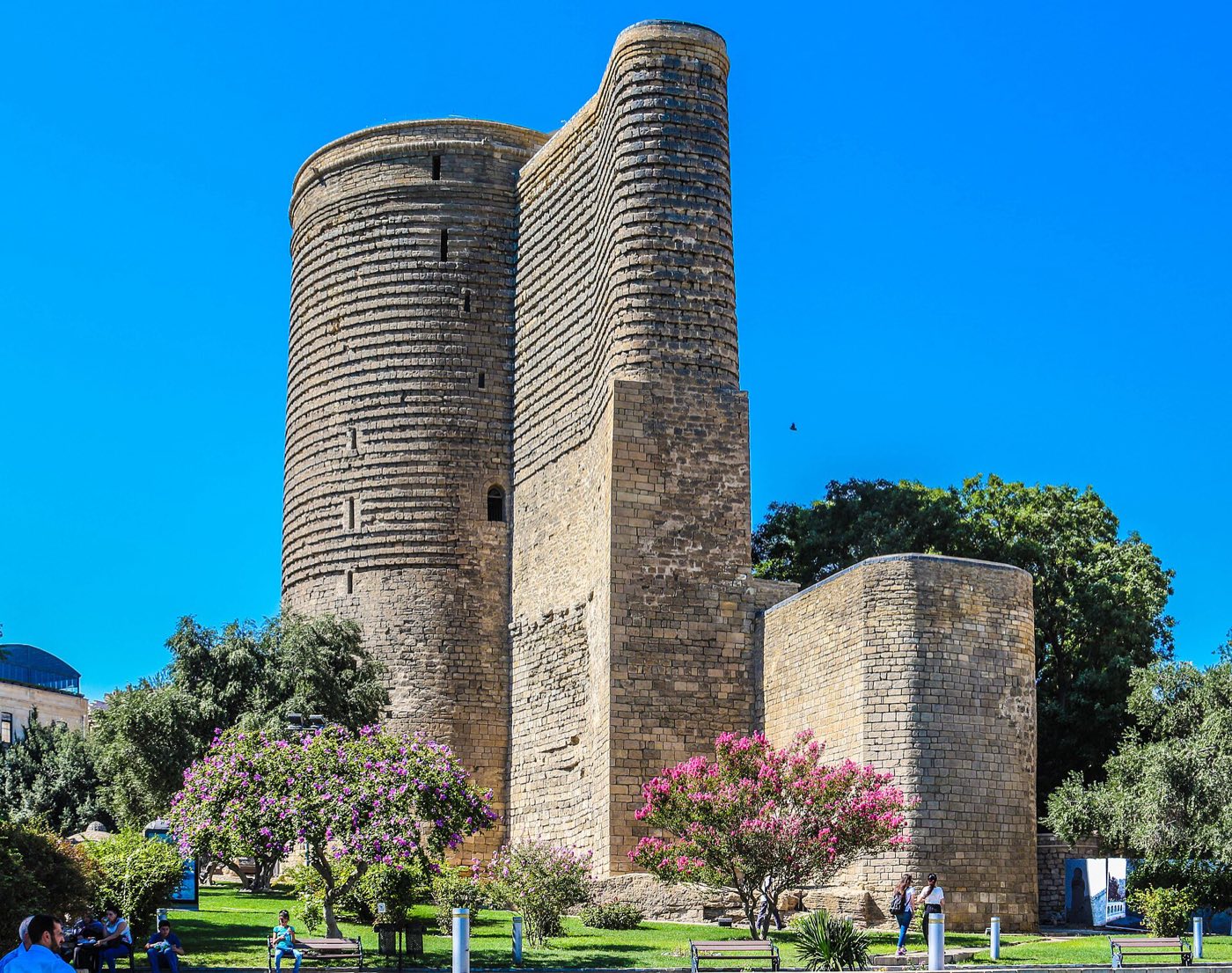
A UNESCO-listed tangle of honey-colored stone lanes inside the medieval ramparts of the capital, with the 12th-century Maiden Tower at one corner and the Shirvanshahs' Palace at the other. You can walk the whole thing in a morning, but the pleasure is stopping for tea at a courtyard carpet shop and letting the afternoon go. Come back at night when the walls are lit and the tour groups have cleared out.
Flame Towers and Heydar Aliyev Center
Baku's architectural statement pieces. The three Flame Towers curl above the city like stylized flames, sheathed in LEDs that put on a light show every evening after dark. A few kilometers away, Zaha Hadid's Heydar Aliyev Center flows in a single continuous white curve that you'll want to walk around twice — once for the building, once for the reflection in the pools that surround it.
Ateshgah Fire Temple
Thirty kilometers east of central Baku, the Ateshgah is a pentagonal stone caravanserai built over a natural gas vent that once burned on its own for centuries. Hindu and Zoroastrian pilgrims worshipped here; the central altar still carries a controlled flame, and the surrounding cells display artifacts and inscriptions from 17th-century traders. Pair it with Yanar Dag on the same afternoon.
Gobustan petroglyphs and mud volcanoes
About an hour south of Baku, the Gobustan reserve holds some 6,000 rock carvings — boats, dancers, hunters — pecked into limestone boulders between 5,000 and 20,000 years ago. A short drive beyond the visitor center, a field of small gray mud volcanoes bubbles quietly at ankle height in a landscape that looks borrowed from another planet. You can stick your hand in the cold mud; it is oddly satisfying.
Sheki's Khan Palace with stained glass
Sheki sits in the green foothills of the Greater Caucasus, about five hours from Baku, and the 18th-century Khan Palace at its heart is the reason to make the drive. Every window is a mosaic of thousands of hand-cut pieces of colored glass fitted without nails into carved wooden frames — the interior light changes with every cloud. Stay the night at the Karvansara hotel, a working caravanserai in the old town.
Yanar Dag burning mountainside
A ten-meter stretch of hillside on the Absheron Peninsula that has been on fire, continuously, for at least sixty years and probably much longer — a natural gas seep that ignited at some point and has simply kept going. It is best at dusk, when the flames stand out against the dark ground and a cold wind comes off the sea. Expect a small entrance fee and a few minutes of quiet bafflement.
Absheron Peninsula
The stubby promontory that Baku sits on is worth a day to itself — a loop through half-abandoned Soviet oil villages, quiet Caspian beaches, and the two fire sites at Ateshgah and Yanar Dag. Hire a driver or rent a car; distances are short but public transport is patchy. You'll see more of the old petroleum industry than you expect, which is part of the peninsula's strange charm.
When to Go
April through June and September through October bring pleasant temperatures for exploring Baku and the countryside, with wildflowers in the Caucasus foothills in spring and clear skies for Gobustan in autumn. Summers can be brutally hot along the Caspian coast — July and August regularly push past 35°C with heavy humidity — while winters are mild in Baku but properly cold and snowy in the mountain villages around Sheki and Khinalug. Novruz, the spring equinox festival in late March, is the most atmospheric time to be in the country if you don't mind cooler weather.
Getting Around
Baku has a clean, cheap metro that covers most of the central city, and ride-hailing through Bolt or Yandex Go is inexpensive and universal. For day trips around the Absheron Peninsula a hired car with driver is the easiest option; self-drive rentals are available but Baku traffic is aggressive and roundabouts are a contact sport. Intercity travel to Sheki, Ganja, or Qabala is best by marshrutka minibus or the overnight train, and a handful of domestic flights link Baku with Nakhchivan. Roads in the mountains can be rough — allow more time than the map suggests.
Cost & Currency
Azerbaijan uses the manat (AZN), and prices are moderate — higher than neighboring Georgia but still a clear step below Western Europe. Expect 3–5 AZN for a strong tea in a Baku teahouse, 15–25 AZN for a sit-down lunch of dolma or kebabs, and 80–150 AZN a night for a comfortable mid-range hotel room in the capital. Cards are accepted across Baku's restaurants, hotels, and supermarkets, but carry cash for marshrutkas, small teahouses, and anything outside the capital. Tipping is not expected but rounding up or leaving 5–10% in a restaurant is appreciated.
Frequently Asked Questions
- Do I need a visa to visit Azerbaijan?
- Most Western passport holders can apply for an e-visa online through the ASAN Visa portal, which is issued within three working days and costs around $26 for a 30-day stay. Bring a printed copy to the airport; the queue at passport control moves much faster if you have it in hand.
- Is Azerbaijan safe for travelers?
- Yes — Baku and most of the country are very safe for visitors, with low street crime and a visible police presence around tourist areas. Avoid the occupied Nagorno-Karabakh region and the border zones with Armenia, and check current advisories before driving in remote mountain areas where unexploded ordnance has been reported.
- What language will I need?
- Azerbaijani is the official language, Russian is widely understood especially among older generations, and English is common enough in Baku hotels and restaurants to get by. A few basic Azeri phrases go a long way in smaller towns and will often earn you a second cup of tea.
- Can I visit Azerbaijan and Armenia on the same trip?
- No — the two countries have no diplomatic relations, the borders between them are closed, and Azerbaijan will refuse entry to travelers who show evidence of visiting Armenia's occupied Nagorno-Karabakh region. Plan them as two separate trips routed through a neighboring country such as Georgia.
- How many days do I need in Azerbaijan?
- Five to seven days is a comfortable visit — three nights in Baku with a day trip to Gobustan and the Absheron Peninsula, plus two or three in Sheki or Qabala for the mountains. A longer stretch lets you add Khinalug or the Talysh foothills in the south.
Plan a Trip to Azerbaijan
Have you been to Azerbaijan?
Track 195 countries, 50 states & 63 national parks on your map