Uganda
- Capital
- Kampala
- Population
- 48.6M
- Currency
- UGX
- Languages
- English, Swahili
Overview
Uganda is a landlocked East African country the size of Oregon that holds half the world's remaining mountain gorillas, the source of the White Nile, and a biodiversity that earned it Churchill's old label — the Pearl of Africa. Visitors come for gorilla treks in Bwindi, chimpanzee tracking in Kibale, safaris on the Kazinga Channel, and white-water rafting on the Nile at Jinja. The country surprises people who arrive expecting East African savanna. The south is green and wet — tea plantations, banana groves, equatorial rainforest pressed up against the Rwenzori Mountains — while the north opens into drier acacia country. Roads are improving but rural journeys still take longer than a map suggests, and the rhythm of travel is naturally slow. You cover less ground than in Kenya or Tanzania and spend more time at each stop, which is part of the charm. Uganda rewards travelers interested in primates, the birds (over 1,000 species, including the shoebill stork), and a country that gets a fraction of Kenya's visitor numbers despite comparable wildlife. Gorilla permits are the budget item to plan around — US$800 per person at time of writing — and they book out months ahead in peak season. Go with a reputable operator, budget for a 4x4 and driver across the country, and expect warm welcomes in small towns and conversations with guides whose knowledge of forest behavior is unmatched anywhere.
Things to Do
Bwindi Impenetrable Forest gorilla trekking
Bwindi protects around half of the world's roughly 1,000 remaining mountain gorillas, in a UNESCO-listed rainforest whose name is no exaggeration — the undergrowth is thick, steep, and wet. You set out at 7am in a group of eight with trackers, machete-wielders, and armed rangers, and the hike to your habituated family can take one hour or six depending on where they slept. The hour you get with them, sitting three meters from a silverback the size of a sofa, is one of the most concentrated wildlife experiences on Earth. Permits are US$800 and must be pre-booked.
Queen Elizabeth National Park boat safari on Kazinga Channel
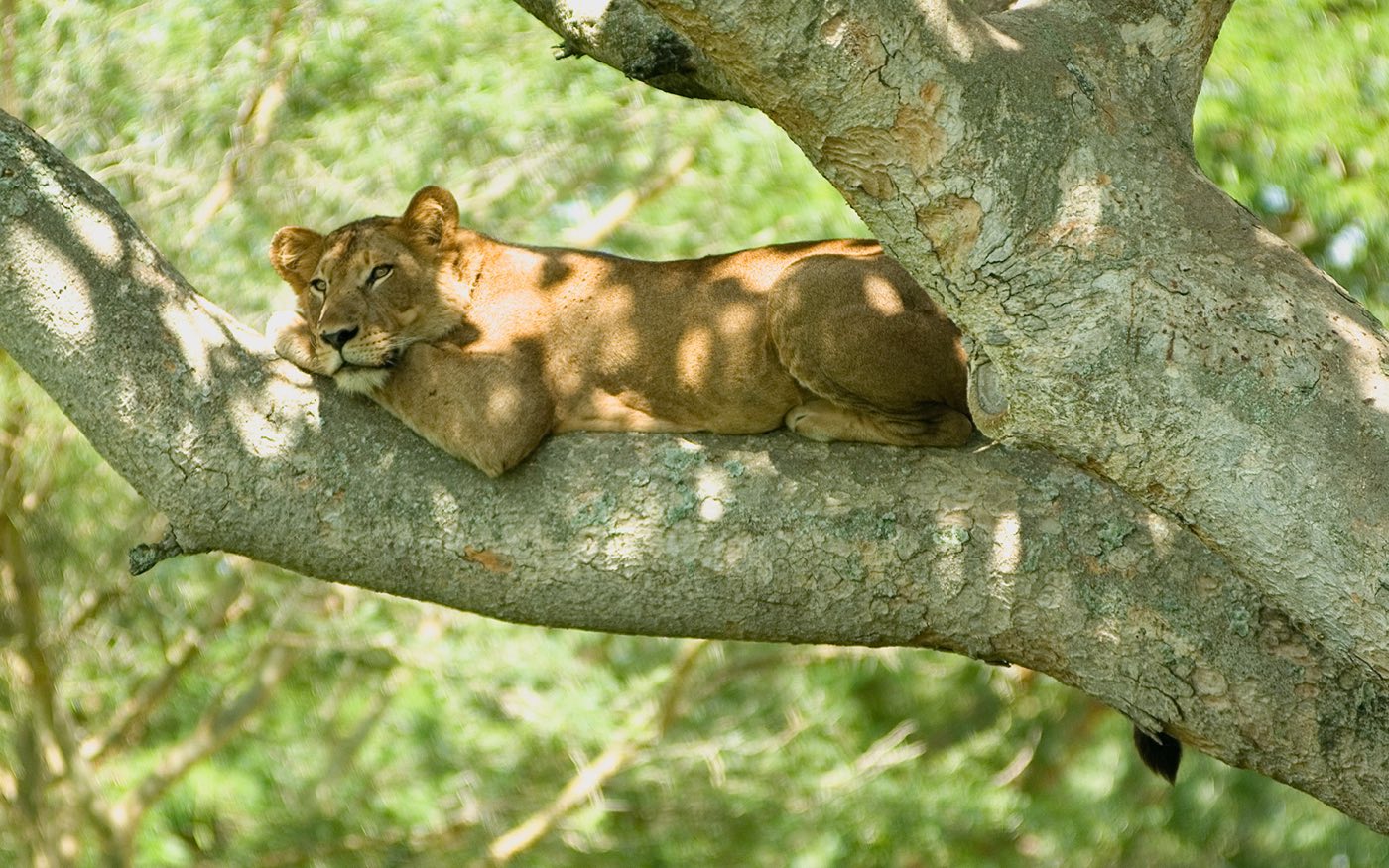
The 40-kilometer Kazinga Channel links Lake Edward and Lake George and carries one of the highest concentrations of hippos anywhere in Africa, along with elephants coming down to drink, crocodiles, and kingfishers by the dozen. The two-hour afternoon boat cruise from Mweya peninsula is inexpensive, the light at 4pm is lovely, and you'll get closer to wildlife than on most Land Cruiser game drives. Combine with a morning drive across the Kasenyi plains for lions.
Murchison Falls on the Nile
The Nile narrows to a seven-meter gap and forces its entire flow through the rock, creating a thundering cascade that drops 43 meters into a chasm below. You see it from above by hiking to the top, from below by boat from Paraa jetty, and from a safari perspective by game drives in Uganda's largest national park — hippos, elephants, rare Rothschild's giraffes, and Nile crocodiles along the riverbanks. Plan at least three nights to do the whole area justice.
Kibale Forest chimpanzee tracking
Kibale holds around 1,500 chimpanzees and one of the highest primate densities in the world — 13 species in all, including red colobus and l'Hoest's monkeys. Morning tracks go out from Kanyanchu with rangers who know the habituated communities; when you find them, you follow the troop through the forest as they drum on buttresses, shriek through the canopy, and occasionally stop to groom within arm's reach. Permits are US$250 and the experience is more active and noisier than gorilla trekking.
Rwenzori Mountains (Mountains of the Moon) trekking
The Rwenzoris rise to 5,109 meters at Margherita Peak — Africa's third-highest — in glaciated ridges that Ptolemy called the Mountains of the Moon. A full climb takes seven to nine days through rainforest, heath, bog, and alpine zones; shorter three- and four-day treks sample the lower ridges without the summit push. The scenery — giant lobelia, moss-draped rock, and remnant glaciers that are shrinking fast — is like nowhere else in Africa. Rwenzori Trekking Services in Kilembe runs the main route.
Jinja — source of the Nile and white-water rafting
Jinja sits where Lake Victoria drains into the Nile and has become Uganda's adventure hub — Grade 5 rapids a short drive from town, kayaking, bungee over the river, and a reasonable backpacker scene. Nile River Explorers and Adrift both run full-day rafting trips with safety kayakers and a good safety record; the rapids themselves are as serious as commercial rafting gets. Plan a day to recover afterward.
Lake Bunyonyi island-studded lake
Deep in the southwest near the Rwandan border, Lake Bunyonyi is a long, terraced crater lake studded with 29 islands, edged by villages and banana-shaded hillsides. It's the natural post-gorilla-trek decompression stop — a couple of nights in a lakeside lodge or on one of the islands, swimming in bilharzia-free water, paddling a dugout, and eating crayfish. Bunyonyi means 'place of many little birds' and you'll hear why at dawn.
When to Go
June through September and December through February are the two dry seasons and the right windows for gorilla trekking — forest trails are less punishing, permits are in higher demand, and game viewing in the savanna parks is easier. The wet seasons, March through May and October through November, bring daily afternoon rain and slick trails but also greener landscapes, fewer visitors, and lower gorilla permit availability at short notice; Murchison Falls is most dramatic when the Nile is high. Temperatures stay pleasant year-round at Uganda's altitude, usually in the mid-20s Celsius during the day.
Getting Around
Domestic flights on Aerolink connect Entebbe to airstrips near the main parks — Kasese for Queen Elizabeth, Kihihi for Bwindi, Pakuba for Murchison Falls — and they're worth considering on longer trips to save a day each way of driving. Otherwise travel is by road, and most visitors hire a 4x4 Land Cruiser with driver-guide through a tour operator for the full itinerary; self-drive is possible but roads to the parks are rough and signage is minimal. Boda-boda motorcycle taxis are the workhorse of every town — agree the fare first, wear the helmet if offered. Intercity buses and shared matatus serve the main towns cheaply but slowly.
Cost & Currency
Uganda uses the Ugandan shilling (UGX), which trades around 3,700 to the US dollar. The country is moderately priced for an African safari destination, dominated by one big-ticket item: the US$800 gorilla permit. Beyond that, expect US$150–$400 per person per day for a mid-range lodge with full board and activities, US$10–$20 for a local restaurant meal, and US$30–$50 per day for vehicle and driver. Dollars in clean, post-2013 bills are widely accepted for larger tourism payments; shillings handle everything day-to-day. Cards are accepted at upscale lodges only. Tip US$10–$20 per day for drivers and rangers, more for a gorilla tracker who finds you a family fast.
Frequently Asked Questions
- How do I book a gorilla trekking permit?
- Permits are issued by the Uganda Wildlife Authority and must be bought in advance — either directly from UWA's offices in Kampala or, more commonly, through the tour operator arranging your trip. Peak-season permits for June to September and December to February sell out three to six months ahead. Plan to pair your permit date with your accommodation booking, since Bwindi lodges fill in parallel with permits.
- Is Uganda safe for travelers?
- The main tourist circuit in southwestern and central Uganda is generally safe, with normal precautions around crime in Kampala and on public transport. Border regions with Democratic Republic of Congo and South Sudan carry higher risk and most governments advise against travel there; the Karamoja region in the northeast should be approached only with a reputable operator. Check your government's current advisory before booking.
- What vaccinations do I need?
- A yellow fever vaccination certificate is required for entry. Routine boosters plus typhoid, hepatitis A and B, and meningitis are strongly recommended, and malaria prophylaxis is essential — Uganda is a high-transmission country in most regions. See a travel-medicine clinic six to eight weeks before departure to cover everything.
- How physically demanding is gorilla trekking?
- It varies from a gentle one-hour walk on relatively level forest trails to a six-hour hike up steep, muddy, tangled ridges at altitude. The rangers match groups to fitness levels where possible, but Bwindi's nickname is literal. Waterproof boots, gaiters, long trousers, and a pair of gardening gloves for grabbing thorny vegetation help considerably — porters can be hired at the trailhead for about US$20 and are worth every cent.
- Can I combine Uganda with Rwanda or Kenya?
- Yes — Uganda pairs naturally with Rwanda for a dual-gorilla-country itinerary, crossing at the Katuna or Cyanika border, and with Kenya for a broader East African safari using daily flights between Entebbe and Nairobi. The East African Tourist Visa (US$100) covers Uganda, Kenya, and Rwanda for 90 days and is worth considering for anything longer than a single-country visit.
Plan a Trip to Uganda
Have you been to Uganda?
Track 195 countries, 50 states & 63 national parks on your map