Libya
- Capital
- Tripoli
- Population
- 7M
- Currency
- LYD
- Languages
- Arabic
Overview
A North African nation of vast Saharan landscapes and Mediterranean coastline, Libya holds some of the ancient classical world's finest and least-visited ruins — Leptis Magna and Sabratha on the Roman side, Cyrene and Apollonia on the Greek. For a brief window in the late 2000s these sites saw the beginnings of a tourist trade. That window closed in 2011 and has not meaningfully reopened. What you need to understand before reading any further is that Libya in 2026 remains a country in active conflict. Power is split between a UN-recognized government in Tripoli in the west and a rival administration aligned with Khalifa Haftar's forces in Benghazi in the east, with periodic flare-ups, shifting militia control, and a functional border that runs roughly along the Gulf of Sirte. The US, UK, Canadian, and Australian governments all advise against all travel to Libya. The risk of kidnapping for ransom — targeted specifically at foreign nationals — is assessed as significant across the entire country. Terrorism, unexploded ordnance, and landmines remain ongoing threats. Independent travel is not possible. The handful of tourists who do reach Libya go with specialist operators — a short list of British, German, and Italian agencies — on escorted itineraries arranged months in advance, with armed security, pre-arranged permits, and the approval of whichever authority controls the region in question. These trips typically focus on Leptis Magna and the Sabratha circuit in the west, or the Greek ruins around Cyrene and the Akakus rock art in the Fezzan. Costs run high. This is a country that will one day be extraordinary to visit again. That day is not close.
Things to Do
Leptis Magna Roman ruins
An hour east of Tripoli on the Mediterranean coast, Leptis Magna is among the finest Roman cities anywhere in the world — the birthplace of the emperor Septimius Severus, who enlarged it into one of the great ports of the empire. The severe beauty of the Severan Basilica, the intact three-tiered theater, the grand colonnaded Hadrianic baths, and the long sand-buried harbor are all still here, preserved by centuries of Saharan dune. When the country has been open the site has been visitable; in current conditions access depends entirely on which operator and which security arrangement you travel under.
Sabratha Roman theater
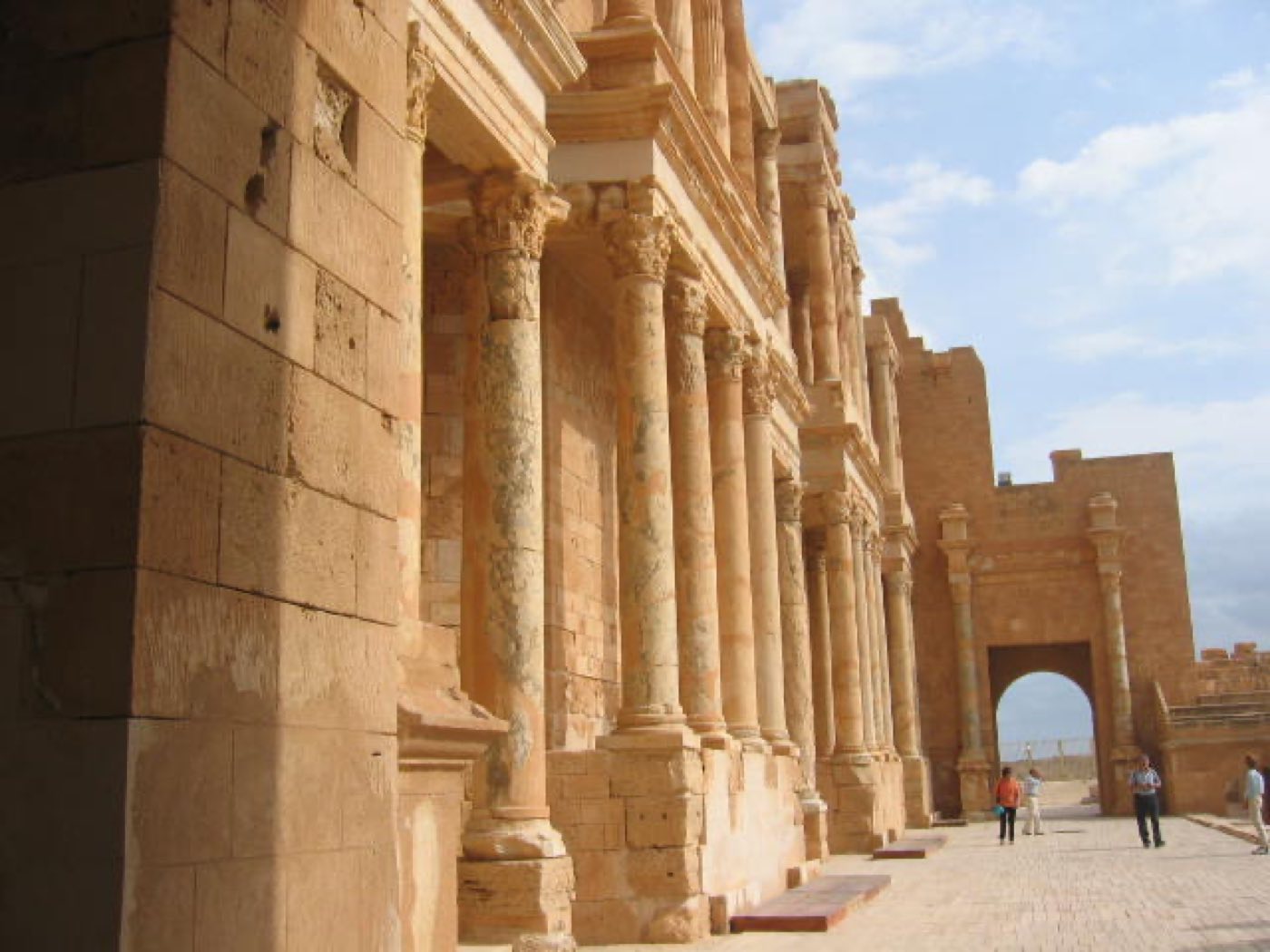
Sixty kilometers west of Tripoli, Sabratha's three-story theater facing the sea is one of the most photogenic Roman structures in the Mediterranean and the visual centerpiece of any western-Libya itinerary. The wider city includes Phoenician-era temples, a forum, and mosaics that rival anything in Pompeii. Proximity to the Tunisian border has made the area a sensitive security corridor, with militia checkpoints and occasional fighting in the surrounding region — specialist operators monitor the road conditions closely before committing to a visit.
Cyrene Greek ruins
In the Green Mountain region of eastern Libya near Shahhat, Cyrene was the greatest Greek city in North Africa, founded by settlers from Thera in 631 BC and later absorbed into the Roman Empire. The Temple of Zeus, the Sanctuary of Apollo, and the Greek agora extend across a hillside above the coastal plain, with March wildflowers making the season particularly striking. The site sits in Haftar-controlled eastern Libya and access requires permits from the eastern administration — a different process entirely from western sites.
Ghadames old town oasis UNESCO site
On the Saharan frontier where Libya meets Algeria and Tunisia, Ghadames is a walled oasis town of whitewashed earth houses, covered alleyways, and a date palm grove that has sheltered a small population for two millennia. The old city was largely emptied in the 1980s when residents moved to modern housing nearby, but the historic core remains and has UNESCO World Heritage status. Reaching it requires a long desert drive from Tripoli and heightened security along the southwestern border region.
Tripoli's Red Castle (Assaraya al-Hamra)
At the edge of Tripoli's medina, the Red Castle has been a fortress since Roman times and now houses the National Museum of Libya — or did, before the 2011 uprising put the building through a long period of uncertainty. Its vast collection of mosaics, Punic artifacts, and Roman sculpture is among the most significant in the Mediterranean. Reopening status shifts; specialist operators check current availability before including it on any itinerary and access depends on the security situation in the capital on the day.
Akakus Mountains rock art UNESCO site
In the deep southwest near the Algerian border, the Akakus massif holds thousands of rock paintings and engravings documenting 12,000 years of human habitation — from when the Sahara was green grassland through its gradual transformation into the world's largest desert. Giraffes, elephants, and cattle still appear on the rock faces in places where none have lived in five thousand years. Access is by specialist desert expedition from Ghat; current conditions have effectively put the region off-limits for most operators.
Ubari Sand Sea and desert lakes
The Ubari Sand Sea in southwestern Libya is a landscape of towering apricot-colored dunes punctuated by a scatter of palm-fringed saltwater lakes — Gabraoun, Mafo, and Um al-Maa — remnants of a prehistoric freshwater system. Tuareg guides from Ghat have historically run desert camping trips here, with campfire nights under some of the darkest skies on earth. Like the Akakus, the region is currently beyond the reach of nearly all operators because of insurgent activity and smuggling routes across the Niger and Chad borders.
When to Go
If circumstances ever allow, October through March is the sensible window for comfortable coastal and Saharan temperatures — Tripoli averages the low 20s Celsius in December, and the southern desert becomes actually tolerable rather than dangerous. March in Cyrene brings brief wildflower bloom across the Green Mountain. Summer along the coast pushes into the high 30s and the southern desert well above 45 degrees. Security conditions, however, tend to follow political cycles more than seasonal ones — flare-ups have happened in every month. The only honest answer to when to go is: when governments lift their travel warnings and the specialist operators restart their regular programs.
Getting Around
There is no normal way to get around Libya in 2026. The country's airspace functions intermittently, with scheduled flights from Istanbul and Tunis to Tripoli (Mitiga) in the west and to Benghazi and Labraq in the east; crossing between the two zones by land is difficult and often closed. Independent overland travel is not viable — roadblocks, militia checkpoints, and the absence of functioning police make unaccompanied movement a serious risk. Any visitor on a specialist tour will travel in a pre-arranged convoy with local drivers, armed security, and permits cleared in advance with whichever authority controls each region. Fuel is cheap when available but shortages are common. Internal flights and trains do not operate as they would in a stable country.
Cost & Currency
Libya uses the Libyan dinar (LYD), with an official rate and a parallel black market rate that have diverged sharply since 2014 — officially around 4.8 to the US dollar in early 2026, unofficially closer to 7. Specialist tours are expensive because of what they include: a ten-day cultural itinerary from a British or European operator typically runs US$5,000–8,000 per person, reflecting armed security, permits, fixers, domestic flights, and comprehensive insurance. Independent budget travel is not a realistic category here. Carry US dollars or euros in cash; international cards and ATMs do not function reliably, and sanctions compliance makes most Libyan banks unreachable from abroad. Tipping drivers, fixers, and site guards generously is standard and expected.
Frequently Asked Questions
- Can I actually travel to Libya in 2026?
- Only with a specialist operator and an escorted itinerary, and only if you accept the serious security risks. The US, UK, Canadian, and Australian governments advise against all travel to Libya because of the civil conflict, kidnapping threat, and terrorism risk. Independent travel is not possible and would be reckless. A handful of European and British tour operators run occasional escorted trips with armed security; these are the only practical way to visit.
- Is Libya safe for tourists?
- No, not in the ordinary sense. The country is split between rival governments in Tripoli and Benghazi, with ongoing militia conflict, unexploded ordnance in previously contested areas, and a documented kidnapping threat specifically targeting foreign nationals for ransom. Even on escorted tours with security, there is meaningful risk. Travel insurance that covers conflict zones is essential and costs accordingly, and most standard policies will not cover Libya at all.
- Do I need a visa to visit Libya?
- Yes, and it is not straightforward. Visas are issued through the embassy of whichever Libyan government controls the region you plan to visit, and the application typically requires sponsorship from a licensed Libyan tour operator and approval from the relevant ministry. Expect the process to take weeks or months. Your specialist tour operator will handle this, because it is essentially impossible to do alone.
- Can I visit both eastern and western Libya on one trip?
- Not easily, and often not at all. The two rival administrations control separate regions with separate permitting systems, and the land border crossing between them has been closed or restricted for much of the post-2014 period. Most specialist itineraries focus entirely on the west (Tripoli, Leptis Magna, Sabratha) or entirely on the east (Cyrene, Apollonia, Benghazi). Combining the two typically requires separate trips through different entry points.
- When will Libya be open to normal tourism again?
- There is no credible timeline. Political reconciliation between the rival governments has been the subject of UN-led negotiations for years without a durable settlement, and until there is a unified state with working police and border control, independent travel will not become viable. Watch for changes in your own country's travel advisories, which will shift before the industry does, and expect gradual rather than sudden reopening when it happens.
Plan a Trip to Libya
Have you been to Libya?
Track 195 countries, 50 states & 63 national parks on your map