Niger
- Capital
- Niamey
- Population
- 26.2M
- Currency
- XOF
- Languages
- French
Overview
One of the largest countries in Africa by area and one of the least visited, Niger is a Sahelian and Saharan nation where ancient caravan routes, Tuareg nomadic culture, the 15th-century mud-brick mosque of Agadez, and the austere dune seas of the Tenere desert survive. Travelers have historically come for the Cure Salee nomad festival outside Ingall, the Air Mountains with their prehistoric rock art, and the rare Kouri cattle and west African giraffes that still live in pockets near the Niger River. The country you can actually visit right now is a different country than the one described in older guidebooks. The July 2023 military coup installed a junta government that has reoriented Niger away from France and toward Russia, and most Western embassies drew down operations in the aftermath. Land borders with Nigeria, Benin, and Mali have opened and closed repeatedly, and the US, UK, France, and Canada all advise against all travel to most of the country as of 2026 due to the combined risks of terrorism from Islamic State Sahel and JNIM affiliates, kidnapping of foreign nationals across the north, and the breakdown of consular support. Niger rewards travelers only under specific conditions that are hard to meet at present. The Sahelian security situation is serious and not a matter of being overly cautious — multiple foreigners have been kidnapped or killed in recent years, the Air Mountains and Tenere are effectively off-limits, and even Niamey has seen sporadic unrest since the coup. Anyone considering a trip needs to be reading current government advisories, working through a specialist operator with serious local connections, carrying evacuation insurance, and accepting that plans can collapse inside a week. Most people reading this should consider Niger as a future destination rather than a current one.
Things to Do
Agadez Grand Mosque and Tuareg culture
The mud-brick minaret of the Agadez Grand Mosque, rebuilt in 1844 on a 16th-century base, rises 27 meters from the old town and is one of the most striking structures in the Sahel. Agadez is the traditional gateway to the Sahara and the historical capital of the Tuareg Sultanate — silver jewelry workshops, camel markets, and caravan logistics still operate in a version of a centuries-old trade. Security in and around Agadez has been uncertain for more than a decade and foreign travel into the region is restricted; any visit requires specialist operator support and current ground intelligence.
Air and Tenere Natural Reserves UNESCO site
The 7.7-million-hectare combined Air Mountains and Tenere desert reserve is on the UNESCO World Heritage List in Danger — a landscape of volcanic peaks, palm oases at Timia and Iferouane, prehistoric rock engravings of giraffes and cattle dating 6,000 years, and dune seas stretching toward the Djado Plateau. It is one of the great Saharan landscapes and has been effectively closed to visitors since the Tuareg rebellions of the 2000s and the subsequent rise of jihadist kidnapping in the region. Current access is essentially zero; the entry here is for context and in the hope of a future reopening.
Cure Salee nomad festival
Every September around Ingall, at the end of the short rainy season, Tuareg and Wodaabe herders converge for a week of camel racing, trading, salt licking for their cattle, and the famous Gerewol courtship dances in which young Wodaabe men paint their faces and perform for unmarried women who choose partners from the lineup. It is one of the great festivals in Africa and the only one of its kind left at scale. It has been severely disrupted since 2019 by security conditions; when it does run, access depends on specialist operators coordinating with the government and local Tuareg authorities.
W National Park
In the far southwest corner where Niger meets Burkina Faso and Benin, the trinational W National Park protects one of the last strongholds of the West African lion, elephant, and Northwest African cheetah. Entry from the Nigerien side at La Tapoa has effectively ceased since 2019 due to security concerns; visitors who have reached the park in recent years have done so via Benin or the closed Burkina Faso side, and that has largely also shut down. Again, this is a site on pause — record the interest and watch for conditions improving.
Niamey's Grand Marche and National Museum
The capital on the Niger River is the most accessible part of the country for visitors — a sprawling Sahelian city with wide sandy streets, the Grand Marche selling silverwork, leather, and fabric, and the National Museum housing the last 'living' Tree of Tenere (the original acacia that marked the sole landmark in the heart of the Tenere until 1973). The Niger River corniche at dusk, with boats working across to Kirkissoye on the opposite bank, gives you a sense of what the city used to be. Niamey remains the realistic limit of what most travelers can currently plan — day trips beyond the capital are heavily restricted.
Niger River giraffes near Koure
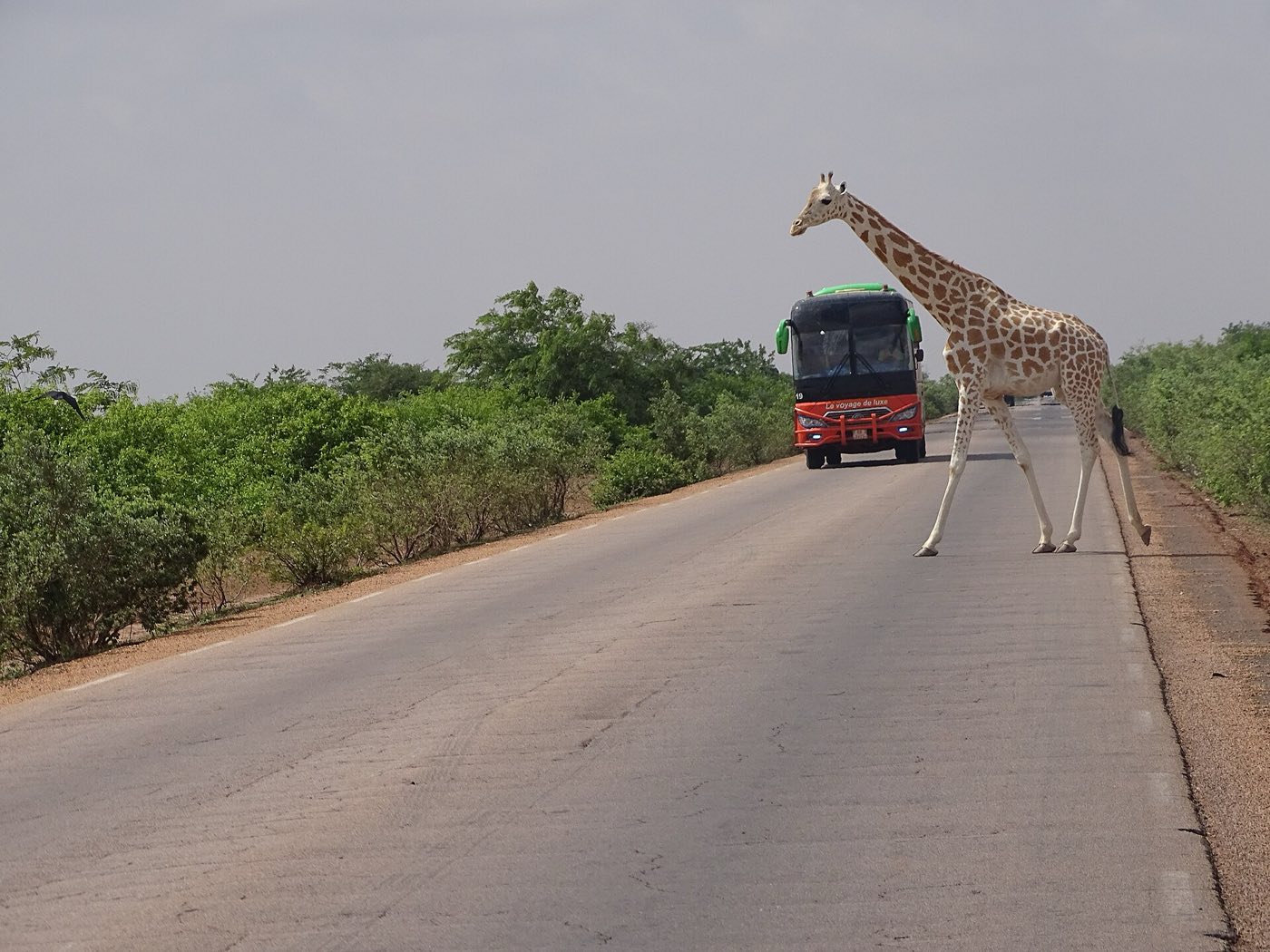
Sixty kilometers southeast of Niamey, the village of Koure is the last natural range in the world for the West African giraffe (Giraffa camelopardalis peralta), a subspecies that rebounded from fewer than 50 individuals in the 1990s to more than 600 today. Guided half-day visits through the local cooperative in Koure were a staple of Niamey-based travel and remain one of the easier day excursions when conditions allow. Current access depends on the same security picture as the rest of the country — check state of affairs through the tourism office or a reputable operator before committing a day.
When to Go
November through February is the cool dry season when daytime temperatures in Niamey run 25–32C (80–90F) and overnight lows drop pleasantly; this is the traditional travel window. The Harmattan wind from late December into February hazes the sky with Saharan dust. March through June is extreme heat — Niamey regularly exceeds 42C (108F) and the north hits 45–50C. The short rainy season from July through September briefly greens the Sahel and coincides with the Cure Salee festival around Ingall. Timing matters less than current security conditions, which shift month by month; any window needs confirming against current advisories close to travel.
Getting Around
Internal movement in Niger is almost entirely by road and almost entirely difficult under current conditions. The main paved routes — Niamey to Tillaberi, Niamey to Konni, the north-south Trans-Saharan axis to Agadez — pass through regions under military oversight and have variable checkpoint delays and restrictions on foreign travel. The overland border with Benin is one of the only land entries that has reopened since the coup; the borders with Mali, Burkina Faso, and Libya are effectively closed. Domestic flights to Agadez have been intermittent. Within Niamey, faba-faba shared taxis and ride-hailing through local apps work for basic movement. Any trip outside the capital requires a hired vehicle and, realistically, a government-approved guide.
Cost & Currency
Niger uses the West African CFA franc (XOF), pegged to the euro at 655.957 to 1. Day-to-day costs in Niamey are modest — a plat du jour lunch runs 2,000–4,000 CFA (US$3–7), a mid-range hotel room 30,000–70,000 CFA, faba-faba rides 200–500 CFA. The real expense in any current Niger trip is the security overlay: a specialist operator with an armored vehicle, a licensed guide, satellite communications, and evacuation insurance can push a week-long itinerary well above US$5,000 per person before any extras. Cards work at international hotels in Niamey but essentially nowhere else; change euros or dollars at banks in the capital and carry CFA in small denominations for fuel stops, markets, and tips.
Frequently Asked Questions
- Is it safe to travel to Niger in 2026?
- No, under any meaningful interpretation. Since the July 2023 military coup the security situation has deteriorated, with active jihadist groups in the tri-border region with Mali and Burkina Faso, kidnapping risk across the north, and most Western governments advising against all travel outside Niamey. The US, UK, France, and Canada have drawn down embassy staff and consular assistance is extremely limited. Travel only if you have specific professional need and a serious operator supporting you.
- Do I need a visa to enter Niger?
- Yes, almost all travelers need a visa in advance. Visas are issued by Nigerien embassies or honorary consulates — processing has been slow and inconsistent since the coup and several European countries no longer accept Nigerien visa applications through their closed embassies. An e-visa system is available but has been unreliable. Plan for six to eight weeks minimum and have a confirmed hotel reservation and invitation letter ready.
- Can I visit Agadez and the Air Mountains?
- In practice, no. The Sahelian insecurity that closed the region in the late 2000s has deepened, and foreign travel to Agadez, the Air Mountains, and the Tenere is not permitted by any Western government advisory and is actively discouraged by the Nigerien authorities themselves. The mosque, the camel markets, and the Cure Salee festival are on hold for foreign visitors indefinitely. Treat this as a place to watch rather than to book.
- What vaccinations and health precautions do I need?
- A yellow fever vaccination certificate is legally required and checked on arrival. Malaria prophylaxis is essential — Niger is high-transmission and chloroquine-resistant. Routine boosters plus typhoid, hepatitis A and B, meningococcal (the country lies across the African meningitis belt), and rabies are recommended. Health infrastructure is limited outside Niamey; carry a stocked travel medical kit, comprehensive insurance including medical evacuation, and satellite communications for anything beyond the capital.
- What language do I need?
- French is the official language and essentially required — English is rare even in Niamey and almost nonexistent outside the capital. Hausa is the most widely spoken local language, Djerma-Songhai the second, and Tamasheq the Tuareg language of the north. A working French vocabulary plus a few phrases of Hausa will carry you through most interactions. Translators and fixers are part of any serious itinerary outside the capital and should be arranged through a reputable operator.
Plan a Trip to Niger
Have you been to Niger?
Track 195 countries, 50 states & 63 national parks on your map