Iran
- Capital
- Tehran
- Population
- 87.6M
- Currency
- IRR
- Languages
- Persian
Overview
A civilization of seven thousand years with a traveler's reputation that has almost nothing to do with the news, Iran holds some of the finest Islamic architecture on earth and a depth of poetic and culinary culture that goes back to the Achaemenids. Visitors come for the turquoise domes of Isfahan, the columned ruins of Persepolis, the pink-tiled Nasir-ol-Molk Mosque in Shiraz, and the mud-brick old town of Yazd. What almost every traveler notices first is the hospitality. You will be invited to tea by people who have nothing to gain from it, photographed with smiling strangers in a public square, and fed by someone who insists on paying the bill despite having met you an hour earlier. The gap between Iran in the headlines and Iran as you actually experience it on the ground is larger than anywhere else most people travel, and it is a disorienting, reorienting experience to cross that gap. This is not free-and-easy travel. US, UK, and Canadian nationals are required to travel with a licensed Iranian guide the entire time on a pre-approved itinerary — this is not optional and it is enforced at the border. Sanctions mean foreign credit and debit cards do not work anywhere in the country, so you bring all of your money in cash (euros or US dollars) and change it for rials as you go. Women, including foreign visitors, must wear a headscarf and loose clothing in public. Plan accordingly and Iran becomes one of the great trips still available to travelers willing to do the preparation.
Things to Do
Isfahan's Imam Square and Sheikh Lotfollah Mosque
Naqsh-e Jahan Square is the second-largest public square in the world and the centerpiece of Safavid Isfahan, with four monumental buildings on its four sides. The Sheikh Lotfollah Mosque on the eastern side is the masterpiece — a small domed prayer hall for the royal women, with no minarets and a tile-work peacock in the dome that only appears at certain angles. Cross the square for the Shah Mosque, then walk the bazaar arcades under the southern portico until dusk when the whole square lights up.
Persepolis ancient ruins
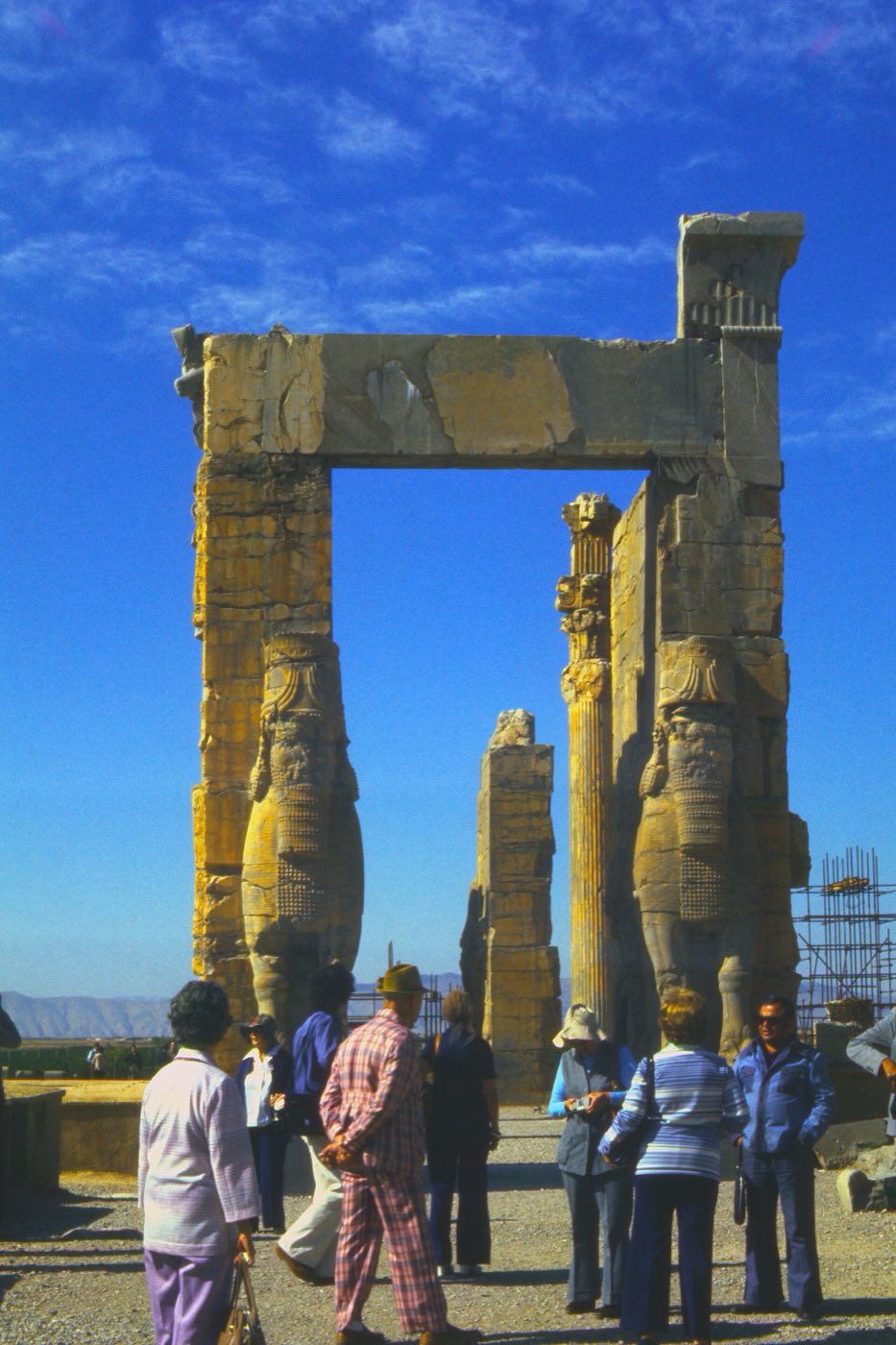
The ceremonial capital of the Achaemenid Empire, built by Darius I starting in 518 BC and burned by Alexander the Great two centuries later, stretches across a terraced stone platform an hour north of Shiraz. The surviving relief carvings of the Apadana stairs — delegations from twenty-three tribute nations climbing up to meet the king — are the reason to come, along with the monumental gate of All Nations and the royal tombs cut into the cliffs at nearby Naqsh-e Rostam. Arrive at opening or late afternoon to avoid midday heat.
Shiraz's Nasir-ol-Molk Pink Mosque and Hafez tomb
The Nasir-ol-Molk mosque is a 19th-century prayer hall famous for the morning light — roughly 7 to 9 a.m. — when the sun pours through stained-glass windows across the Persian carpets and fills the room with pools of colored light. It is crowded and photogenic and genuinely extraordinary in person. In the afternoon, visit the garden tomb of Hafez, where Iranians come to read his poetry aloud at his grave and pay their respects to the country's most-loved poet.
Yazd's desert old town and wind towers
The mud-brick old town of Yazd is a UNESCO-listed maze of shaded lanes, courtyard houses, and windcatchers (badgirs) that still cool interiors through passive ventilation. Climb to a rooftop at sunset — most guesthouses offer terrace access — for the honey-colored skyline at dusk, visit the Jameh Mosque with its tall twin minarets, and take an afternoon to see the Zoroastrian fire temple and the Towers of Silence on the outskirts. Yazd is also the traditional base for short desert trips into the Kalut badlands.
Tehran's Grand Bazaar and Golestan Palace
Tehran is not beautiful in the way Isfahan is, but its scale and energy make it essential for understanding modern Iran. The Grand Bazaar is a covered labyrinth where carpet dealers, spice sellers, and goldsmiths have worked for centuries, and a guided half-day is the best way to make sense of it. Pair it with Golestan Palace — the Qajar royal complex with its mirrored halls — and the extraordinary National Museum's twin galleries of pre-Islamic and Islamic Iran.
Tabriz Historic Bazaar UNESCO site
The bazaar of Tabriz in the country's Azeri-speaking northwest is the largest covered market in the world and has been continuously operating for at least a millennium. Its interconnected caravanserais, mosques, and domed halls were a major stop on the Silk Road, and the carpet trade here remains serious business. Plan a full day with a local guide who can lead you through the specialty sections — rugs, copper, jewelry, spices — and finish with abgoosht stew at a traditional eatery tucked off one of the galleries.
Dasht-e Lut desert and kaluts formations
The hottest ground temperature ever recorded on earth — 70.7°C — was measured in the Dasht-e Lut, a UNESCO-listed desert in southeastern Iran. Its signature landscape is the kaluts, wind-sculpted ridges of yellow sandstone that stretch for miles in parallel rows. Base out of Kerman or Shahdad and go on an overnight desert trip in October or March — not in summer, when the heat is genuinely dangerous — to see sunrise and sunset from the kalut ridges. A 4x4 with a driver who knows the terrain is essential.
When to Go
Spring, from mid-March to late May, is the best all-round window — warm days, cool evenings, desert wildflowers, and the Nowruz Persian New Year on March 21 bringing families into public gardens. Autumn (September to November) runs it a close second with golden light on tilework and comfortable temperatures. Summer is brutal: Isfahan and Yazd hit the mid-40s°C, and the Persian Gulf coast becomes essentially unusable. Winter is cold in Tehran and the north, and snow closes some of the mountain passes; the south and Persepolis stay mild, so a winter trip focused on the south can work well. Iranian weekends run Thursday–Friday.
Getting Around
Domestic flights on Iran Air, Mahan, and Aseman connect all the major cities cheaply — Tehran to Shiraz, Isfahan, Tabriz, and Yazd each take about an hour and cost $30–$60. Buses are the standard overnight option and VIP services between cities are clean and comfortable. Trains are slower but scenic, particularly the overnight Tehran–Yazd and the day route through the Alborz to the Caspian. Within cities, Snapp — Iran's ride-hailing app, though it does not accept foreign cards and has to be used through your guide or hotel — is the easiest way to get around. Licensed guided groups typically travel by a private van with a driver, which is the simplest solution for US, UK, and Canadian passport-holders.
Cost & Currency
Iran uses the rial (IRR), but prices are almost always quoted in toman, which is one rial divided by ten — this is confusing for the entire first week and then you get used to it. Because of international sanctions, no foreign card works anywhere in the country: you bring all of your trip budget in cash (US dollars or euros in clean, unmarked notes) and change small amounts at exchange houses as you go. The rial has devalued heavily, so local prices are extraordinarily low for visitors — a boutique traditional-house hotel in Isfahan runs $35–$70, a full meal at a good local restaurant is $4–$8, and a one-hour domestic flight is $30–$50. Licensed guided tours for US/UK/Canadian travelers typically run $100–$180 per person per day all-in. Tipping is modest: 10% at nicer restaurants, a few dollars to drivers, and a tip at the end of the tour for your guide if the service warranted it.
Frequently Asked Questions
- Can Americans, British, and Canadian citizens visit Iran?
- Yes, but with real constraints. Nationals of the US, UK, and Canada must travel on a pre-approved itinerary with a licensed Iranian tour operator and be accompanied by an Iranian guide for the entire trip — independent travel is not permitted for these passport holders. Your tour operator handles the visa authorization number, which you use to collect the visa on arrival at Imam Khomeini International Airport or at an Iranian consulate abroad. Build in six to eight weeks for the process.
- Do women have to wear a headscarf in Iran?
- Yes — the hijab is a legal requirement for all women in public, including foreign visitors, from the moment the plane lands until the moment you leave. Scarves can be worn loosely over a loose knot of hair rather than tightly wrapped, and standards have relaxed in cities since 2022, but the legal requirement remains. Pack a lightweight scarf for the plane, long-sleeved tunics that cover to mid-thigh, and loose trousers. Manteau-style coats are the standard local layer.
- Can I use my credit card or withdraw cash from an ATM in Iran?
- No — because of international sanctions, no Visa, Mastercard, or Amex cards work anywhere in Iran, and no ATM will dispense cash against a foreign card. You must bring every dollar of your trip budget in cash (US dollars or euros in clean, unmarked, recent notes), which you change into rials at exchange houses as you go. Many tour operators now also offer a preloaded local Mah Card for foreigners, which is worth asking about.
- Is Iran safe for tourists?
- Iran has a consistently low rate of crime against travelers, and most visitors describe feeling notably safer on city streets than in many European capitals. The real risks are political rather than criminal — avoid protests, do not photograph government or military buildings, do not discuss politics in public with locals you have just met, and follow your guide's advice on no-go areas near borders with Afghanistan, Pakistan, and Iraq. Dual nationals have occasionally been detained, so check your embassy guidance if you hold an Iranian passport alongside a Western one.
- How many days do I need to see Iran?
- Two weeks is the classic minimum for a first trip on the cultural circuit — Tehran, Kashan, Isfahan, Yazd, Shiraz (with Persepolis), and back. Add a few days for Tabriz and the northwest, or Kerman and the Lut desert, if you have three weeks. Shorter than ten days and you are skimming the surface of cities that reward slow afternoons of tea and wandering through the bazaars.
Plan a Trip to Iran
Have you been to Iran?
Track 195 countries, 50 states & 63 national parks on your map