Vietnam
- Capital
- Hanoi
- Population
- 99.5M
- Currency
- VND
- Languages
- Vietnamese
Overview
A long, thin country that follows 3,200 kilometers of South China Sea coastline, Vietnam bundles more landscape, food, and history per kilometer than almost anywhere in Southeast Asia. Visitors come for Ha Long Bay's limestone karsts, the UNESCO old town of Hội An, Hanoi's street pho, and the green terraces above Sapa. You feel the country's shape in how you travel. The north is mountains and cool air — Hanoi's old quarter with its narrow brick tube-houses and motorbike swarms, tea hills climbing into Yunnan, the karst towers of Ninh Binh rising straight out of rice paddies. The center is imperial tombs and beach — Huế on the Perfume River, Đà Nẵng's arc of new towers, Hội An's lantern-lit lanes. The south is delta — wide flat rivers, floating markets near Can Tho, and Saigon moving at a speed of its own. What keeps travelers here is the food, and how available it is to anyone who sits down. Pho simmered since before dawn on a Hanoi sidewalk, bún chả grilled over charcoal in a back alley, cà phê sữa đá thick enough to stand a spoon in, bánh mì with pâté and pickled daikon on a baguette that is quietly one of the best things to come out of French colonization. Ten days is not enough for Vietnam and most travelers leave knowing they'll come back.
Things to Do
Ha Long Bay cruise among limestone karsts
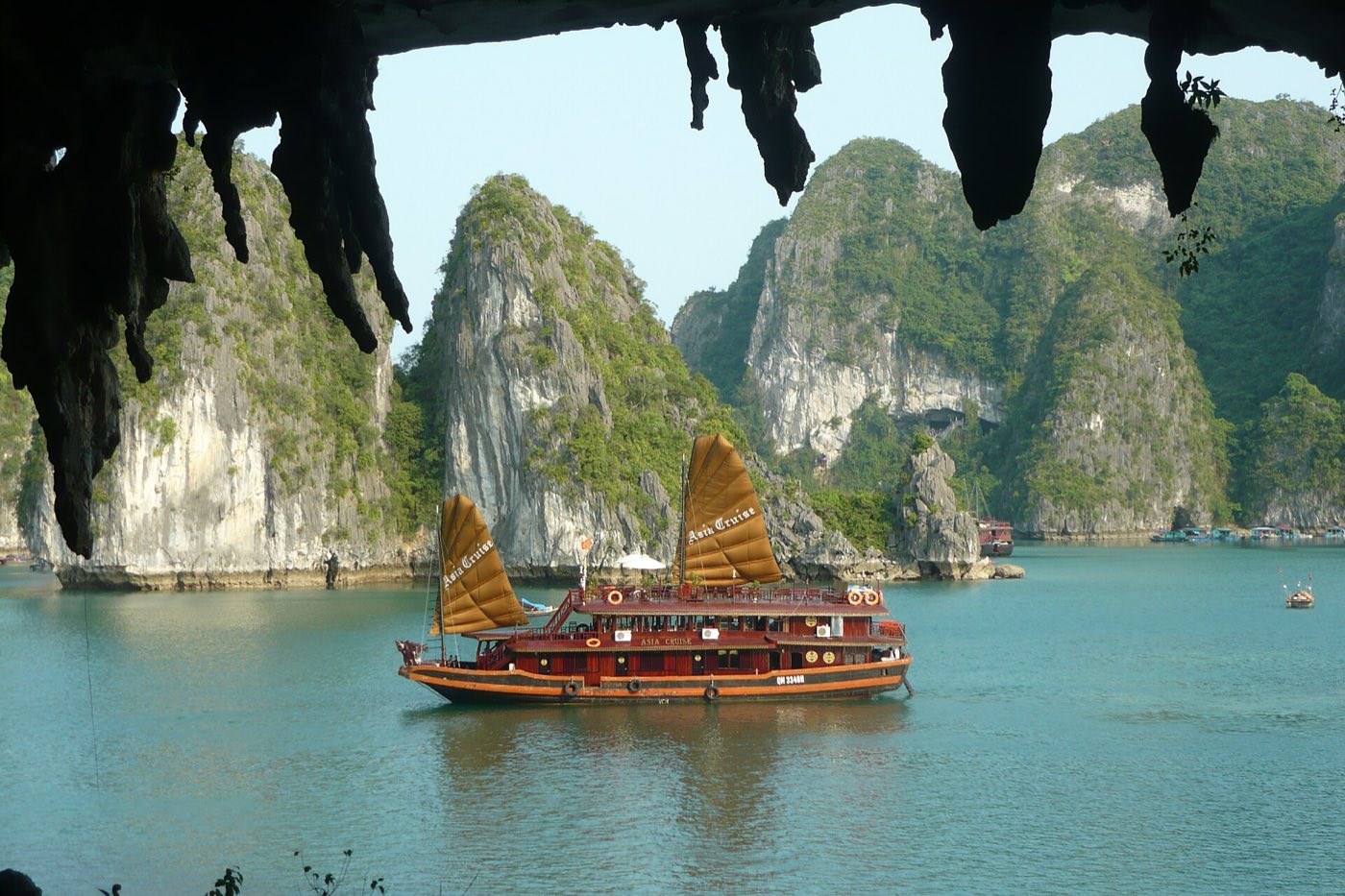
Some 1,600 limestone islands rise out of the Gulf of Tonkin in green-capped towers, a UNESCO-listed seascape a few hours east of Hanoi. Overnight cruises on traditional junks and newer sleeper boats weave through the archipelago with stops for kayaking into hidden lagoons, swimming off the deck, and a night anchored among the towers under a sky full of stars. Pick Lan Ha or Bai Tu Long for quieter water than the main Ha Long route.
Hội An ancient town lantern-lit streets
A 15th-century trading port on the central coast whose wooden shophouses, Japanese covered bridge, and Chinese assembly halls survived the war largely intact, Hội An at dusk becomes a grid of lanterns reflected in the Thu Bồn River. Tailors will turn around a suit or a dress in 24 hours; the town's cao lầu noodles and white rose dumplings are worth a dedicated lunch. Rent a bicycle and ride ten minutes to An Bang beach for the quieter half of the day.
Hanoi's Old Quarter and street food
Thirty-six original guild streets named for what they once sold — silk, silver, tin, paper — still wind between tube houses and lake-edged temples in the heart of the capital. Eat your way through it: pho bo on Hàng Trống, bún chả near Hoàn Kiếm Lake (the Obama-Bourdain place is one of many good ones), egg coffee upstairs at Café Giảng, bia hơi on Ta Hien corner with plastic stools and cold fresh beer pulled that morning.
Phong Nha-Ke Bang caves
The central Annamite range holds some of the world's largest caves, including Son Doong — big enough to contain its own jungle and cloud system, only accessible via a small-group multi-day expedition with Oxalis. Paradise Cave and Phong Nha Cave are day-trip accessible from Phong Nha town and still extraordinary on their own; Hang En offers an overnight camp on a river beach inside a cave the size of several football fields.
Sapa rice terraces and minority villages
The far northwest mountains above the Vietnam-China border rise in green staircases carved over centuries by the Hmong, Dao, and Giáy people. Trek out of Sapa town for one or two days between villages, sleeping in family homestays with rice wine and mountain views. The best terraces are at full water in May and golden in September just before harvest. Avoid July and August heat; pack layers for the cool nights even in summer.
Ho Chi Minh City's War Remnants Museum and Ben Thanh Market
The War Remnants Museum is unvarnished about the American War — tanks and helicopters in the courtyard, photographs and Agent Orange exhibits inside — and is the single most useful half-day for context on modern Vietnam. Finish with the food stalls inside Ben Thanh Market or at an open-air quán on a side street nearby; Saigon's late afternoon is the best time to ride pillion on a motorbike food tour through District 1 and the old Cho Lon quarter.
Ninh Binh's Tam Coc "inland Ha Long Bay"
Two hours south of Hanoi by car or train, the karst towers of Ha Long Bay repeat themselves across flooded rice paddies in landlocked Ninh Binh. A hand-rowed sampan takes you through three low river caves at Tam Coc (the oarswomen row with their feet — worth seeing) or along the longer, quieter route at Tràng An. Climb the Mua Cave steps to the dragon at the top for the view everyone photographs.
Mekong Delta floating markets
The Mekong breaks into nine mouths as it meets the South China Sea, feeding a delta of rice fields, orchards, and villages built half on stilts. Can Tho is the base for early-morning visits to Cai Rang floating market, where wholesalers sell pineapples, watermelons, and pomelos boat-to-boat. Stay overnight to catch the market properly at sunrise, add a bike ride through the back lanes, and try hủ tiếu noodles cooked on a floating kitchen.
When to Go
The country is long enough that the best window depends on where you're going. The north — Hanoi, Ha Long, Sapa — is best from October through April for cool, dry weather, though January and February can be grey and cold. Central Vietnam around Huế, Hội An, and Đà Nẵng is driest from February through August, with the wettest months October through November. The south — Saigon, the Mekong — runs on a simpler dry-wet split: December through April is dry and March is the hot peak. Overall, March through May is the most consistent window for a full-country trip.
Getting Around
The Reunification Express railway runs the spine of the country from Hanoi to Ho Chi Minh City in about 35 hours on soft-sleeper berths, and shorter legs (Hanoi to Ninh Binh, Huế to Đà Nẵng) are some of the most scenic rail rides in Southeast Asia. Domestic flights on VietJet, Bamboo, and Vietnam Airlines keep the main cities an hour or so apart and are often cheaper than you'd expect. Within cities, Grab (ride-hailing) is the standard for cars and motorbike taxis; trains and sleeper buses handle the backbone between stops. Rent a motorbike only if you are confident — traffic is dense and rules are more suggestion than law.
Cost & Currency
Vietnam uses the dong (VND) and remains one of Asia's better values. A bowl of pho on a Hanoi sidewalk runs 40,000–70,000 VND (about $1.50–$3), a bánh mì is 20,000–40,000 VND, and a mid-range hotel room in a tourist city lands at 800,000–1,800,000 VND (around $30–$70). Cards are accepted at larger hotels, airlines, and restaurants in cities; keep cash for street food, markets, and smaller towns, and withdraw from ATMs in chunks to minimize fees. Tipping is not expected at casual places, but round up at restaurants and give 50,000–100,000 VND to drivers or guides on longer services.
Frequently Asked Questions
- Do I need a visa to visit Vietnam?
- Most visitors need an e-visa, which can be applied for online through the official government portal and is usually granted within three business days for up to 90 days. A number of nationalities (UK, France, Germany, Japan, South Korea, and several others) are eligible for visa-free stays of up to 45 days. Requirements do shift, so check the official immigration site close to your trip.
- Is Vietnam safe for travelers?
- Yes — Vietnam is considered one of the safer countries in Southeast Asia with low violent crime and a well-developed tourist infrastructure. The main risks are traffic (cross the road steadily and predictably), petty theft in crowded areas and on overnight buses, and occasional food-hygiene upset. Motorbike accidents are the most common serious incident for visitors.
- How long should I plan for a first trip?
- Two weeks is the comfortable minimum for a north-south run — three nights in Hanoi with a Ha Long cruise, a few days in Hội An and Huế, and three to four nights in Ho Chi Minh City with a Mekong overnight. Three weeks lets you add Sapa, Phong Nha caves, or a Con Dao beach stretch; under ten days you're better picking one region.
- What should I eat?
- The food is the point of the country. Pho bo for breakfast, bún chả for lunch, bánh mì between meals, cao lầu in Hội An, bún bò Huế in Huế, and cà phê sữa đá at every stop in between. Vietnamese food is generally safe to eat at busy street stalls with high turnover — crowded is good, empty is not. Vegetarians should learn the phrase 'an chay' (vegetarian).
- What's the best way to travel between cities?
- For long distances, cheap internal flights on VietJet and Vietnam Airlines are usually fastest — Hanoi to Ho Chi Minh City is about two hours in the air versus 35 on the train. The overnight Reunification Express train in a four-berth soft sleeper is a more atmospheric option and great for shorter legs like Huế to Đà Nẵng. Sleeper buses fill the rest of the gaps, though trains are more comfortable.
Plan a Trip to Vietnam
Have you been to Vietnam?
Track 195 countries, 50 states & 63 national parks on your map