Cambodia
- Capital
- Phnom Penh
- Population
- 17M
- Currency
- KHR
- Languages
- Khmer
Overview
Home to Angkor Wat, the largest religious monument on Earth, Cambodia is a Southeast Asian nation of extraordinary archaeological wealth and a resilience that quietly shapes daily life. Travelers come for the sandstone spires of Angkor at sunrise, the lake-bound floating villages of the Tonlé Sap, the soft island beaches of Koh Rong, and a capital city whose recent history is impossible to walk past. You arrive in Siem Reap and you are almost immediately inside the Angkor park, which is not one temple but dozens spread across a hundred and fifty square miles of jungle and paddy — the great one at sunrise, the smiling Bayon faces of Angkor Thom in late morning, the strangler figs of Ta Prohm in filtered afternoon light. Three days cover the classic circuit; five or more draw you out to the remote and beautiful sites at Banteay Srei, Beng Mealea, and Koh Ker. Then there is the other Cambodia — the one that matters just as much. Phnom Penh is not Angkor and is not trying to be; it is a riverfront capital of French-colonial boulevards, motorbike traffic that finds its own shape, and the weight of the Khmer Rouge memorials at Tuol Sleng and Choeung Ek. The country's warmth sits on top of a 1975–1979 genocide that killed around a quarter of the population, and you will feel both. Go slowly. Eat the fish amok. Take the night bus to the coast. Let the country work on you for longer than three days.
Things to Do
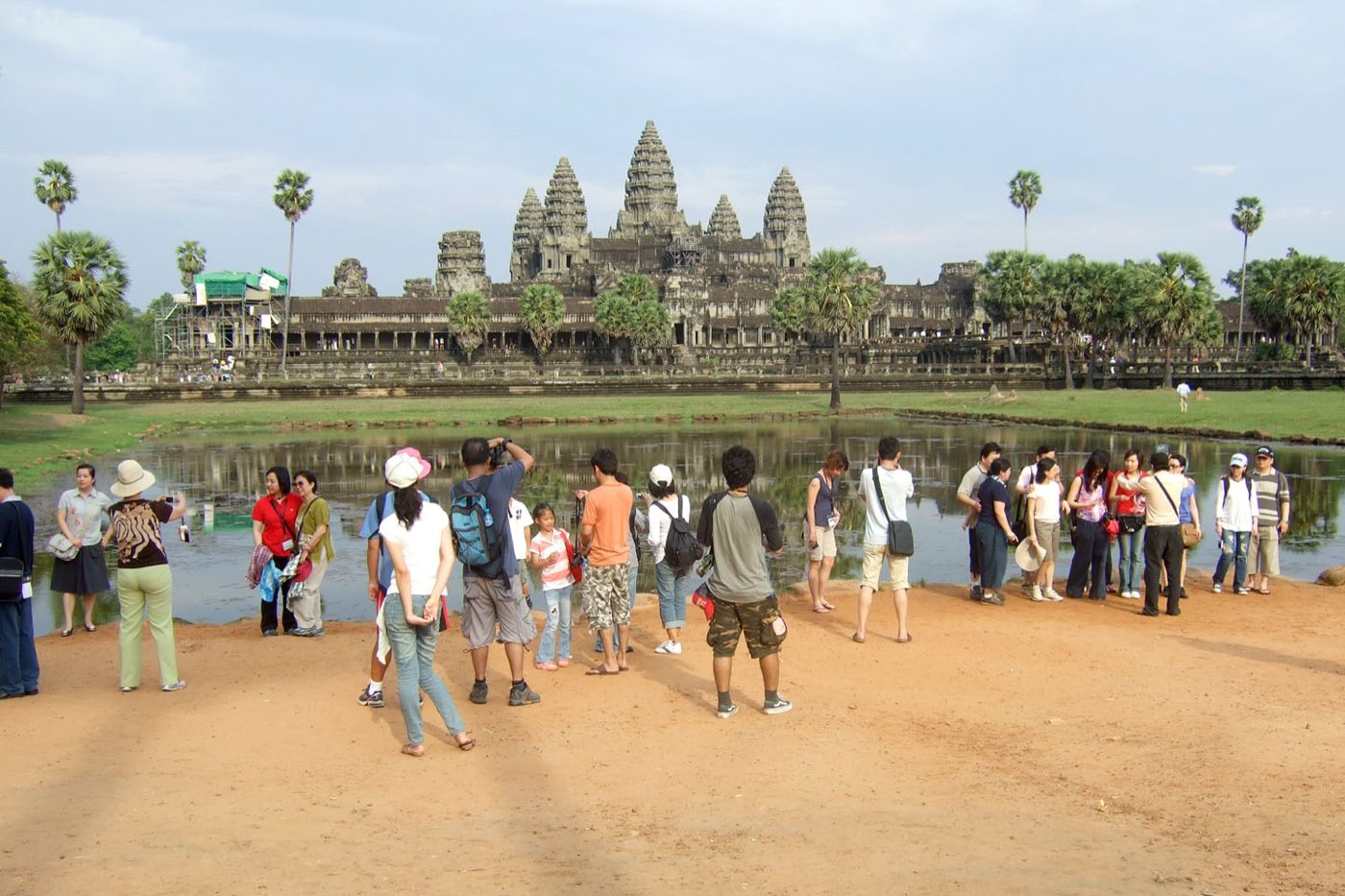
Angkor Wat sunrise
Built by Suryavarman II in the first half of the 12th century and still the largest religious monument on earth, Angkor Wat is worth every superlative. Get there at 5 am with the crowds for the silhouette of the five towers reflected in the north reflecting pool — tea stalls behind you, monks filing in at dawn — then linger until 7:30 when most of the tour groups leave and you have the galleries of bas-reliefs to yourself. The Churning of the Sea of Milk along the east gallery is worth an unhurried half-hour with a guide who can read the figures.
Bayon Temple's stone faces at Angkor Thom
At the center of the walled royal city of Angkor Thom, the Bayon rises as 54 towers carved with the enigmatic serene-smiling faces of Avalokiteshvara — or Jayavarman VII himself, depending on which scholar you ask. Over 200 faces look at you from every angle as you climb through the temple's three tiers. Come in late morning when the sun is high enough to illuminate the upper faces, and circle the outer galleries slowly to take in the extraordinary bas-reliefs of Khmer daily life — markets, childbirth, cockfights, war.
Ta Prohm temple with tree roots
The one they left for the jungle. Ta Prohm has been partially consolidated by archaeologists but the deliberate decision was made to leave the great silk-cotton and strangler-fig roots still pouring over the temple's courtyards and galleries — the effect is of a building being slowly digested by the forest. It is the temple Lara Croft made famous and the one that most powerfully suggests what the rediscovery of Angkor must have felt like in the 19th century. Go at opening or last light to dodge the crowds.
Phnom Penh's Royal Palace and Silver Pagoda
The pale yellow walls and gilded finials of the Royal Palace complex sit along the Phnom Penh riverfront and remain the residence of the king of Cambodia. The Throne Hall and adjacent Silver Pagoda — named for 5,000 silver floor tiles, now mostly carpeted over for protection — house the royal emerald Buddha, a 90-kilogram solid gold Buddha studded with diamonds, and a small but moving collection of royal regalia. Dress modestly (covered shoulders and knees) or you will be turned away at the gate.
Tuol Sleng Genocide Museum and Killing Fields
A former high school that the Khmer Rouge converted into Security Prison 21, where at least 14,000 people were tortured and sent to their deaths between 1975 and 1979. Tuol Sleng is now a museum and a memorial, and it is harrowing — walk it with the audio guide, which lets the voices of survivors and staff carry you through. The mass graves at Choeung Ek — the Killing Fields — lie 17 km south of the city and pair with Tuol Sleng as a single, necessary half-day. This is not sightseeing; come prepared.
Tonlé Sap floating villages
Southeast Asia's largest lake rises and falls by a factor of four between dry and wet seasons, and the villages around it either float on barrels (Kampong Phluk, Mechrey) or stand on 10-meter stilts that look absurd when the water is down. Go by longtail boat from Siem Reap in the early morning — Kampong Phluk is the most atmospheric and the least staged of the accessible villages — and bring binoculars for the waterbird colonies at Prek Toal, a Ramsar wetland reserve reached on a longer day trip.
Sihanoukville and Koh Rong island beaches
Sihanoukville itself has been reshaped by a decade of Chinese-driven casino construction and is a complicated place to stay, but it remains the jumping-off point for Koh Rong and its quieter sister Koh Rong Samloem — pale sand, clear warm water, and a handful of beach bungalows you can reach by a 45-minute fast ferry. Head straight through Sihanoukville to the pier and go. The beaches at Saracen Bay on Koh Rong Samloem and Long Set Beach on Koh Rong deliver the Thai-island quality you came for, with a fraction of the infrastructure.
When to Go
November through February is the cool, dry stretch and the time most visitors aim for — temple exploring at Angkor is manageable with pleasant temperatures, humidity drops, and the Tonlé Sap is still high enough for boat access. March and April are fine but extremely hot, with temperatures regularly pushing 38°C; pack accordingly and start temple days at dawn. The southwest monsoon from June through October brings afternoon downpours that cool the country, green the paddy fields, and thin the crowds — September and October are genuinely lovely if you don't mind getting wet, and the moats at Angkor Wat are at their fullest for reflections.
Getting Around
Distances are short and flat but roads are mixed. Cheap, frequent buses and more comfortable Giant Ibis and Mekong Express coaches connect Phnom Penh, Siem Reap, Battambang, and Sihanoukville on paved highways; the Siem Reap–Phnom Penh route takes around 6 hours. Trains are slow but newly revived — the line to Sihanoukville runs as a weekend scenic option. Within Siem Reap and Phnom Penh, tuk-tuks via the PassApp or Grab app are reliably cheap. For Angkor, hire a tuk-tuk driver for US$20–30 a day who knows the circuit order; for rural temple runs like Beng Mealea and Koh Ker, a car with driver is the sensible move. Domestic flights link Phnom Penh to Siem Reap quickly if you are short on time.
Cost & Currency
Cambodia uses the Cambodian riel (KHR) but the US dollar circulates freely and is accepted everywhere — ATMs dispense dollars, menus are priced in dollars, and change under a dollar comes back in riel at roughly 4,000 to 1. Daily costs are low: street food like fish amok or bai sach chrouk runs $2–4, a sit-down meal in a tourist restaurant $8–15, a comfortable mid-range hotel room in Siem Reap or Phnom Penh $35–70, and the Angkor three-day temple pass is $62. Cards are accepted at mid-range hotels and restaurants in the main tourist cities, less reliably elsewhere; keep small dollar bills for tuk-tuks and markets. Tipping is not traditional but increasingly appreciated — round up taxis and leave 10% at sit-down meals.
Frequently Asked Questions
- How long should I plan for a first trip to Cambodia?
- Seven to ten days is a comfortable first visit — three nights in Siem Reap for Angkor (three full temple days with breaks), two nights in Phnom Penh, and two or three on Koh Rong or Koh Rong Samloem. Two weeks lets you add Battambang, Kampot, and the remoter temples at Koh Ker and Preah Vihear. Under five days, focus on Siem Reap and Angkor alone.
- Do I need a visa for Cambodia?
- Most travelers need a visa, and the simplest option is the e-visa (evisa.gov.kh) which processes in about 3 business days for around $36 and is valid for 30 days. Visa on arrival is also available at the airports and most land borders for the same fee, though queues can be long. Bring a passport photo and a printout of any e-visa approval.
- Is Cambodia safe for travelers?
- Yes, generally — violent crime against tourists is rare and Siem Reap, Phnom Penh, and the coast are well-traveled and welcoming. The main risks are petty theft on tuk-tuks and motorbike bag-snatching in Phnom Penh (keep your bag on the inside of the tuk-tuk, not the outside), scams at border crossings, and unexploded ordnance in remote rural areas near the Thai and Laotian borders — stick to marked trails and paths.
- Do I need vaccinations and malaria pills?
- Routine boosters plus hepatitis A, typhoid, and Japanese encephalitis are recommended for most travelers; check with a travel clinic 6 weeks before you fly. Malaria is present in rural forested areas like Koh Ker and the Cardamom Mountains but is absent from Siem Reap, Phnom Penh, and Angkor — prophylaxis is generally only recommended if you are heading into deep rural zones. Dengue is a year-round risk; use repellent.
- Is the tap water safe to drink?
- No — tap water is not safe to drink in Cambodia. Stick to bottled or filtered water, which is inexpensive and available everywhere, and use bottled water even for brushing your teeth in budget accommodation. Ice in reputable restaurants and cafes is generally fine as it is made from filtered water, but avoid it from street carts. Most mid-range hotels provide free bottled water daily.
Plan a Trip to Cambodia
Have you been to Cambodia?
Track 195 countries, 50 states & 63 national parks on your map