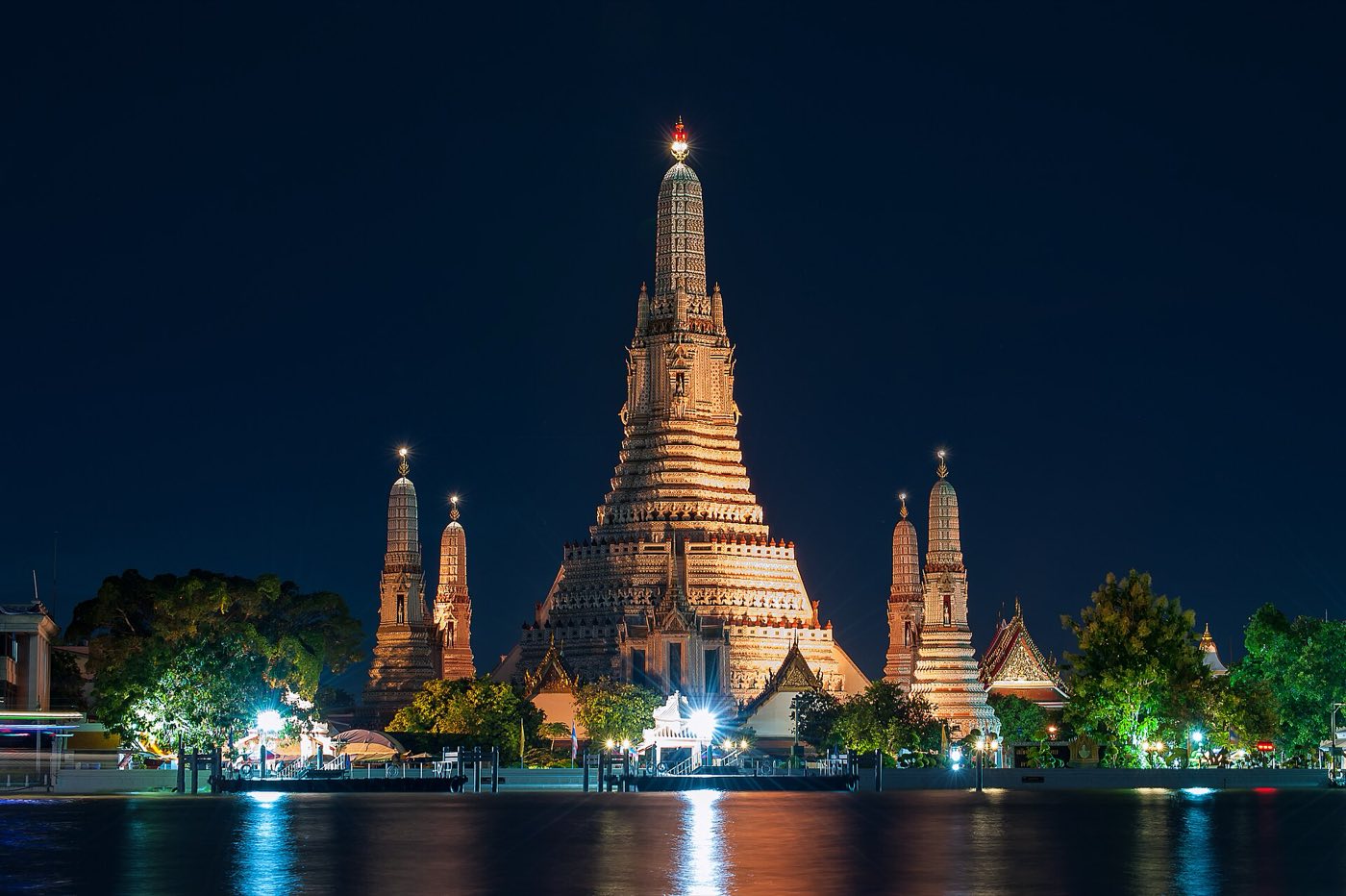
Thailand
- Capital
- Bangkok
- Population
- 71.8M
- Currency
- THB
- Languages
- Thai
Overview
Southeast Asia's most visited country, and for good reason — Thailand has the template elements of a Southeast Asian trip in a single place: gilded Buddhist temples, white-sand islands, food so consistently excellent that you can eat brilliantly for two dollars a plate, and a tourism infrastructure that works. Travelers come for Bangkok's Grand Palace and Wat Pho, for Chiang Mai's walled old city and night bazaar, for the limestone karsts of Krabi and Phang Nga Bay, and for the island chains on both sides of the peninsula. The country is bigger and more varied than first-timers expect. Bangkok alone deserves four or five days to walk properly — you want the river ferries, the flower market at Pak Khlong Talat before dawn, a proper Thai massage in a second-floor shophouse, and at least one long night of skybar drinks looking down on the tangled skyline. Then the north opens into a different country altogether: cool mornings in the hills above Chiang Mai, Lanna-era temples, hilltribe villages, and a slower tempo that rewards a week or more. The beach circuit is what most visitors come for and it does deliver, though crowding is real — Maya Bay has reopened with daily visitor caps, Phi Phi is saturated, and the full-moon parties on Koh Phangan have industrialized. Go further and quieter and the coastline holds up: Koh Lanta, Koh Kood, Koh Yao Noi. A smart first trip is two weeks long, mixes Bangkok and Chiang Mai with a single island stop, and leaves you with reasons to come back.
Things to Do
Grand Palace and Wat Pho in Bangkok
The walled Grand Palace complex on the Chao Phraya is the ceremonial center of the Thai monarchy and home to Wat Phra Kaew, the temple of the Emerald Buddha — the most sacred image in the country, carved from a single block of jade. Go at opening to beat both the heat and the coach tours, dress strictly (knees and shoulders covered, sarong rentals on site), and walk five minutes south afterward to Wat Pho for the 46-meter reclining Buddha and the finest traditional massage school in the city. Two hours for the palace, another hour for Wat Pho, followed by lunch at Tha Tien pier.
Chiang Mai's old city temples and night bazaar
The moated square kilometer of the old city holds more than thirty working temples, the best of them Wat Phra Singh and Wat Chedi Luang — the latter a partially collapsed 14th-century brick stupa that dominates the skyline inside the walls. Walk the temples in the morning, take a cooking class in the afternoon, and end at the night bazaar or the Sunday walking street along Ratchadamnoen Road when it closes to traffic. Three nights in Chiang Mai is the minimum; add a day trip up Doi Suthep for the view over the city and another to the elephant sanctuaries east of town.
Phi Phi Islands and Maya Bay
Ko Phi Phi Leh's Maya Bay — the beach in The Beach — reopened in 2022 after a four-year closure for reef recovery, and now operates on a daily visitor cap with designated approach times. Swimming is no longer permitted in the bay itself; you enter from the back via a short boardwalk. Day tours from Phuket or Krabi are the usual approach, but staying a night or two on neighboring Phi Phi Don lets you do sunrise at Maya before the tours arrive. Diving and snorkeling around both islands remains excellent and the water clarity is generally superb from November through April.
Ayutthaya historical temple ruins
The capital of Siam from 1350 until the Burmese sack in 1767, Ayutthaya is a flat island in the Chao Phraya an hour and a half north of Bangkok by train. What the Burmese left standing is one of the most atmospheric ruin complexes in Southeast Asia — prang towers, headless Buddhas, and the famous stone Buddha head held by banyan roots at Wat Mahathat. Rent a bicycle at the station and ride the ring road around the main sites; a day trip works, but an overnight lets you catch the temples at dawn when the air is cool and the tour buses haven't arrived.
Koh Samui and Koh Phangan beaches
The Gulf of Thailand's two big-name islands sit an hour's ferry apart in the Surat Thani archipelago. Koh Samui is the polished one — paved ring road, international flights, family resorts along Chaweng and Lamai — while Koh Phangan is rougher, younger, and organized around the monthly Full Moon Party at Haad Rin. The quieter north and west coasts of Phangan (Bottle Beach, Hin Kong, Mae Haad) are where the island's original appeal still lives. A week split between the two gives you both registers.
Railay Beach rock climbing in Krabi
Railay is a peninsula cut off from the mainland by limestone cliffs so sheer you can only reach it by longtail boat from Ao Nang. It has been one of Southeast Asia's signature rock-climbing destinations for three decades — more than 700 bolted routes on seaside karsts, with reputable schools running day courses for first-timers and multi-day programs for anyone with basic belay skills. The climbing works year-round but November to April has the most stable weather. Stay at Ton Sai next door for the climbing-scene version of Railay at about half the cost.
Chiang Rai's White Temple (Wat Rong Khun)
Three hours north of Chiang Mai, Chalermchai Kositpipat's Wat Rong Khun is a privately built, still-expanding Buddhist temple in bone-white plaster studded with mirror fragments — a sincere religious site that also looks like a Dalí painting. The bridge to the main hall crosses a field of outstretched hands representing desire, and the interior murals feature superheroes, Matrix characters, and 9/11 imagery among traditional Buddhist scenes. Combine with the Blue Temple (Wat Rong Suea Ten) and the Black House in one long day trip, or overnight in Chiang Rai before crossing to Laos or Myanmar.
Khao Sok National Park floating bungalows
Inland on the Surat Thani side of the peninsula, Khao Sok is older than the Amazon — a 160-million-year-old rainforest — and its Cheow Lan Lake is a reservoir flooded in 1982 that drowned a limestone karst valley, leaving spires sticking up out of the water like a Halong Bay with fewer boats. You stay in simple floating bungalow camps accessible only by longtail, wake up to gibbon calls, and do guided jungle walks and canoe trips from the camp. Two nights is enough; book directly with one of the established camps like Smiley or Praiwan.
When to Go
November through February is the sweet spot across most of the country — cool, dry, and clear, with daytime temperatures in Bangkok and the south around 30°C and the north dropping into the teens at night. This is also high season, with higher prices and busier temples and beaches. March through May is hot season, brutally so by April when Bangkok pushes past 40°C. The southwest monsoon brings rain to the Andaman coast (Phuket, Krabi, Phi Phi) from June through October, while the Gulf coast (Koh Samui, Koh Phangan) runs on a different cycle and is wettest in October and November — useful to know if you're island-hopping outside peak months.
Getting Around
Thailand's transport is unusually good for Southeast Asia. Domestic flights on AirAsia, Nok Air, Thai Lion, and Bangkok Airways connect every major destination cheaply — Bangkok to Chiang Mai or Phuket is typically under USD 60 if booked ahead. Overnight trains to Chiang Mai, Surat Thani, and the south are a comfortable alternative and still cheap; book second-class sleepers on the State Railway site. Ferry networks are extensive and reliable, with Lomprayah and other operators running the Gulf islands. In cities, Bangkok's BTS Skytrain and MRT metro are air-conditioned and efficient; Grab (the Southeast Asian Uber) is everywhere and solves the tuk-tuk pricing issue for visitors who don't want to haggle.
Cost & Currency
Thailand uses the baht (THB) and remains one of Asia's better travel values even after decades of rising prices. A pad kra pao from a street cart is 60–80 baht, a sit-down meal at a mid-range restaurant 200–400 baht, and a comfortable boutique hotel in Bangkok or Chiang Mai 2,000–4,000 baht a night. Long-tail boat and ferry transfers in the south run 200–600 baht, domestic flights 1,500–2,500 baht booked ahead. Cards are accepted at hotels, malls, and larger restaurants; smaller places are cash-only. ATMs are everywhere but charge a flat 220-baht foreign-card fee per withdrawal — take out larger amounts less often. Tipping is not customary but rounding up or leaving 20–50 baht at a sit-down meal is appreciated.
Frequently Asked Questions
- Do I need a visa for Thailand?
- Most Western travelers get a 60-day visa exemption on arrival as of the 2024 rules change — no application needed, just a valid passport with six months of validity. If you're staying longer or working remotely, look into the 60-day tourist visa, the 180-day multiple-entry, or the Destination Thailand Visa for digital nomads. Always check the latest rules on the Royal Thai Embassy site before you fly.
- Is Thailand safe for solo travelers?
- Thailand is one of the most solo-friendly destinations in Asia, with excellent hostel infrastructure, widely spoken English in tourist areas, and low rates of violent crime. The usual issues are scams around tuk-tuks at major temples and rental-motorbike disputes on the islands. Use Grab instead of tuk-tuks for metered pricing, and photograph any rental vehicle before you take it out to document existing damage.
- How many days do I need for a first trip to Thailand?
- Two weeks is the comfortable first-timer length — four or five nights in Bangkok, three in Chiang Mai, and a week for one beach destination of your choice. Shorter and you'll be tired from the transit; longer and you can add a second island, Khao Sok, or a side trip into Laos or Cambodia. Don't try to do both the Gulf and the Andaman coasts on a single two-week trip.
- What's the food situation if I have dietary restrictions?
- Vegetarian eating is easy — the Thai Buddhist jay tradition has a dedicated October festival, but vegetarian options marked with a yellow flag are available year-round, and Chiang Mai in particular has a strong meat-free scene. Gluten-free is trickier because soy sauce and oyster sauce are widely used; learn to say mai sai see ew and mai sai nam pla if you're strict. Spice levels are negotiable — phet nit noi means a little spicy, mai phet means not spicy.
- Are the island day tours worth it or should I base on the islands?
- Staying on the islands beats day-tripping almost every time — you get the sunrise and sunset hours that day-trippers miss, you can avoid the midday tour-boat peak, and you pay less per day than you would on organized tours. Exception: if you only have two or three days in Phuket or Krabi and want to see Phi Phi or Phang Nga Bay, a day tour is fine. Otherwise, pick one island and stay.
Plan a Trip to Thailand
Have you been to Thailand?
Track 195 countries, 50 states & 63 national parks on your map