Myanmar
- Capital
- Naypyidaw
- Population
- 54.4M
- Currency
- MMK
- Languages
- Burmese
Overview
A Southeast Asian country of gilded pagodas, ancient royal cities, and a deeply Buddhist culture — and, since the February 2021 military coup, a nation in active civil war. The old traveler's itinerary of Yangon, Bagan, Mandalay, and Inle Lake technically remains possible in 2026, but the country you'd visit today is not the country guidebooks describe. Treat any trip here as a serious ethical and practical decision rather than a standard Southeast Asia stop. In the areas that remain under junta control, Bagan's 2,000 brick temples still stretch across the plain at sunrise, Shwedagon Pagoda still glows over Yangon at dusk, and the leg-rowing Intha fishermen still work the shallows of Inle Lake. The draw hasn't changed. What has changed is the context — Western governments (US, UK, EU, Australia, Canada) advise against all or non-essential travel to Myanmar, travel insurance is difficult or impossible to obtain, internet blackouts and curfews are routine, and tourist dollars that flow through regime-linked businesses (hotels, airlines, ground transport) directly fund a military accused of widespread human rights violations. Entire ethnic states — Rakhine, Chin, Kayah, Kachin, Shan, parts of Sagaing and Magway — are effectively off-limits either due to fighting between the military and resistance forces, landmine risk, or government restrictions. Responsible travel to Myanmar in the current period means, at minimum, traveling with local guides and locally-owned accommodation where possible, avoiding regime-owned operators, staying out of conflict zones, and accepting that you are making a choice many Burmese voices (including the exiled National Unity Government) have asked travelers not to make. Read widely before you decide. The rest of this page describes the country's geography and attractions as context, not as a recommendation to go right now.
Things to Do
Bagan's thousand temple-studded plains
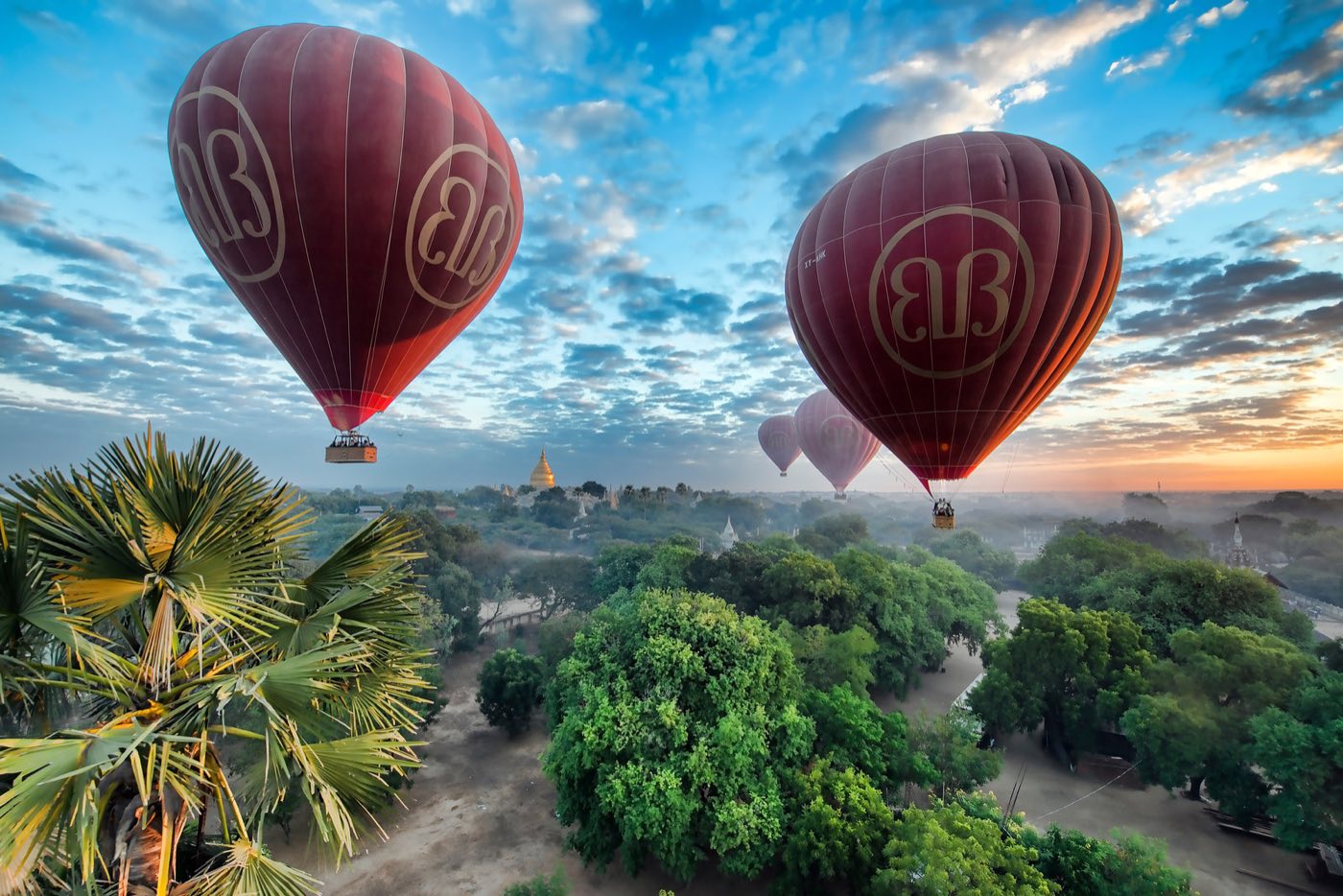
On a dry plain along the Irrawaddy River, the 11th-to-13th-century kings of the Pagan Empire built more than 10,000 Buddhist temples and stupas; over 2,000 still stand across 40 square kilometers. Sunrise and sunset are the hours — red brick and golden stupas against pale dust and haze. E-bikes are the accepted way to explore now that climbing most temples has been restricted. Hot-air balloon flights over the plains operate October through April when weather permits.
Shwedagon Pagoda in Yangon
The golden stupa that dominates Yangon's skyline is Myanmar's holiest Buddhist site — tradition dates it to 600 BCE, archaeology suggests somewhere between the 6th and 10th centuries. The stupa itself is sheathed in genuine gold plates and topped with thousands of diamonds and rubies. Go at dusk when the lights come up and the heat eases; walk the tiled terrace clockwise, sit with the locals for evening chanting, and the place opens up well beyond a 30-minute photo stop.
Inle Lake floating gardens and leg-rowing fishermen
In southern Shan State, a freshwater lake 22 kilometers long holds 17 stilt-house villages, floating tomato gardens tethered to bamboo poles, and the famous Intha fishermen who row standing up with one leg wrapped around the oar. A full day in a wooden longtail covers a handful of villages, a silk weaving workshop, a silversmith, and the five-day rotating market when timing works. Sleep on the lake itself in a stilt-resort for the quiet and the sunrises.
Mandalay's royal palace and U Bein Bridge
The last royal capital before British annexation in 1885, Mandalay is a working central-Myanmar city of 1.3 million with the reconstructed Royal Palace at its heart and Mandalay Hill rising behind it for the sunset view. Twenty minutes south in Amarapura, U Bein Bridge is a 1.2-kilometer teak footbridge across Taungthaman Lake, built in 1850 and still crossed daily by monks and farmers. The silhouette at sunset is one of the country's enduring images.
Golden Rock (Kyaiktiyo Pagoda)
A granite boulder covered in gold leaf, balanced improbably on the edge of a cliff in Mon State, topped by a small stupa said to contain a strand of the Buddha's hair. Pilgrims have been coming here for 2,500 years; you get there now by open truck up a steep switchbacking road, then a short walk. Only men are allowed to touch or apply gold leaf to the rock itself. An overnight stay lets you catch both sunset and sunrise, when the rock glows against the mist.
Mrauk U ancient temple city
In Rakhine State, the 15th-to-18th-century capital of the Arakan Kingdom preserves hundreds of temples and pagodas across a green valley — less famous than Bagan and, when open, far less touristed. Important note: Rakhine State has been a center of the Rohingya crisis since 2017 and a major front of the post-2021 conflict. Access has been restricted or closed entirely for most of the recent period. Consider it on your list for a future, more peaceful Myanmar rather than a current destination.
Ngapali Beach on the Bay of Bengal
A seven-kilometer stretch of white sand and palms on Myanmar's western coast, widely considered one of Southeast Asia's finest beaches. Accessed by short flight from Yangon, Ngapali has traditionally drawn travelers looking for a quiet end to a Burma loop — low-rise resorts, fishing villages at the ends of the beach, and boat trips to nearby islands. Like Mrauk U, Ngapali is in Rakhine State and access has been affected by conflict; check the current status closely before planning.
When to Go
November through February is the cool-dry season and the only window most travelers should consider — daytime highs in the high 20s Celsius, low humidity, clear skies for Bagan balloons and Inle boats. March through May is the hot-dry season with Mandalay and Bagan regularly passing 40°C in April; only worth it for the Thingyan water festival in mid-April if the political situation permits public gatherings. June through October is the southwest monsoon — heavy rain, flooded roads in lower Myanmar, Ngapali resorts mostly closed, but green landscapes in Shan State and fewer visitors where the country stays open. Power cuts and fuel shortages have been more frequent since 2021; build slack into any plan.
Getting Around
Domestic flights between Yangon, Mandalay, Bagan, Heho (for Inle), and Ngapali are the practical way to cover distances — bus journeys that take 10 to 14 hours by road compress to a one-hour flight. Several carriers operate but schedules and reliability have slipped since the coup and reciprocal sanctions complicate international payments. Trains are a slow, scenic, very bumpy way to travel (Yangon–Mandalay in 15 hours, the Gokteik Viaduct route from Mandalay to Hsipaw in roughly eight), and the JJ Express and Elite overnight coaches remain the budget standard between major cities. Within towns, taxis, tuk-tuks, and in Yangon the Grab ride-hailing app handle short hops. Nighttime curfews apply in some areas; confirm with your hotel on arrival.
Cost & Currency
Myanmar uses the kyat (MMK), and the currency has been deeply unstable since 2021 — the official rate and the parallel market rate diverge significantly, and USD cash in pristine, post-2013, unfolded, unmarked bills is still the traveler's safest currency. Expect to pay more in dollars than the numbers on a menu suggest. A sit-down curry and rice lunch runs roughly 5,000 to 10,000 kyat, a mid-range hotel room 50 to 100 USD equivalent in tourist hubs, and domestic flights 80 to 150 USD one-way. ATMs and international cards work inconsistently at best due to banking sanctions; bring enough clean USD cash for your entire trip plus a buffer. Tipping is not traditional but appreciated for guides, drivers, and porters — 1,000 to 5,000 kyat for small services, more for a full day.
Frequently Asked Questions
- Should I travel to Myanmar right now?
- Most Western governments advise against all or non-essential travel to Myanmar due to the ongoing civil war that began after the February 2021 coup. Travel insurance is difficult to obtain, parts of the country are active conflict zones with landmines and clashes, and tourist revenue can flow to regime-linked businesses. Many Burmese voices — including the exiled National Unity Government — have asked tourists to defer visits. Read widely and weigh the ethics before booking.
- Which areas are off-limits to travelers?
- Travel restrictions and active fighting affect most of Rakhine, Chin, Kayah (Karenni), Kachin, and Shan states, plus much of Sagaing and Magway regions. Mrauk U and Ngapali in Rakhine have been repeatedly closed. Even the "classic" tourist circuit of Yangon, Bagan, Mandalay, and Inle Lake sees periodic curfews, internet blackouts, and roadblocks. Travel with a local operator who monitors the situation and be ready to change plans.
- Do I need a visa and how do I get it?
- Yes — most nationalities need a visa. Myanmar's e-visa system remains active for tourist visas through the official government portal, typically issued within a few business days for a single-entry 28-day stay. Given the political situation, confirm the status of e-visas and entry points close to travel; land border crossings have opened and closed repeatedly since 2021.
- Can I use credit cards and ATMs?
- Rarely and unreliably. International banking sanctions and the kyat's instability mean most travelers should plan to bring enough clean, crisp, undamaged US dollars in small and large denominations to cover the entire trip, plus a buffer. Some upscale hotels in Yangon accept Visa/Mastercard but do not count on it. No bill with a fold, stain, or tear will be accepted for exchange.
- How can I travel more responsibly if I decide to go?
- Book with locally owned guesthouses and guides rather than regime-linked chains and state-owned hotels (lists of known regime-linked businesses circulate among Myanmar travel communities online). Spend cash directly with small operators, artists, and market stalls. Avoid military-owned airlines where alternatives exist. Don't photograph soldiers, police, or checkpoints. And listen more than you ask — political conversation can put locals at real risk, so let them lead if they want to.
Plan a Trip to Myanmar
Have you been to Myanmar?
Track 195 countries, 50 states & 63 national parks on your map