Switzerland
- Capital
- Bern
- Population
- 8.8M
- Currency
- CHF
- Languages
- German, French, Italian, Romansh
Overview
A landlocked Alpine confederation of four languages and 26 cantons, Switzerland packs an outsized range of landscapes into a country smaller than Denmark — glaciated peaks, lakeside vineyards, German-Swiss villages of dark timber, and French-Swiss towns that sit at café tables late into the evening. Travelers come to stand at the foot of the Matterhorn in Zermatt, ride the cogwheel up to the Jungfraujoch, take the Glacier Express slowly from St. Moritz to Zermatt, and eat fondue in a Lausanne cellar that has been serving it since before your grandfather was born. The country runs on a precision that can feel almost funny until you realize how much of your trip depends on it. Trains leave to the minute. Swiss postal buses reach alpine villages that look impossible to get to, at schedules you can set a watch by. Cable cars, funiculars, and lake steamers link seamlessly on a single Swiss Travel Pass, and you rarely wait more than 20 minutes for a connection even in deep valleys. Once you trust the network, you stop planning and start riding. What you spend here you spend on the scenery and the logistics of reaching it. A single cable-car ride can run the price of a hotel night in Portugal, and a fondue dinner for two with wine can pass 150 francs without effort. The payoff is access — cable cars to summits you could never walk, trails maintained like garden paths, and the certainty that whatever transport you booked will arrive on time in a rainstorm in November. Come with a pass, good shoes, and the budget to match.
Things to Do
Matterhorn views from Zermatt
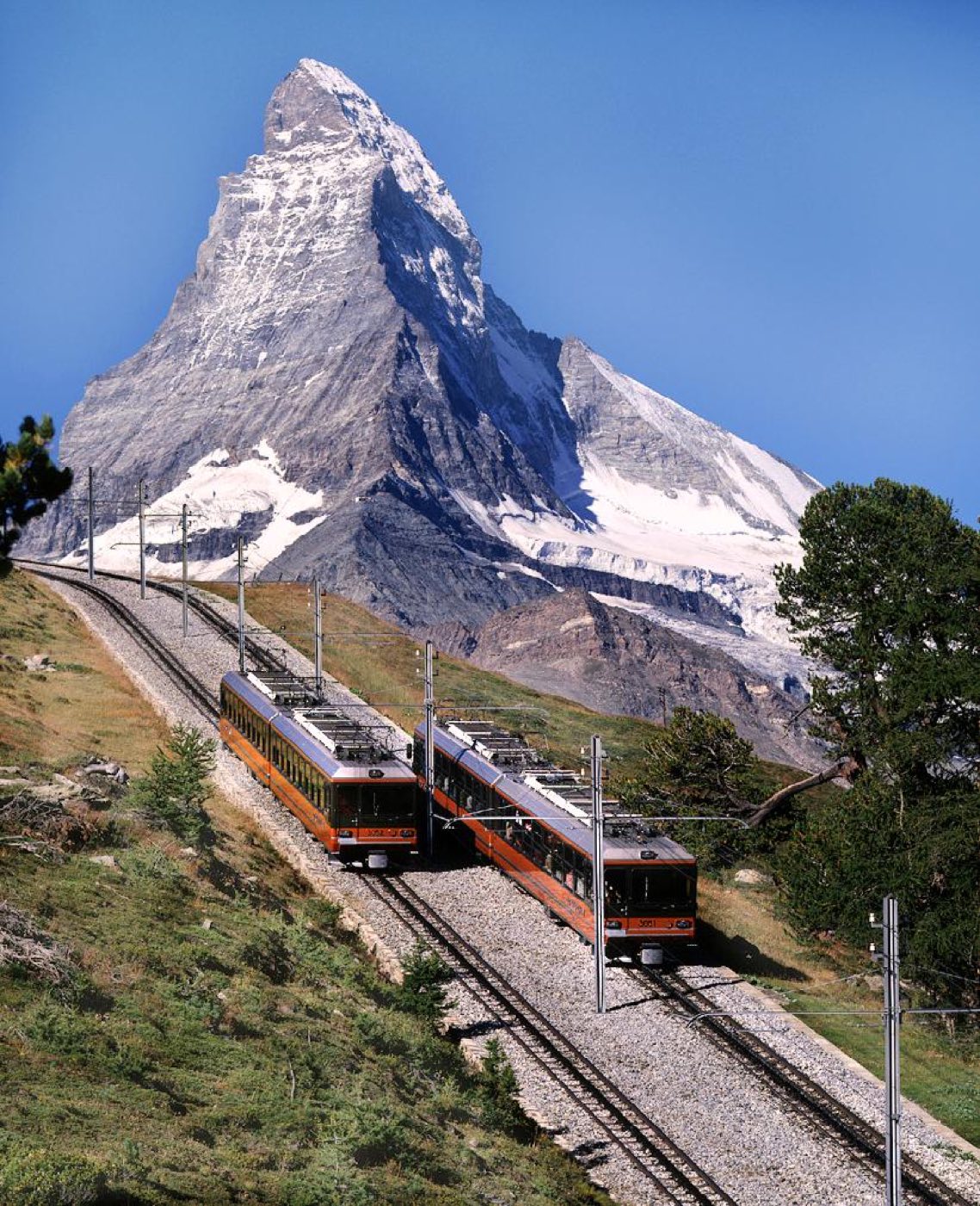
The car-free village of Zermatt sits at the end of a steep valley in southwest Switzerland, facing the sharp pyramid of the Matterhorn that rises alone above the surrounding ridges. Take the Gornergrat cogwheel railway up to 3,100 meters for the classic postcard view, or ride the higher Matterhorn Glacier Paradise cable car to 3,883 meters for year-round skiing. The sunrise view from Riffelsee, where the peak reflects in a small alpine tarn, is the photograph most people come for.
Jungfraujoch — Top of Europe railway
Europe's highest railway station sits at 3,454 meters on a saddle between the Jungfrau and the Mönch, reached by a 100-year-old cogwheel line that burrows seven kilometers through solid rock. The ride from Interlaken climbs past Kleine Scheidegg, pauses at two viewing windows inside the Eiger's north face, and deposits you at a glacier-level complex with an ice palace, an observation deck, and usually a solid wall of cloud or brilliant sunshine with nothing in between. Go early and check the mountain webcam before committing.
Lucerne's Chapel Bridge and Lion Monument
The covered wooden Kapellbrücke has crossed the Reuss River since 1333 and is still the centerpiece of Lucerne's old town, with painted panels under its roof depicting the city's history. A short walk takes you to Mark Twain's favorite piece of sculpture — the Lion Monument, carved into a cliff face to commemorate Swiss Guards killed defending the Tuileries in 1792. Twain called it the most mournful piece of stone in the world, and he was not wrong.
Lake Geneva and Lavaux vineyard terraces
The northern shore of Lake Geneva east of Lausanne is lined with stone-walled vineyard terraces stepping down to the water — a UNESCO-listed landscape of Chasselas grape farming that has looked essentially the same since the 11th century. Walk the five-hour ridge path from Lutry to Saint-Saphorin with a glass of local white at every third village, or ride the wine-country train along the bottom. Either way, finish with a lake ferry into Montreux as the sun drops behind the French Alps.
Interlaken adventure sports and Grindelwald
The town of Interlaken sits between two lakes at the foot of the Bernese Oberland and has specialized for a century in sending people up, down, and out of the surrounding mountains — paragliding off Beatenberg, canyoning in the Saxeten gorge, ice climbing above Grindelwald, skydiving over the peaks. The village of Grindelwald, a short train ride up, is the more atmospheric base if you want valley hiking and Eiger views without the booking agents at every corner.
Bern's medieval old town UNESCO site
Switzerland's federal capital is a walled medieval peninsula of sandstone arcades, trickling fountains, and a 500-year-old astronomical clock that chimes four minutes before every hour while figurines rotate. Walk the four kilometers of covered arcades — the longest continuous weather-protected shopping street in Europe — and climb the Bern Minster's spire for the Aare River loop views. The city's bear park at the bottom of the hill still keeps live brown bears, the symbol on the cantonal flag.
Glacier Express scenic train journey
Eight hours and 291 bridges from Zermatt to St. Moritz, on a panoramic-windowed train billed as the slowest express in the world. The route climbs over the 2,033-meter Oberalp Pass, crosses the Landwasser Viaduct, and threads the Rhine Gorge — Switzerland's Grand Canyon — with a multi-course lunch served at your seat. Book the Excellence Class if budget allows, or standard for a quarter the price with the same scenery.
Swiss National Park in the Engadin
The country's only national park sits in the far eastern Engadin valley near Italy, and at 170 square kilometers it is strictly protected — no dogs, no off-trail walking, no mountain biking, and fines for picking flowers. The payoff is quiet: ibex, marmot, chamois, and golden eagle in landscapes almost untouched since the park's founding in 1914, the oldest in the Alps. Base in Zernez or S-chanf and day-hike the Val Trupchun for the best wildlife viewing in late autumn.
When to Go
June through September is the main window for hiking, lake swimming, and alpine cable cars, with July and August the warmest and busiest. Shoulder weeks in late May, early June, and mid-September offer the same scenery with fewer people and lower lodging rates. December through March is the winter season for skiing — Zermatt, Verbier, St. Moritz, and Grindelwald all run full from mid-December through early April, with Christmas markets in Bern, Zurich, and Lucerne through December. November and early May are the real off-seasons, with many cable cars shut for maintenance.
Getting Around
The SBB rail network is the spine of the country and genuinely reaches everywhere worth reaching, from Zurich airport to mountaintops, lakeside villages, and cross-border into Italy and France. A Swiss Travel Pass (three, four, six, or 15 consecutive days) covers trains, buses, ferries, and most urban public transport plus half-price mountain cable cars — the math almost always works if you are moving around. PostBus yellow coaches fill in the last kilometers to alpine villages where trains do not run, on equally precise schedules. Rental cars make sense for rural loops in the Jura or the Engadin, but in cities they are a liability — parking is punitive and the public network is faster. Tap-and-go on trains and buses is standard; download the SBB Mobile app for tickets and real-time connections.
Cost & Currency
Switzerland uses the Swiss franc (CHF), not the euro, though some tourist businesses accept euros and give change in francs. Prices sit at the top of the European range — expect CHF 25–35 for a simple lunch, CHF 60–100 for a mid-range dinner with a glass of wine, and CHF 200–350 (€210–€370) a night for a decent mid-range hotel in Zurich, Lucerne, or Zermatt. Cable-car day passes for major mountains run CHF 100–200. Cards work everywhere and contactless is ubiquitous; keep CHF 50–100 in small notes for mountain huts, rural buses, and tips. Service is usually included on restaurant bills — rounding up 5–10% for warm service is appreciated but never expected.
Frequently Asked Questions
- Is the Swiss Travel Pass worth it?
- For most visitors, yes — if you are planning to ride more than a couple of intercity trains plus any lake ferries or mountain excursions, the pass usually pays for itself within three days. It also simplifies travel by eliminating ticket purchases and includes free admission to most Swiss museums. Calculate your planned route with the SBB fare tool before buying to confirm.
- Do I need to speak German, French, or Italian?
- No — English is widely spoken across Switzerland's four language regions, especially in tourism, hospitality, and major cities. A few words in the regional language (Grüezi in German Switzerland, Bonjour in the French, Buongiorno in Ticino) are appreciated. Train announcements and menus are usually bilingual or trilingual, often including English.
- When is the best time for skiing?
- Mid-December through early April covers the main ski season in all major resorts. January and February bring the most reliable snow conditions; Easter week is the last reliable stretch of the season. Zermatt, Saas-Fee, and the Jungfrau region offer year-round glacier skiing at altitude, though the terrain is more limited outside of winter.
- Can I drink the tap water?
- Yes, tap water throughout Switzerland is excellent quality and safe to drink, including from the public fountains in towns like Bern, which have flowed continuously for centuries. Carry a refillable bottle — bottled water in restaurants costs CHF 5–8 and is unnecessary. Alpine streams in the high mountains are generally safe but still worth filtering as a precaution.
- How far in advance should I book summer accommodation?
- Three to six months ahead for July and August in popular spots like Zermatt, Grindelwald, and the Lauterbrunnen valley, where capacity is limited and demand is high. Urban hotels in Zurich, Lucerne, and Geneva are more flexible but still benefit from a few weeks' notice. Shoulder-season trips in late May or late September need only a couple of weeks' lead time.
Plan a Trip to Switzerland
Have you been to Switzerland?
Track 195 countries, 50 states & 63 national parks on your map