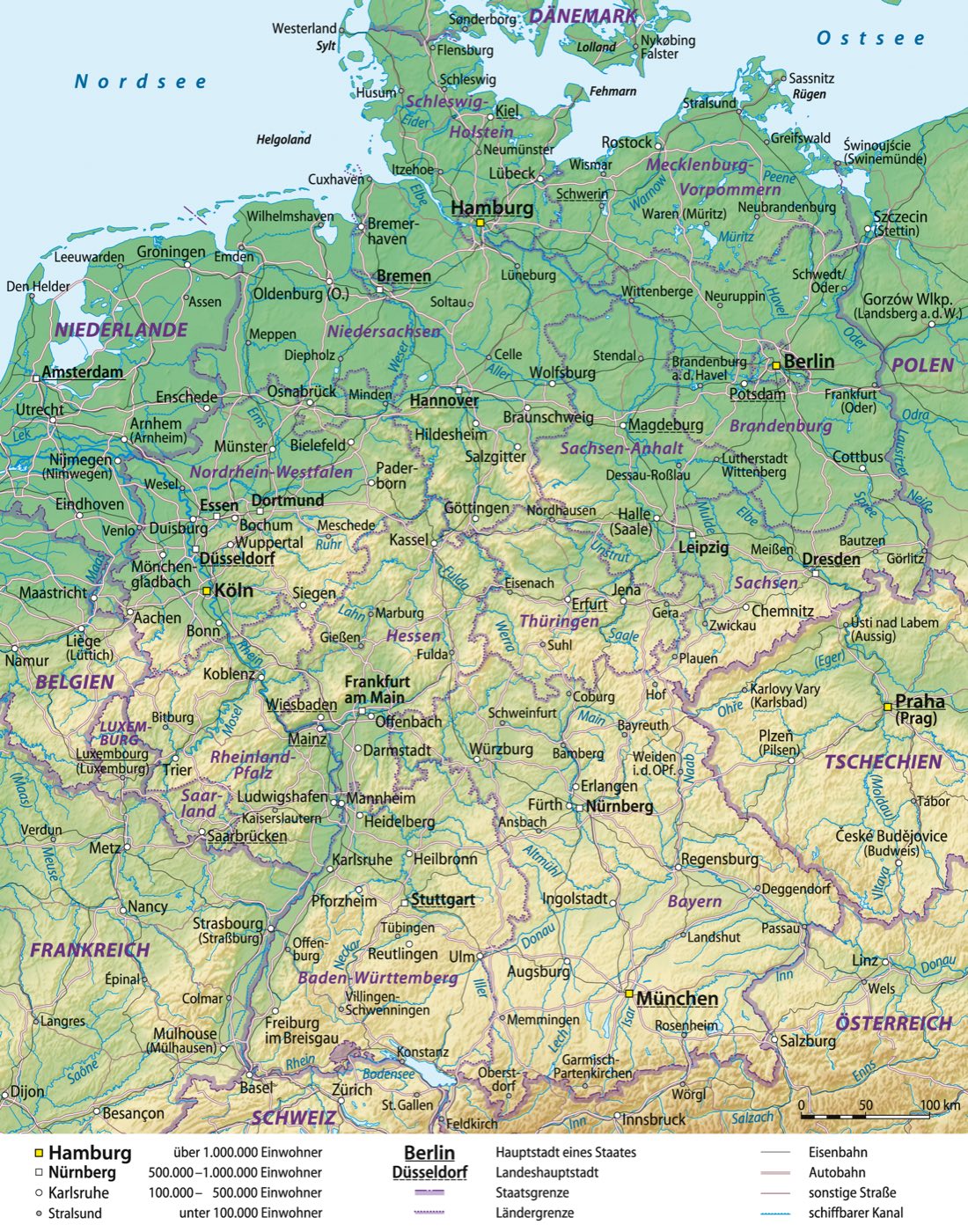
Germany
- Capital
- Berlin
- Population
- 84.5M
- Currency
- EUR
- Languages
- German
Overview
Europe's largest economy and the country that sits at the geographic and cultural middle of the continent, Germany packs a remarkable range into a single itinerary — Bavarian beer halls and onion-domed Baroque churches in the south, Hanseatic brick-Gothic cities on the Baltic, Rhine castles staring at each other across a green gorge, and in Berlin a capital that has spent thirty years reckoning honestly with a hard twentieth century. You feel the regionalism quickly. A train ride from Munich to Hamburg passes through several distinct countries that happen to share a federal flag — dialect, beer, bread, and architectural vocabulary all change every couple of hours. Food moves from pretzels and weisswurst in the south to curly pork knuckle in the west to fish sandwiches on the northern coast. That variety is the quiet argument for seeing more than one city: a Germany trip built around only Berlin or only Munich leaves most of the country unopened. Germany rewards travelers who like their infrastructure to work, their museums to be serious, and their countryside to be hiked on maintained paths with a brewery every couple of villages. Trains are fast and frequent, cards are accepted in most places though cash still runs deeper than other European countries, and English is widespread in cities and tourist regions. Go with a week at minimum, a willingness to leave the capital for at least a few nights, and an appetite for both heavy lunches and late-evening cathedral light.
Things to Do
Brandenburg Gate and Berlin Wall Memorial
The central set-piece of reunified Berlin — a neoclassical arch that stood inside the death strip for forty years and now frames Unter den Linden and the Reichstag. Walk north from the gate to the Memorial to the Murdered Jews of Europe, a field of 2,711 concrete stelae by Peter Eisenman, and make time later in the day for the Berlin Wall Memorial on Bernauer Straße — a preserved section of wall with documentation that does a better job than any museum in the city at explaining how the division actually worked.
Neuschwanstein Castle in Bavaria
King Ludwig II's nineteenth-century fantasy castle perches on a forested ridge in the Bavarian Alps near Füssen, its white limestone turrets the literal inspiration for Disney's castle. You book a timed entry ticket online, take a bus or horse-drawn carriage up the steep road, and tour the interior in a thirty-minute guided group. The real payoff is walking out to the Marienbrücke pedestrian bridge in the gorge behind the castle for the classic postcard view. Pair it with a night in Füssen or the nearby Hohenschwangau.
Munich's Oktoberfest and Marienplatz
Late September through early October, the Theresienwiese fills with fourteen enormous beer tents and six million visitors drinking one-liter masses of Märzen brewed specially for the festival by Munich's six main breweries. It's a cultural institution that repays an evening with a table reservation and a trip to the carnival rides at sunset. Outside festival season, the Marienplatz glockenspiel, the Hofbräuhaus, and the Englischer Garten with its river surfers carry plenty for two days.
Cologne Cathedral
The Gothic cathedral at the center of Cologne is the largest church in Germany by volume and took 632 years to complete — the spires weren't finished until 1880. Climb the 533 steps of the south tower for a view over the Rhine and the city, then slip inside for the Shrine of the Three Kings, the medieval goldsmith work that drew pilgrims for centuries. The cathedral sits directly beside the main train station, which makes it one of the easiest world-class monuments to visit in Europe.
Rhine Valley castle cruise
The Upper Middle Rhine between Koblenz and Bingen is a UNESCO site for good reason — forty-plus castles strung along sixty-five kilometers of steep-sided river gorge, vineyards climbing the slopes, and the Lorelei rock at the narrowest bend. A KD Line day boat lets you sit on deck and watch the castles roll past; a hiking stretch between Bacharach and Oberwesel gives you a half-day of ridge trails with the river below. Stay a night in a half-timbered inn in Bacharach.
Black Forest villages and hiking
The dark, steep-sided pine forest of Baden-Württemberg's southwest is a working landscape of dairy farms, cuckoo-clock workshops, and half-timbered villages like Triberg and Gengenbach. The Westweg long-distance path runs 285 kilometers from Pforzheim to Basel through the best of it, but shorter day walks from Triberg to the waterfalls or along the Feldberg summit give you the feel in a day. Eat Schwarzwälder Kirschtorte where it actually comes from — cherries, kirsch, whipped cream.
Heidelberg's old town and castle
The red-sandstone ruin of Heidelberg Castle stands above the old town on the Neckar, half-destroyed by French artillery in the seventeenth century and the better for it — the picturesque ruin on the ridge is the image of German Romanticism that pulled Mark Twain and half of nineteenth-century English literature here. Ride the funicular up, walk the old town below to the arched Karl Theodor Bridge, and stay for the university's Studentenkarzer, the historic student jail, for a glimpse of how Heidelberg's scholars used to live.
Dresden's rebuilt Frauenkirche
The Baroque dome of the Frauenkirche collapsed in the February 1945 firebombing of Dresden and sat as a rubble pile for fifty years as an East German memorial, then was reconstructed stone by stone through the 1990s and 2000s using original blackened blocks wherever possible — the light and dark patchwork of the facade is the point. Inside, the reconstructed nave is bright and restrained. Combine with a walk through the Zwinger and the riverside promenade on the Elbe.
When to Go
May through September is the main travel season — warm, long days, outdoor beer gardens open, mountain huts running in the Alps, and festivals across the country. July and August get busy and hot, especially in Berlin, and are the peak time for families. Oktoberfest runs mid-September to early October in Munich and books out well ahead. December transforms the old towns with Christmas markets — Nuremberg, Dresden, Cologne, and Rothenburg are the classics — and the atmosphere is worth the cold. January and February are thin on daylight but excellent for skiing in Bavaria at Garmisch or Oberstdorf.
Getting Around
Germany's ICE high-speed train network is the best way to move between major cities — Berlin to Munich in under four hours, Frankfurt to Cologne in an hour, Hamburg to Berlin in under two. Book online a few weeks ahead for the cheapest fares on Deutsche Bahn. Renting a car makes sense for the Romantic Road, the Black Forest, and the Mosel and Rhine valleys where stopping at random villages is half the point. Autobahn sections have no speed limit but local roads and cities are strict. Within cities, the U-Bahn and S-Bahn networks are extensive and reliable; buy day passes rather than single tickets. The Deutschland-Ticket at €49 a month is an extraordinary deal for regional travel.
Cost & Currency
Germany uses the euro and sits roughly in the middle of western European price ranges — less expensive than France or Scandinavia, more than Spain or Portugal. Expect €3–€4 for a bakery coffee, €12–€20 for a sit-down lunch of schnitzel or a big bowl of ramen in Berlin, and €100–€160 a night for a mid-range hotel in Berlin, Munich, or Hamburg. Cards are accepted at chains and hotels but smaller restaurants, bakeries, and bars are often cash only — carry €50–€100. Tipping is done by rounding up or adding 5–10% and handing the total amount directly when paying; don't leave cash on the table. Tap water is excellent and free on request.
Frequently Asked Questions
- Do I need a visa to visit Germany?
- Germany is part of the Schengen Area, so EU citizens enter freely and travelers from the US, UK, Canada, Australia, and many other countries can visit for up to 90 days in any 180-day period without a visa. From 2025 onward, ETIAS pre-authorization applies to visa-exempt non-EU visitors. Passports must be valid for at least three months beyond your planned departure date.
- Is Germany safe for travelers?
- Germany is one of Europe's safer countries with low violent crime. Pickpocketing in crowded tourist areas — around Berlin Hauptbahnhof, Munich's Marienplatz, and on the S-Bahn in all major cities — is the main concern. Keep an eye on bags and phones. Solo travelers and women generally report Germany as comfortable, and public transport is safe at night in city centers.
- Is German necessary or is English enough?
- English is widely spoken in cities, by younger Germans, and in all tourist-facing businesses — you can travel the country comfortably without German. A few basic phrases (please, thank you, sorry) are warmly received and useful in smaller towns and rural restaurants where the default is German. Train announcements and signage are bilingual on ICE routes and at major stations.
- How long should I plan for a first trip?
- Seven to ten days is a comfortable first visit — three nights in Berlin, two in Munich, and the rest split between the Rhine Valley, the Black Forest, or a day-trip-accessible city like Cologne or Dresden. Two weeks lets you add Hamburg and the Baltic coast or a proper Bavarian Alps stay. Trains make multi-city itineraries easy.
- What's the best way to get from Berlin to Munich?
- Take the ICE high-speed train — it runs the route in under four hours, departs roughly hourly, and costs €30–€80 booked a week or two ahead on bahn.de. Flying is slightly faster door-to-door but the train drops you in the city center at both ends and is far less hassle. Night trains and a handful of direct buses also run if you want to save a hotel night.
Plan a Trip to Germany
Have you been to Germany?
Track 195 countries, 50 states & 63 national parks on your map