Belgium
- Capital
- Brussels
- Population
- 11.6M
- Currency
- EUR
- Languages
- Dutch, French, German
Overview
A compact kingdom punching far above its weight in art, architecture, beer, and chocolate in the heart of Western Europe. Travelers come for Bruges's medieval canals, Brussels's Art Nouveau gems, and some of the world's finest trappist ales. What you notice first is how small it is. You can have breakfast in Brussels, lunch in Ghent, dinner in Antwerp, and still be back in a Brussels hotel before bedtime — and the trains that let you do that run every fifteen or twenty minutes. The second thing you notice is the light in late afternoon on a Flemish facade. Brick gables, guild houses with gilded letters, the particular grey-green-copper of a belfry roof — it is the set dressing for half the paintings you remember from museums, and it is still there, unapologetically, on any small square in Ghent or Bruges. Belgium rewards travelers who like their cities close together, their food serious, and their drinking thoughtful. It is a country of two hours over mussels and fries, of tram rides through neighborhoods that change language at an intersection, of monk-brewed beers poured into glasses shaped specifically for them. Give it a week; you will not run out of things to chew on.
Things to Do
Bruges's medieval canals and Belfry tower
The whole center of Bruges is a UNESCO-protected medieval time capsule — cobbled lanes, step-gabled guild houses, swans on the canals, a working belfry you can climb via 366 narrow spiral steps for the view over red-tile rooftops. Come very early or very late; the middle of the day in high season is shoulder-to-shoulder. Stay overnight if you can — once the last bus trip empties out around five, the city becomes genuinely peaceful and the canal reflections settle into something out of a painting.
Brussels Grand Place
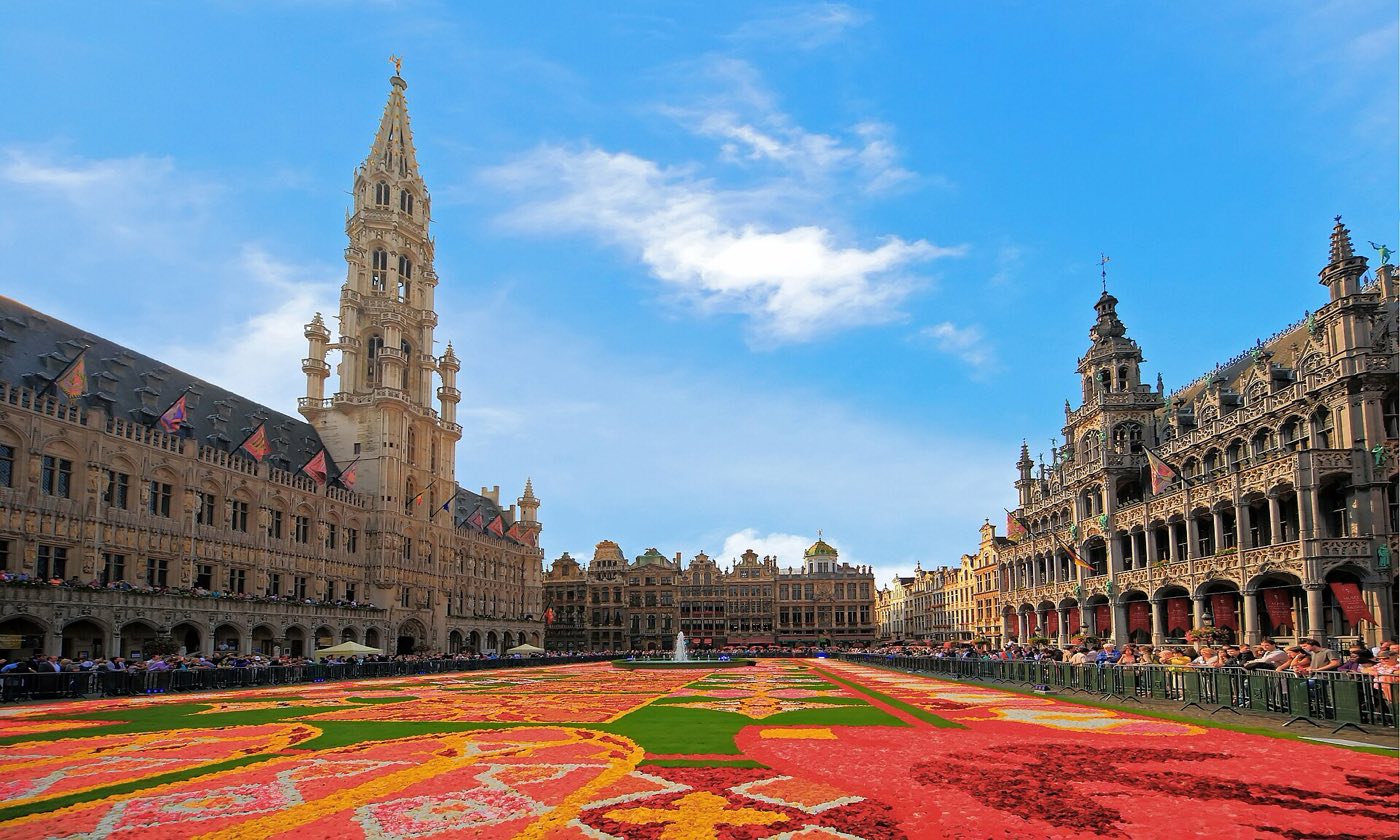
The main square of the capital is almost entirely surrounded by Baroque guild houses in gold-leafed black stone, rebuilt after a 1695 French bombardment and completed with an almost compulsive care. The Hôtel de Ville rises on the south side with its off-center spire, and a flower market fills the square most mornings. Return at night — the whole thing is floodlit in a way that somehow does not feel touristy, just correctly staged.
Ghent's Gravensteen castle and Altarpiece of Ghent
Ghent feels like Bruges with a university and half the crowds — a canal-threaded medieval center that still functions as a working city. Climb up through the ramparts of Gravensteen, the twelfth-century counts' castle in the middle of town, and then walk ten minutes to St Bavo's Cathedral to stand in front of the Van Eyck brothers' Ghent Altarpiece, cleaned and restored over the last decade and one of the genuine landmarks of Western painting.
Antwerp's diamond district and Rubens House
Antwerp handles roughly 85% of the world's rough diamonds, and the few blocks around the central station where that trade happens make for an hour of genuine curiosity. A ten-minute walk away is the Rubenshuis, the painter's own Italianate townhouse and studio, recently reopened after a long restoration. Eat frites in the evening on the Grote Markt, where the gabled guild houses look almost identical to Brussels's but less photographed.
Trappist beer abbey visits (Orval, Chimay, Westvleteren)
Belgium has six of the world's eleven authentic Trappist breweries, and visiting one on its home ground is an experience quite different from ordering the beer anywhere else. Orval in the Ardennes has a public bar and abbey ruins you can walk through; Chimay has a visitor center and cafe; Westvleteren, the most elusive, sells its legendary 12 by reservation from a small cafe across the lane. You need a car for any of them, and you should plan the driving accordingly.
Belgian chocolate workshops
The chocolatiers that actually matter — Pierre Marcolini in Brussels, Dominique Persoone in Bruges, a handful of small ateliers in Antwerp — offer hands-on workshops where you spend two or three hours making your own truffles or pralines under a chocolatier's eye. Book ahead; the good ones fill a week or more in advance. Even if you skip the workshop, the shop counters themselves reward slow browsing and a small box to eat on a park bench.
Flanders Fields WWI memorials at Ypres
The town of Ieper, known in English as Ypres, sat at the center of four years of First World War trench warfare, and the countryside around it is dotted with Commonwealth and German cemeteries, preserved trench sections, and the In Flanders Fields Museum in the restored Cloth Hall. At eight every evening, the Last Post is played under the Menin Gate, as it has been every evening but a few since 1928. It is quiet and honest and worth the journey out.
When to Go
May to September for outdoor café terraces and canal-side strolls in pleasant weather. December brings enchanting Christmas markets in Brussels, Bruges, and Ghent with warming mulled wine. July and August are the warmest but also the busiest in Bruges specifically, and rain is a year-round possibility — even in summer, pack a light layer and assume you will need it at some point. March and April bring early blossom along the canals and shoulder-season hotel rates; October delivers golden-leaf walks along the Ardennes rivers with the smallest crowds of the year.
Getting Around
The train network is the easiest way to move around — SNCB/NMBS runs frequent services between Brussels, Antwerp, Ghent, Bruges, Leuven, and Namur, with most intercity journeys under an hour. A weekend ticket discounts return fares sharply if you travel Friday evening through Sunday. Brussels has a metro, tram, and bus system on a single contactless card; Antwerp and Ghent are best walked or cycled. Renting a car only makes sense for the Ardennes, the Trappist breweries, or the WWI battlefields in West Flanders. Cycling infrastructure in Flanders is outstanding and intercity bike rental is straightforward in tourist cities.
Cost & Currency
Belgium uses the euro and sits in the mid-range for Western Europe — cheaper than Paris, more expensive than Lisbon. Expect €3–€4 for a coffee at a cafe, €18–€28 for a mussels-and-fries lunch with a beer, and €110–€180 a night for a mid-range hotel room in Brussels or Antwerp (Bruges runs higher in summer). Cards, including contactless, work almost everywhere — Belgium is one of the most card-accepting countries in Europe — but keep €30–€50 in cash for smaller cafes in Wallonia and the rural Ardennes. Tipping is modest: round up a bar bill, leave 5–10% at a sit-down dinner if the service has been attentive.
Frequently Asked Questions
- Is Bruges or Ghent better for a short trip?
- Bruges is the postcard — smaller, more medieval, more crowded in season — while Ghent is a working city with a university and arguably a better food scene. If you have only one day, pick Bruges; if you have two, stay in Ghent and day-trip to Bruges, which gives you the best of both and cheaper hotel rates.
- Do I need to speak French or Dutch?
- No — English is widely spoken across Brussels, Flanders, and the main tourist cities, and most restaurants and hotels default to it the moment they hear you. A few polite words in French go further in Wallonia and in older cafes in Brussels, and Dutch is more appreciated than attempted in Flanders.
- How do I get from the airport into Brussels?
- Brussels Airport (Zaventem) has a direct train to Brussels Central station every fifteen minutes, taking about 20 minutes for around €12. Brussels South Charleroi, used by budget airlines, is an hour south and reached by a shuttle bus to the city center timed to flights.
- Is the beer really that different from what I get at home?
- Yes — Belgian brewing covers lambics, trappist ales, saisons, and abbey beers that ferment for months in ways mass-market brewing does not replicate, and the correct glass is taken seriously. Try Westmalle Tripel, an aged Rodenbach, or a young gueuze and you will understand what the fuss is about.
- How many days do I need for a first trip?
- Four to five days covers Brussels, Bruges, and Ghent comfortably with time to sit in cafes; seven days lets you add Antwerp and either the Ardennes or the WWI battlefields at Ypres. Any less and you will feel like you are sprinting between train stations.
Plan a Trip to Belgium
Have you been to Belgium?
Track 195 countries, 50 states & 63 national parks on your map