Seychelles
- Capital
- Victoria
- Population
- 100K
- Currency
- SCR
- Languages
- English, French, Creole
Overview
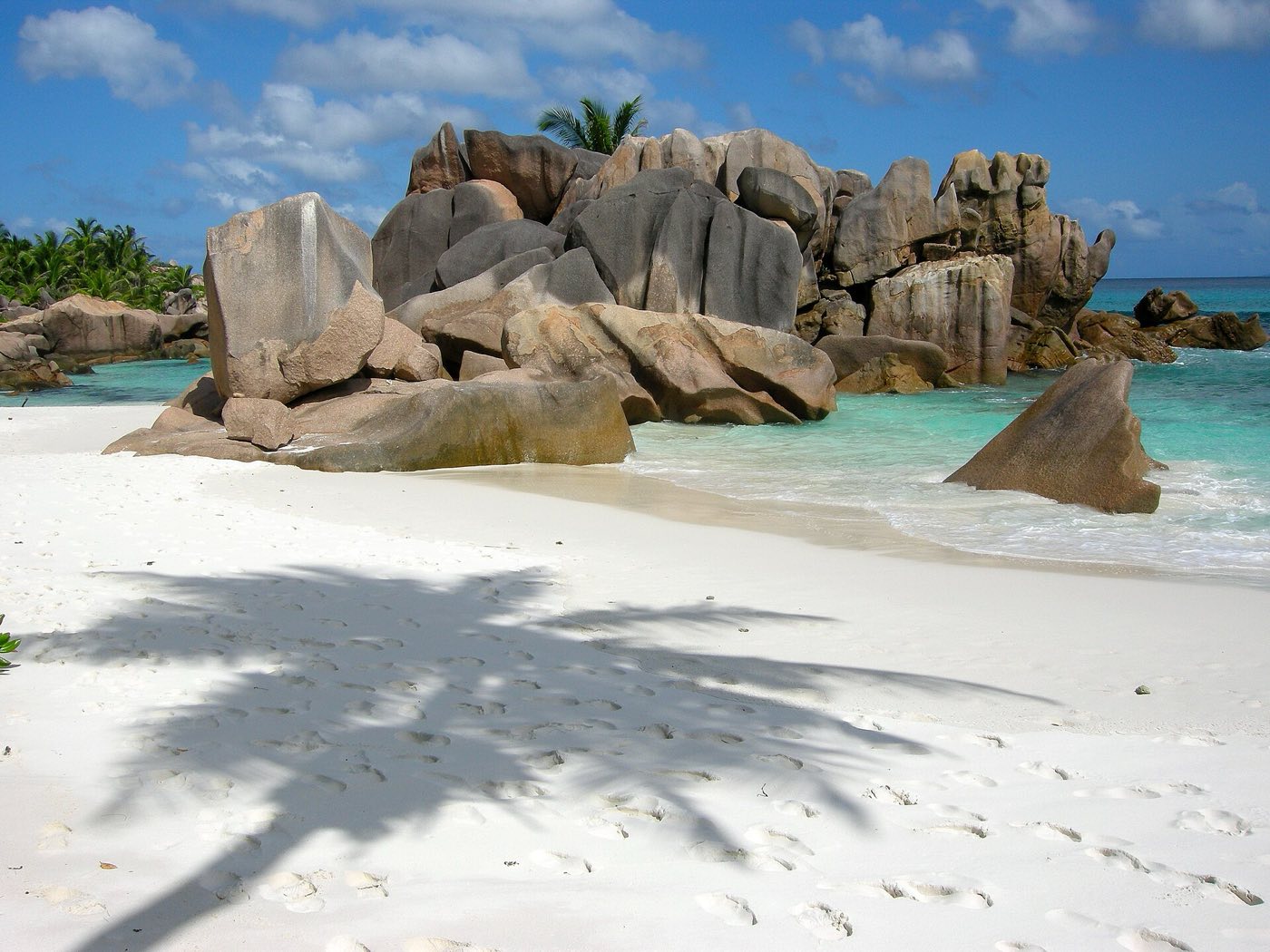
An archipelago of 115 islands scattered across the western Indian Ocean, Seychelles is famous for a particular kind of beach — pink-granite boulders piled against white sand, turquoise shallows, and a few wind-bent takamaka trees for shade. Travelers come for the boulder-strewn coves of La Digue, snorkeling with whale sharks, the coco de mer palms of Praslin's Vallée de Mai, and the rare combination of equatorial beach and forested mountain interior you get on the larger islands. You fly into Mahé, and within an hour of landing you're likely on a beach with water that looks photoshopped. The main island is mountainous, with Morne Seychellois rising above 900 meters and covered in palms, frangipani, and jackfruit trees; a ring road takes you past fishing villages, Creole restaurants, and a dozen postcard bays. A short flight or ferry takes you to Praslin, and from Praslin a 15-minute boat ride gets you to La Digue, where ox-carts and bicycles still outnumber cars and the pace drops several notches. Seychelles rewards travelers who want beach time without the packaged resort feel — most islands have a few high-end lodges, a scatter of guesthouses, and long stretches of protected coast. It's expensive by African standards but cheaper than the Maldives and more varied, with jungle hikes, birdwatching on Cousin, and the Aldabra tortoise colonies to break up the beach days. A week is right; two is better if you're island-hopping.
Things to Do
Anse Source d'Argent beach on La Digue
The most photographed beach in Seychelles — and, arguably, on Earth — is a curve of shallow turquoise broken by enormous pink granite boulders on La Digue's southwest coast. You reach it through the L'Union Estate coconut plantation, past a giant tortoise pen and an old copra mill. Arrive before 10 am or after 3 pm to miss the cruise-ship groups; the best swimming is at the far end, where the reef flats open into deeper water. Rent a bike at the Praslin ferry pier and cycle the whole island.
Vallée de Mai Nature Reserve and coco de mer on Praslin
A small palm forest in the middle of Praslin holds the last native stand of the coco de mer, a palm that produces the largest seed on the planet — a suggestively shaped double coconut weighing up to 30 kilos. UNESCO-listed since 1983, the valley is a prehistoric-feeling tangle of six endemic palm species, with the black parrot calling overhead. The marked trails take about 90 minutes; mornings are cooler. The forest is one of the weirdest natural places in the Indian Ocean.
Anse Lazio beach on Praslin
At Praslin's northwest tip, a broad half-moon bay protected by rocky headlands holds what might be the best swimming beach in the country — deep water close to shore, clear visibility, and the usual granite boulders at each end. A couple of small restaurants behind the beach serve grilled fish and Seybrew beer at reasonable prices. Watch for currents in the middle of the bay and around the northern point, and don't leave valuables on the sand — monkeys come down from the hills at lunchtime.
Aldabra Atoll giant tortoise colony
Reaching Aldabra takes commitment — it's 1,100 kilometers southwest of Mahé, accessible only by expedition cruise or private charter, and visitation is capped to protect the UNESCO-listed atoll. The reward is the largest population of giant tortoises on the planet, around 100,000, wandering across one of the least-disturbed coral atoll ecosystems on Earth. If you can't reach Aldabra, the tortoises at Curieuse Island near Praslin are descended from the same population and a much easier day trip.
Morne Seychellois National Park hiking on Mahé
The interior of Mahé rises into a forested spine protected as national park, and a dozen marked trails thread through it — from the 90-minute Copolia climb with a granite dome payoff, to the serious full-day ascent of Morne Seychellois itself. The Tea Factory trail passes through a working plantation. Go with a guide on the harder routes; the trails can be faint and the afternoon rain arrives fast. Leeches are a real thing in the wetter months — long socks and a decent pair of shoes.
Sainte Anne Marine National Park snorkeling
Six islands in a protected marine park off Mahé's east coast sit in shallow water thick with parrotfish, angelfish, rays, and the occasional turtle. Half-day boat trips from Eden Island or Beau Vallon visit three or four of the islands, typically stopping for lunch on Cerf and snorkeling off Round Island. The reefs have taken bleaching damage in recent years but still snorkel well in the lee of the islands. Bring reef-safe sunscreen and your own mask if you can — rental gear is variable.
Victoria's Sir Selwyn Selwyn-Clarke Market
The capital is the world's smallest — you can walk across it in fifteen minutes — and its produce market is the best place to see what actually grows and swims in Seychelles. Stallholders sell passionfruit, jackfruit, soursop, chili paste, and the morning's tuna and bourgeois laid out on ice. Pick up saffron-stained rice, ginger, and Creole chili sauce to take home, then stop at one of the lunch counters upstairs for a plate of octopus curry with lentils.
When to Go
Seychelles has two monsoon seasons separated by calm windows. April to May and October to November are the sweet spots — low wind, clear water, excellent diving visibility, and warm temperatures around 28°C. December through March brings the northwest monsoon with more humidity and rain, though the seas on the western sides of the islands stay calm. May through September is the southeast trades season, drier but windier, with choppier seas and good conditions for windsurfing and kitesurfing on Mahé's east coast.
Getting Around
Movement between the three main inhabited islands is easy: the Cat Cocos catamaran runs Mahé to Praslin three times a day in about an hour, and a smaller ferry continues on to La Digue in 15 minutes. Inter-island flights on Twin Otters are quick and scenic but weight-limited. On Mahé, renting a small car is the realistic choice — buses run a single coastal ring and are cheap but infrequent, and taxis are metered but add up fast. On Praslin, the island is small enough for taxis or a rental to cover everything. La Digue has almost no cars; rent a bike at the port and you have the island.
Cost & Currency
Seychelles uses the Seychellois rupee (SCR), though most hotels and tour operators quote in euros. It's the most expensive destination in Africa: expect €150–€250 a night for a mid-range guesthouse, €400–€1,200 at a proper hotel, and €30–€60 a head for a sit-down Creole dinner. Self-catering apartments are the cost-saver — a studio with a kitchen halves your food bill. Cards are accepted almost everywhere; keep rupees for the market, small restaurants, and taxis. ATMs are on all three main islands. Tipping isn't expected but is appreciated — round up and leave 5–10% at restaurants if service was warm.
Frequently Asked Questions
- Do I need a visa to visit Seychelles?
- No — Seychelles is visa-free for all nationalities, but you'll need to complete a free online Travel Authorization before arrival, plus show proof of onward travel and accommodation. The permit is typically issued within 72 hours. Stays are granted for up to three months and can be extended once in-country.
- How expensive is Seychelles compared to the Maldives?
- Cheaper at the mid-range, comparable at the top end, and more varied throughout. The Maldives is almost entirely resort-based with limited alternatives; Seychelles has a robust guesthouse scene, self-catering apartments, and public beaches, which lets you build a trip at several price points. Expect to spend €150–€300 a day per person for a comfortable mid-range experience.
- Is Seychelles safe for travelers?
- Yes — Seychelles is one of Africa's safest destinations, with very low violent crime. Petty theft does happen on popular beaches if you leave valuables on the sand unattended; lock things up or take them swimming with you in a dry bag. Never leave phones or wallets visible in rental cars.
- Can I drink the tap water in Seychelles?
- The tap water on Mahé, Praslin, and La Digue is treated and generally safe, though many visitors and locals prefer bottled for taste — it can have a slightly saline quality. On smaller islands and at some guesthouses the water may come from rain catchment; your host will tell you whether it's drinkable. Bottled water is cheap and widely available.
- How many islands should I visit on a first trip?
- Three is the sweet spot for a week: two or three nights on Mahé for airport access and Morne Seychellois, three on La Digue for the beaches and the slower pace, and two on Praslin for Vallée de Mai and Anse Lazio. You can easily spend a whole trip on La Digue alone if you want pure beach time with a bicycle and not much else.
Plan a Trip to Seychelles
Have you been to Seychelles?
Track 195 countries, 50 states & 63 national parks on your map