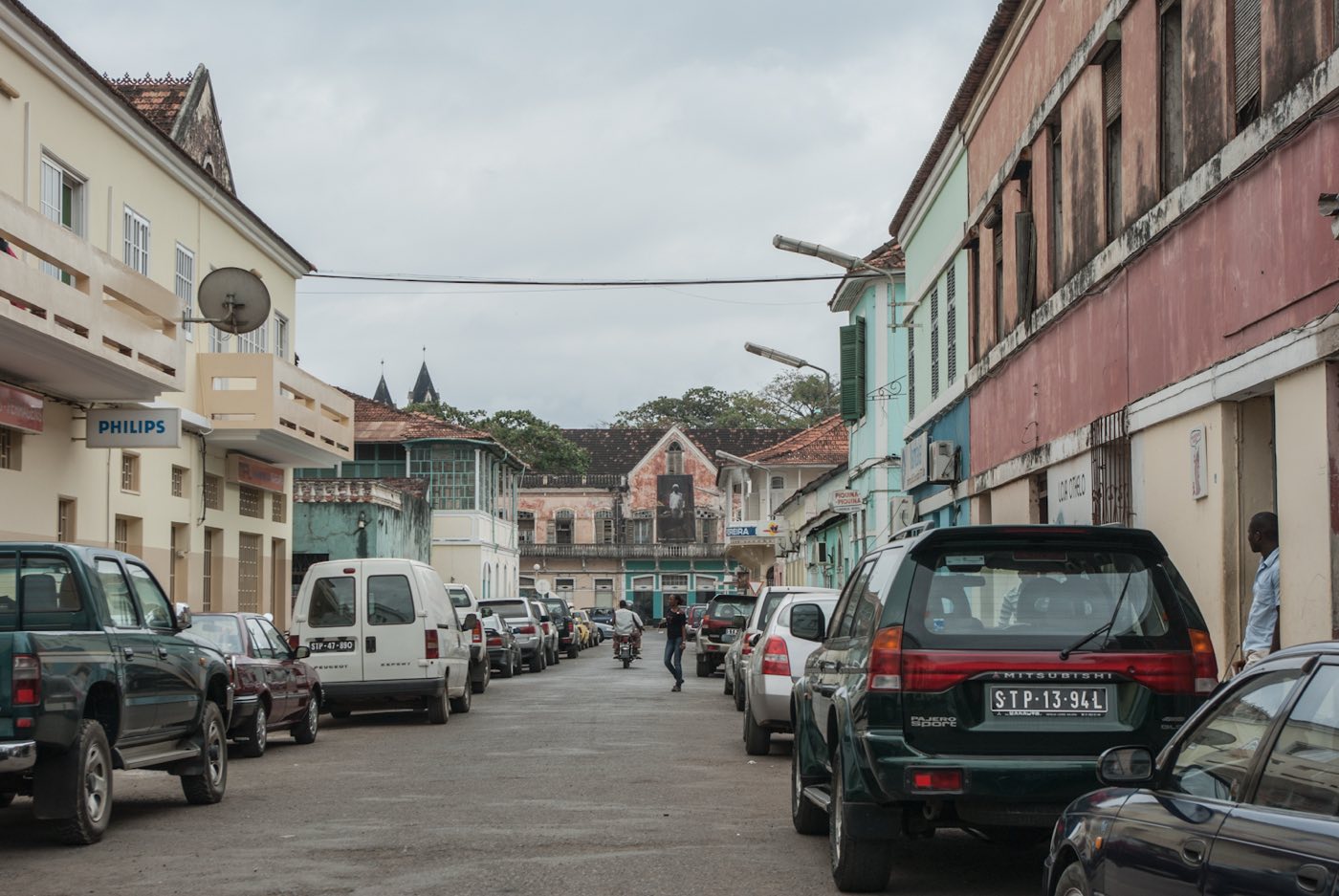
Sao Tome and Principe
- Capital
- São Tomé
- Population
- 228K
- Currency
- STN
- Languages
- Portuguese
Overview
A two-island nation in the Gulf of Guinea, about 150 miles off the Gabonese coast, set squarely on the equator and among the smallest countries in Africa. Sao Tome and Principe was a Portuguese colony for nearly five centuries, and the signature of that era is still everywhere — crumbling roças, the old plantation estates that once ran the global cocoa trade, and a relaxed Lusophone creole culture that has as much in common with Cabo Verde as with the African mainland. What the islands have in quantity is unspoiled landscape. The rainforest of Obo National Park covers most of the interior and climbs to volcanic peaks wrapped in cloud; Pico Cão Grande, a basalt needle rising 300 meters from the jungle floor, is the signature image. Beaches are empty by default — wide curves of black or golden sand fringed by coconut palms and, on Principe especially, framed by granite monoliths dropping into calm bays. In the water, humpback whales pass through from July to October and green and hawksbill turtles nest on the southern beaches from late year through March. This is slow, quiet travel. English is rare; Portuguese opens doors. Infrastructure is modest — one paved ring road per island, a handful of eco-lodges and restored roças converted to hotels, limited ATMs. Expect to pay in euros or dobras, bring malaria prophylaxis, and give yourself a week to let the pace settle. What you get back is one of the few corners of equatorial Africa that still feels undiscovered.
Things to Do
Pico Cão Grande volcanic needle
A volcanic plug rising 300 meters straight out of the southern rainforest of Sao Tome, the Great Dog's Peak is the country's defining image and one of the most photogenic rock formations in Africa. The standard experience is a viewpoint hike from the Praia Xixi or Monte Pico areas, with the needle appearing between trees as you round bends in the trail. Summiting requires technical climbing and is rarely attempted; most travelers are content with the half-day trek, a guide, and a cold Rosema beer afterward at Roça Porto Alegre.
Praia Banana and Praia Jale beaches
Praia Banana on Principe is a crescent of golden sand curving between two forested headlands, often listed among the most photographed beaches in Africa and reachable on foot from the island's Bom Bom Resort or by boat. Praia Jale on Sao Tome's southeast coast is longer, wilder, and an important nesting site for sea turtles — stay the night at the simple community lodge run by Mares program and you can see green turtles coming ashore under red-filtered torchlight. Both beaches are swimmable, calm, and essentially empty.
Obo National Park rainforest
The park covers about 30% of Sao Tome and nearly 80% of Principe, protecting endemic bird species (the Sao Tome grosbeak, the Principe thrush), gigantic begonias, and the old-growth forest that Portuguese planters cleared around the edges but left intact at altitude. Guided day hikes leave from Bom Sucesso on Sao Tome into the Lagoa Amelia crater area, and from Principe's interior villages into the forest around Pico de Principe. Bring rain gear; it drizzles at altitude most days.
Roça plantation heritage tours
Starting in the 19th century, Portuguese settlers covered the islands in roças — plantation estates with their own hospitals, chapels, workers' quarters, and processing halls, many run with indentured labor from Cabo Verde and Angola. Some are ruined, some restored into hotels or cultural centers. Roça Agostinho Neto near the capital, Roça Sundy on Principe (where Einstein's relativity was confirmed during the 1919 eclipse), and Roça Água Izé on Sao Tome's east coast are the most visited. Go with a local guide who can explain the colonial history honestly.
Sao Tome colonial town center
The capital is a small port city of pastel-painted Portuguese architecture, a neoclassical cathedral, and a waterfront market that runs on fish brought in at dawn. Walk from the Praça da Independência past the Presidential Palace to the old fort of São Sebastião, now the National Museum, and down to the market for a plate of calulu or moqueca at a lunch kiosk. The city is compact enough to cover in half a day and pleasant in the evening, when the heat eases and locals gather on the seawall.
Principe Island UNESCO Biosphere Reserve
The smaller island, a 35-minute STP Airways flight from Sao Tome, is an entire UNESCO-recognized biosphere with a population of around 8,000 and a pace even quieter than its larger sibling. Granite monoliths (the Seven Stones, Pico Papagaio) rise out of rainforest, beaches run empty for miles, and the tiny capital of Santo António is hardly more than a church and a few streets. HBD Principe runs most of the tourist infrastructure; a three- or four-night stay is the sweet spot for most visitors.
Boca de Inferno blowhole
On the south coast of Sao Tome near São João dos Angolares, the Mouth of Hell is a natural lava tunnel where incoming swells compress and shoot seawater 15 or 20 meters into the air. It's a quick stop on the coastal road south from the capital, best combined with lunch at João Carlos Silva's acclaimed open-kitchen restaurant at Roça São João — one of the genuine culinary experiences on the island, where the Portuguese-trained chef cooks whatever came in that morning.
When to Go
June to September is the gravana, the main dry season, with cooler temperatures, less rain, and the best hiking and road conditions. July to October is humpback whale season, with boat trips from Sao Tome or Principe finding mothers and calves in calm water. A shorter second dry season runs from mid-December to mid-February and coincides with the peak of sea-turtle nesting on the south-coast beaches. The wet months from March to May bring afternoon downpours and some roads become difficult, though the forest is at its most lush and birdwatching excellent.
Getting Around
A single paved ring road circles Sao Tome, making self-drive or hired-car-with-driver the most practical way to explore. Rental cars are available in the capital; a 4x4 helps for some of the roças and south-coast beaches where roads deteriorate. Shared taxis and minibuses (táxi coletivo) serve most routes cheaply but run on their own schedules. A daily 35-minute flight on STP Airways connects Sao Tome to Principe; book well ahead as the small planes fill quickly. On Principe, distances are short and most hotels arrange transfers and day trips. Taxis in the capital are cheap but negotiate fares before getting in — there are no meters.
Cost & Currency
The local currency is the dobra (STN), pegged to the euro at 24.5 to 1, so euros are accepted almost universally — carry them rather than dollars. Costs are mid-range for Africa: expect €80–€150 a night for a comfortable hotel or restored roça on Sao Tome, €200–€500 at the handful of upscale lodges on Principe, €8–€15 for a full plated meal of fish and breadfruit at a local restaurant, and around €20–€35 for a taxi across the main island. Cards are accepted only at upscale hotels; ATMs are limited and unreliable, so bring enough cash in euros for your stay. Tipping is modest — round up and add a euro or two per person for good service.
Frequently Asked Questions
- Do I need a visa to visit Sao Tome and Principe?
- Visitors from the US, EU, UK, and most other Western countries can apply for an e-visa online in advance (about €25 and usually granted within a week), or get a visa on arrival at Sao Tome airport for a similar fee. You'll need a passport valid for six months, proof of onward travel, and proof of accommodation. A yellow fever vaccination certificate is required for entry regardless of where you are coming from.
- What language do people speak?
- Portuguese is the official language and is spoken by virtually everyone; local creole Forro and Principense are used informally. English is uncommon outside the handful of upscale hotels, so a working knowledge of Portuguese — or at least a phrasebook — makes travel significantly smoother. Spanish speakers often get by reasonably well. Younger Santomeans in the tourism industry are increasingly comfortable in English.
- Is Sao Tome and Principe safe?
- Yes, the country is one of the safest in Africa, with very low violent crime and a relaxed, welcoming culture. Petty theft from unattended bags is the main concern in the capital's market and on public beaches; keep valuables in a hotel safe. Driving at night is hazardous because of unlit roads, livestock, and pedestrians. No specific areas require avoidance.
- Do I need malaria prophylaxis?
- Yes. Both islands are malaria zones and prophylaxis is strongly recommended — see a travel clinic before departure for a prescription. Use insect repellent with DEET, sleep under a mosquito net (most hotels provide them), and cover up at dawn and dusk. Dengue fever is also present at lower levels. A yellow fever vaccination is legally required and you will be asked for your certificate on arrival.
- Is it worth flying to Principe or should I just stay on Sao Tome?
- If you have a week or more, flying to Principe for at least three nights is worth it — the smaller island is a UNESCO biosphere, the beaches are emptier, and the sense of remoteness is genuine. If you have less than five days, stick to Sao Tome, where you can cover the national park, the southern beaches, and the old roças without losing a day to inter-island flights. The 35-minute STP Airways flight runs daily but occasionally gets cancelled for weather.
Plan a Trip to Sao Tome and Principe
Have you been to Sao Tome and Principe?
Track 195 countries, 50 states & 63 national parks on your map