Romania
- Capital
- Bucharest
- Population
- 19M
- Currency
- RON
- Languages
- Romanian
Overview
A Carpathian country where wolves still roam the forests, painted Byzantine monasteries hide in mountain valleys, and Dracula folklore keeps its grip on Transylvania's gothic silhouettes. Travelers come for Bran Castle's steep roofs and moody turrets, the frescoed walls of Bucovina, the Danube Delta's labyrinth of reed channels, and Bucharest's layered Belle Époque and communist-era architecture. What distinguishes Romania is how intact its rural life still feels. In Maramureș and the Apuseni you'll pass hay wagons pulled by horses on paved roads, and the old wooden churches with needle-thin spires are still used for Sunday services. The Saxon villages scattered across Transylvania — Viscri, Biertan, Sighișoara — are preserved because time largely skipped them, and walking between them on marked footpaths is one of Europe's best low-key hiking experiences. Romania rewards travelers who like their cities complicated, their food heavy, and their landscapes still wild enough to matter. Expect stews thick with smoked pork and dill, coffee that comes dark and strong, and evenings that go on over house wine in small restaurants in Brașov or Sibiu. The roads can surprise you — the Transfăgărășan and Transalpina are among the most dramatic drives in Europe — and the people you'll share them with are warmer than the country's reputation suggests.
Things to Do
Bran Castle (Dracula's Castle) in Transylvania
The 14th-century fortress at Bran perches on a rock above a mountain pass and has become forever linked with Bram Stoker's Dracula, though Vlad the Impaler's actual connection is thin. The rooms are small, the stairs are narrow, and the castle's real interest is the improvised, asymmetric layout — a working fortified customs post rather than a grand palace. Pair it with a drive through Râșnov and Brașov; the three sit within an hour of each other and make for a full day of Transylvanian medieval sites.
Painted Monasteries of Bucovina
In northeastern Romania, half a dozen 15th- and 16th-century Orthodox monasteries carry elaborate frescoes across their exterior walls — biblical scenes painted in blues, reds, and greens that have survived five centuries of Carpathian winters. Voroneț is the most famous for its intense cobalt, Sucevița for its completeness, and Humor for its warmth. They are working monasteries, so dress modestly, move quietly, and time your visits outside of service hours.
Danube Delta birdwatching by boat
Where the Danube finally meets the Black Sea, it splits into a 3,500-square-kilometer maze of channels, reedbeds, and floating islands that shelters more than 300 bird species. You explore it by small boat from Tulcea, sleeping in floating guesthouses or in fishing villages like Sfântu Gheorghe and Mila 23. Spring brings pelicans and herons in clouds, summer adds warm swims in the delta's backwaters, and September is the quietest time to go.
Sibiu's medieval old town
A Saxon-founded city in central Transylvania with two levels — an upper town of pastel guild houses around three interconnected squares, and a lower town of workshops and tanneries along the river below. The rooflines are what you remember: dormer windows shaped like half-closed eyes that gave the city its nickname. Spend an evening on Piața Mare, climb the Council Tower, and don't skip the Brukenthal Museum, one of Europe's oldest public art collections.
Brașov's Black Church and Council Square
Brașov sits in a valley ringed by the Carpathian peaks and its Piața Sfatului is one of Europe's better-preserved medieval squares. The Black Church, named for the smoke stains of a 1689 fire, is the largest Gothic church between Vienna and Istanbul and holds a remarkable collection of Ottoman prayer rugs given by Transylvanian Saxon merchants. Ride the cable car up Tâmpa mountain for the Hollywood-style BRAȘOV sign and the best view of the red-roofed old town.
Sighișoara's fortified medieval citadel
One of the few still-inhabited medieval citadels in Europe, Sighișoara climbs a hill in the middle of Transylvania and can be walked across in twenty minutes. The Clock Tower dominates the skyline, the covered wooden Scholars' Stairs climb to the church on the hill, and Vlad the Impaler was reputedly born in the yellow house near the entrance. Stay overnight — day-trippers leave by five and the citadel becomes unexpectedly quiet as the light drops.
Peleș Castle in Sinaia
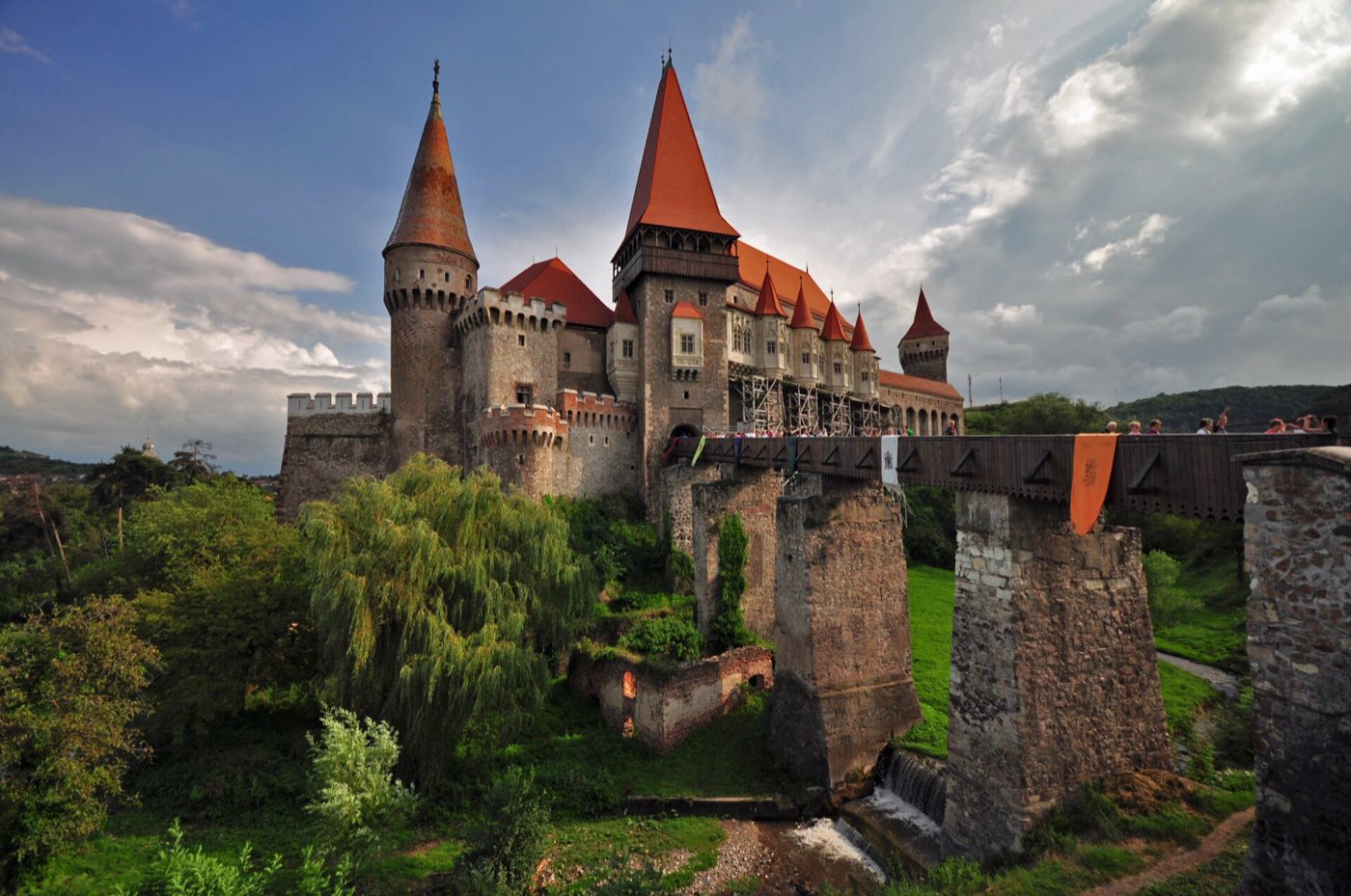
Romania's 19th-century royal summer residence sits above Sinaia in the Carpathian foothills, its turrets and timbered balconies modeled on German Renaissance palaces. Inside is more impressive than the exterior — 160 rooms of carved walnut, Murano glass, and Moorish tilework that Carol I assembled as a statement of young Romanian statehood. It's an easy two-hour train or drive from Brașov or Bucharest, and the surrounding Prahova Valley is a jumping-off point for Bucegi Mountains hiking.
Transfăgărășan Highway drive
Built on Ceaușescu's orders in the 1970s and open only from June through October, the Transfăgărășan climbs the Făgăraș Mountains in a series of hairpins that Top Gear once called the best driving road in the world. The pass tops out at 2,042 meters at Bâlea Lake, where a glacial tarn and a 1970s cable-car restaurant sit together strangely. Drive it from south to north for the more dramatic approach, and start early — afternoon fog and weekend traffic can stall the whole route.
When to Go
May to early October is the stretch to aim for, with the warmest weather from late June through August and long evenings for terrace dinners in Sibiu and Brașov. The Transfăgărășan and Transalpina only open reliably from mid-June to October — plan around that if a mountain drive matters to you. September brings wine harvests in the Dealu Mare and Cotnari regions and the first crisp nights in the Carpathians. December is worth considering for the Christmas markets in Sibiu and Brașov, and the snow-piled Saxon villages look better than any postcard.
Getting Around
Trains are the right call between major cities, though the network is slower than Western Europe's — Bucharest to Brașov takes about two and a half hours, and CFR Călători sells cheap advance tickets online. Renting a car opens up the best of Romania: the Saxon villages of Transylvania, the Bucovina monasteries, and the Transfăgărășan all need four wheels to reach properly. Roads are mostly paved but rural ones can surprise you with horse carts and potholes; drive defensively and avoid night driving in the countryside. Bucharest's metro is cheap and clean, and ride-hailing via Bolt or Uber covers most city travel for a few euros a trip.
Cost & Currency
Romania uses the Romanian leu (RON), with roughly 4.9 lei to the euro, and remains one of the EU's best travel values. Expect 15–25 lei for an espresso and pastry, 50–90 lei for a sit-down lunch of sarmale or mici with a beer, and 250–450 lei per night for a comfortable mid-range guesthouse in Brașov or Sibiu. Cards are widely accepted in cities but carry 100–200 lei in cash for rural guesthouses, monasteries, and markets. Tipping is gentle — round up at a café, leave 10% at a sit-down dinner, and tip drivers a few lei per bag. Fuel is cheaper than the EU average, which helps if you rent a car for a week or two.
Frequently Asked Questions
- Do I need a visa to visit Romania?
- US, UK, Canadian, Australian, and EU citizens do not need a visa for stays up to 90 days. Romania joined the Schengen Area for air and sea travel in March 2024, so flights from Schengen countries no longer involve passport control — though land borders with Hungary and Bulgaria still retain some checks as of 2026.
- Is Romania safe for travelers?
- Yes, Romania is generally safe and violent crime against tourists is very rare. Watch for pickpocketing around Bucharest's Gara de Nord train station and on crowded trams, and be cautious with taxi fares at the airport — use Bolt or the official Black Cab app to avoid overcharging. Stray dogs in rural areas can be a nuisance; give them space.
- Do people speak English?
- English is widely spoken by younger Romanians, in Bucharest, Cluj, and any tourist-facing business. In rural villages, Saxon communities, and among older people, you'll do better with French, German, or Italian, which many Romanians understand. A few polite phrases in Romanian — bună ziua, mulțumesc — go a long way anywhere.
- How long should I plan for a first trip?
- Ten days is a comfortable first visit — two nights in Bucharest, three or four in Transylvania splitting between Brașov and Sibiu with day trips to the Saxon villages, and the rest in Bucovina for the painted monasteries. Add three more days if you want to include the Danube Delta, which is remote enough to deserve its own stretch.
- Should I rent a car in Romania?
- Yes, if you want to explore Transylvania beyond the main cities or drive the Transfăgărășan and Transalpina passes. Trains and buses connect the major hubs fine, but the Saxon villages, Apuseni Mountains, and Maramureș really need a car. Roads are paved but watch for horse carts, unmarked livestock, and aggressive passing on two-lane highways.
Plan a Trip to Romania
Have you been to Romania?
Track 195 countries, 50 states & 63 national parks on your map