Pakistan
- Capital
- Islamabad
- Population
- 230M
- Currency
- PKR
- Languages
- Urdu, English
Overview
A South Asian country stretched between the Karakoram and the Arabian Sea, Pakistan contains the world's second-highest peak, the ruins of an Indus Valley civilization older than Egypt's pyramids, and Mughal capitals whose mosques still define what scale means in brick and tile. Travelers come for trekking under K2, the Badshahi Mosque in Lahore, and the Karakoram Highway — one of the most dramatic paved roads on earth. What surprises most first-time visitors is the hospitality. You will be offered chai in shops you did not intend to enter, invited to weddings by people you met on a bus, and adopted by families in Hunza who will not let you pay for a meal. The food is a reason to come on its own — charred nihari in Lahore, apricot-oil pilafs in Gilgit, chapli kebabs in Peshawar — and the tea is constant. You will need to plan more carefully than in most destinations. Security situations vary by province, infrastructure in the north can fail suddenly, and paperwork for restricted areas takes time. Khyber-Pakhtunkhwa's tribal districts and much of Balochistan carry serious travel advisories and should only be approached with specialist tour operators or not at all. Punjab, Islamabad Capital Territory, and Gilgit-Baltistan are the safer regions where most independent travelers spend their trips, and these alone hold enough mountains, mosques, and ruins for a month.
Things to Do
Hunza Valley and Karimabad views of Rakaposhi
The Hunza Valley sits at around 2,400 meters in Gilgit-Baltistan, an arc of terraced apricot and cherry orchards under the sheer white wall of Rakaposhi. Base yourself in Karimabad, where Baltit Fort rises on a spur above the village and the morning light on the peak across the valley is reason enough to come. Walk up to Duikar in the afternoon for the sunset view, and try to time the trip for late March and early April when the blossoms open — or for autumn, when the poplars turn gold against the snow line.
Lahore's Badshahi Mosque and Walled City food street
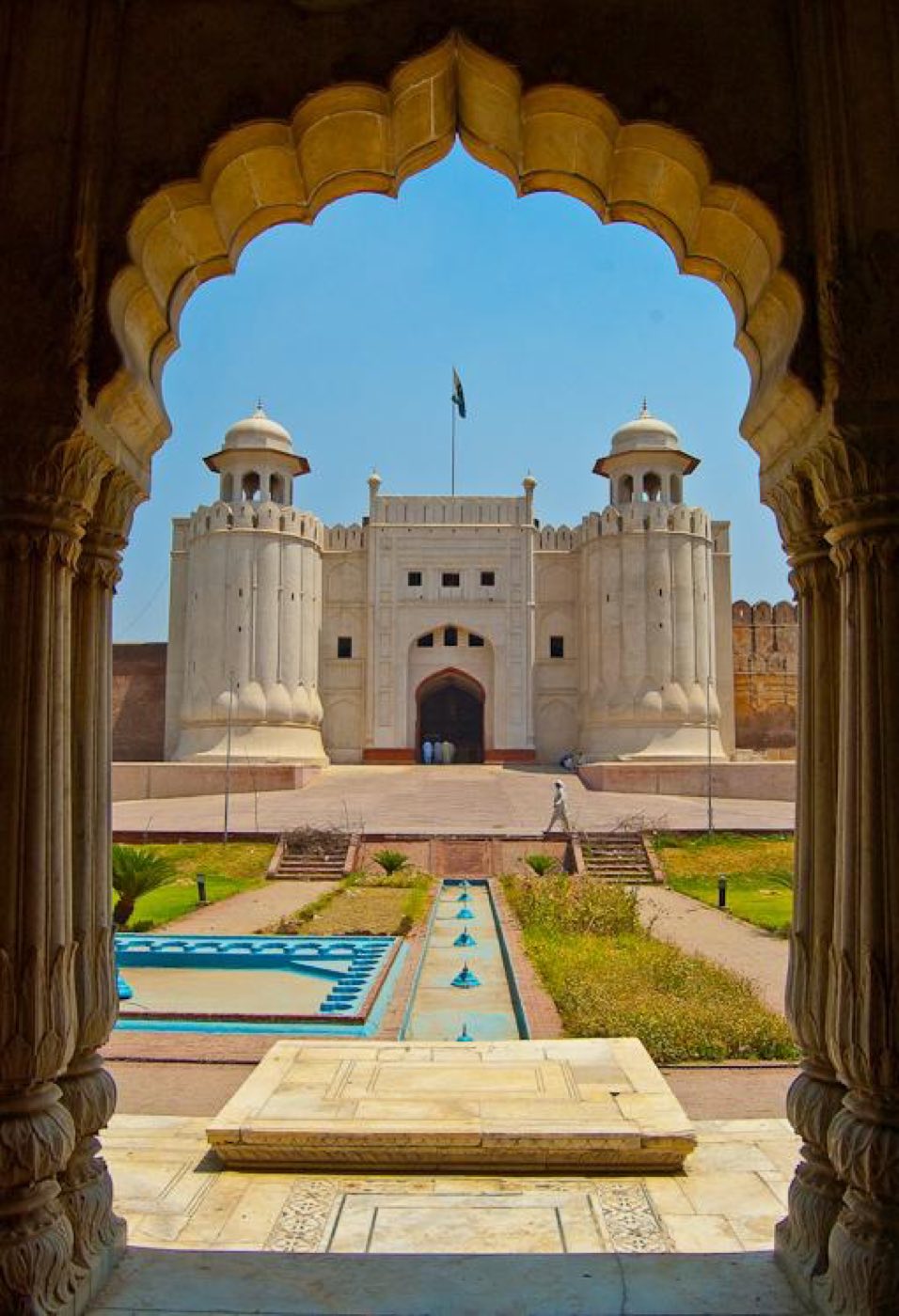
The Badshahi Mosque was the largest in the world when Aurangzeb finished it in 1673, and standing in its red sandstone courtyard at dusk is still one of the great architectural experiences in the subcontinent. Pair it with Lahore Fort across the square, and then walk into the Walled City for dinner on Fort Road Food Street — rooftop tables face the mosque while you eat mutton karahi and naan pulled hot from the tandoor. Old Lahore is the country's culinary capital and you should eat twice a night.
K2 base camp trek in the Karakoram
The trek to K2 base camp is a serious three-week expedition from Skardu over the Baltoro Glacier, past the granite towers of Trango and Masherbrum, and onto Concordia — where four of the world's fourteen eight-thousand-meter peaks stand in a single amphitheater. You need a licensed trekking operator, a permit, porters, and real mountain experience; altitude above 4,500 meters is constant for days. Go in July or August when the passes are open and the weather gives you the best chance of clear mornings at Concordia.
Mohenjo-daro ancient Indus Valley ruins
In rural Sindh, five hours north of Karachi, the excavated streets of Mohenjo-daro lay out a city that was planned in grids, plumbed with drains, and housing tens of thousands of people when Stonehenge was still new. The Great Bath and the granary are the set-piece ruins, but the quieter impact is walking blocks of two-story brick foundations and understanding that urban civilization happened here before it happened most places. Pair with the museum on-site, and go early — Sindh gets brutally hot by mid-morning.
Fairy Meadows and Nanga Parbat views
The meadow at 3,300 meters is the classic front-row view of Nanga Parbat, the ninth-highest peak on earth and one of the most lethal. You reach it by a jeep ride off the Karakoram Highway that is genuinely nerve-shredding, then a three-hour hike up from Tattu village. Stay two nights in one of the wooden cabins, hike up toward Beyal Camp on the second morning for a closer angle on the Rupal face, and accept that at 3,500 meters the stars at night outnumber anything you have seen.
Skardu and Shangrila Resort
Skardu is the gateway town for the Baltoro trek and worth time in its own right — the Shigar Valley with its wooden-balconied fort converted into a Serena hotel, the cold-water lakes at Kachura and Satpara, and the sand dunes along the Indus that sit implausibly against snowcapped ranges. Shangrila Resort on Lower Kachura Lake is the old-fashioned stop: log cabins around a bright green lake, an honest Pakistani-Chinese menu, and walks that end before sunset with the peaks catching the last light.
Karakoram Highway drive
The KKH runs over 1,300 kilometers from Hasan Abdal near Islamabad up to the Khunjerab Pass at 4,693 meters on the Chinese border — the highest paved international crossing in the world. You can hire a car with driver in Islamabad and do the northern half in about a week, with stops in Besham, Chilas, Gilgit, Karimabad, and up to Sost. The road hugs the Indus for much of it, threads through the Nanga Parbat massif, and at Jaglot gives you the view where the Karakoram, Himalaya, and Hindu Kush meet.
Taxila Buddhist ruins
An hour west of Islamabad, Taxila is a UNESCO site where a Gandharan Buddhist civilization flourished between the 5th century BCE and the 5th century CE, leaving monasteries, stupas, and a museum full of gray-schist Buddha heads that show how Greek sculptural technique reached South Asia after Alexander. Walk Dharmarajika, Jaulian, and Sirkap in a half-day with a guide — the site is sprawling and the context matters. It pairs well with an afternoon back in Islamabad at Faisal Mosque and the Margalla Hills.
When to Go
April through June and September through October are the best stretches for combined itineraries — northern valleys have opened up, the plains have not yet hit 45°C, and the light is clean in Lahore and Islamabad. July and August are prime trekking months in the Karakoram when the passes above 4,500 meters are reliable, but the same weeks are monsoon in Punjab and Sindh, where flooding on roads and heat in cities make travel uncomfortable. Late March and early April bring the Hunza blossom, arguably the most beautiful time to be in the north. December through February is cold in the mountains — many roads close — but excellent for Lahore, Multan, and Karachi sightseeing.
Getting Around
Domestic flights are the realistic choice for the long north-south distances: PIA and private carriers connect Islamabad with Skardu, Gilgit, Karachi, and Lahore in under ninety minutes each, though mountain flights cancel routinely in cloud. Trains on the main Karachi–Lahore–Rawalpindi line are atmospheric and cheap; book the air-conditioned business class for overnight runs. For the north, a private car with driver is the norm — roads along the Karakoram Highway require experience, altitude, and patience for landslides. Within cities, Careem and inDrive rideshare apps work well in Islamabad, Lahore, and Karachi. Buses and shared vans cover everywhere else inexpensively, though foreign travelers generally find it easier to hire transport for longer hauls.
Cost & Currency
Pakistan uses the Pakistani rupee (PKR) and is one of the cheapest major destinations in Asia. A sit-down plate of biryani or karahi costs 600–1,200 PKR (around $2–$4), a mid-range hotel room in Lahore or Islamabad runs 8,000–18,000 PKR, and a guesthouse in Karimabad can be had for 4,000–7,000 PKR in shoulder seasons. Rideshare in cities rarely exceeds 500 PKR for cross-town rides. Cards are accepted at international chains and larger restaurants in Islamabad, Lahore, and Karachi, but cash is king everywhere else — ATMs work reliably in cities but not always in the north, so stock up before leaving Gilgit. Tipping is modest: round up at restaurants, 200–500 PKR per day to drivers and guides is appreciated.
Frequently Asked Questions
- Is Pakistan safe for travelers?
- It depends sharply on region. Punjab (Lahore, Islamabad, Multan) and Gilgit-Baltistan (Hunza, Skardu, Fairy Meadows) are the areas where most independent travelers spend their trips without incident. Khyber-Pakhtunkhwa's tribal districts and much of Balochistan remain under serious travel advisories from most Western governments, and Sindh outside Karachi requires local guidance. Check your government's advice close to travel and use a licensed tour operator for anything off the main tourist circuit.
- Do I need a visa to visit Pakistan?
- Yes — most nationalities need a visa, but Pakistan's e-visa system is now reasonably functional for over 175 countries and can be applied for online with a typical 7–10 day turnaround. Some nationalities can get visa-on-arrival for tourism at major airports. Bring a printed e-visa and onward ticket, and check requirements for restricted areas like Azad Kashmir, which require additional permits.
- Can women travel independently in Pakistan?
- Yes, and increasing numbers do, but expect more attention than in most destinations. Dressing modestly (shalwar kameez or long loose clothing, a scarf for mosques) cuts down on stares considerably, and the north — Hunza and Skardu in particular — is relaxed and comfortable for solo women travelers. In Punjab and Karachi, female travelers tend to prefer mid-range or upscale hotels and app-based transport over street-flagged rickshaws, especially after dark.
- Do I need special permits for the north?
- For most of Gilgit-Baltistan, including Hunza, Skardu, Fairy Meadows, and travel along the Karakoram Highway to Khunjerab, no special permit is needed — just your passport and visa. For trekking permits on high peaks (K2 base camp, Gondogoro La), you need a licensed tour operator to arrange them. Certain border zones and Azad Kashmir require a No Objection Certificate (NOC) from the Ministry of Interior; your tour operator handles this.
- Is the tap water safe to drink?
- No — stick to bottled or filtered water throughout Pakistan, including in major hotels. Waterborne illness is a real risk and even locals in cities generally drink filtered water. Bottled water is cheap and sold everywhere. Carry a filter bottle or SteriPen for trekking days when bottled supplies are uncertain.
Plan a Trip to Pakistan
Have you been to Pakistan?
Track 195 countries, 50 states & 63 national parks on your map