North Macedonia
- Capital
- Skopje
- Population
- 1.8M
- Currency
- MKD
- Languages
- Macedonian
Overview
A small landlocked country in the southern Balkans, North Macedonia is built around one of Europe's deepest and oldest lakes and one of its strangest, most rebuilt capital cities. Most trips centre on Lake Ohrid — a 358-meter-deep tectonic lake older than three million years, dotted with Byzantine churches and monasteries on its limestone shores — and on Skopje, where a state-led rebuilding campaign in the 2010s filled the city centre with neoclassical facades and oversized statues in a scheme Macedonians themselves are still divided about. Between Ohrid and Skopje is a country of mountains most European travelers have never heard of. The Shar range on the Kosovo border, Mavrovo National Park to the west, and the Pelister pine forests in the south are all serious hiking country with almost no crowds, waymarked trails, and village konaks (guesthouses) offering bed and a home-cooked dinner for €30 or less. Matka Canyon outside Skopje is an easy half-day of kayaking or cave exploration. The food is rewarding — ajvar red pepper relish, grilled peppers, smoked trout from Ohrid, and the same strong Turkish coffee you find across the Balkans. North Macedonia rewards travelers who want the Balkans without the crowds of Croatia or the paperwork of Albania. English is widely spoken by younger Macedonians, the country uses the Macedonian denar rather than the euro (though euros are accepted in many tourist contexts), and the post-2019 name change and NATO membership have opened up easier access from Western Europe. A week gets you Skopje, Ohrid, and a serious day or two in the mountains.
Things to Do
Lake Ohrid and Church of St. John at Kaneo
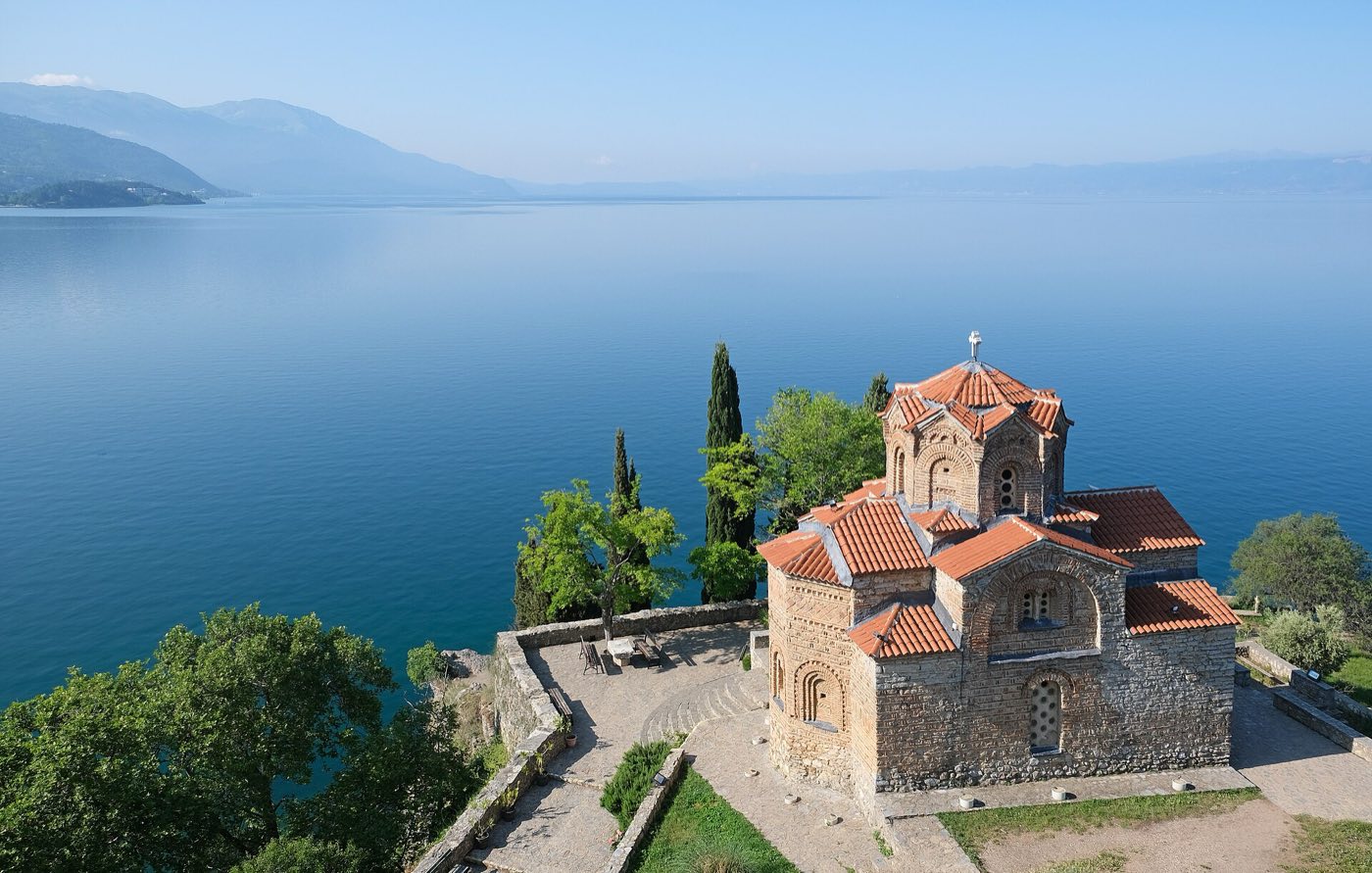
The small 13th-century Byzantine church of St. John the Theologian sits on a low rocky headland above Lake Ohrid, and it is the image that shows up on every postcard of the country — stone walls, red-tile roof, the lake stretching away toward Albania in the background. The old town of Ohrid climbs the hillside above with cobbled lanes, Ottoman-era houses, and around 365 churches in the wider area (one for every day of the year, locals will tell you). Swim from the pebble coves below Kaneo; eat smoked trout at a terrace taverna afterward.
Skopje's Old Bazaar and Stone Bridge
The Stone Bridge over the Vardar River has connected Skopje's north and south banks since at least the 15th century, and crossing it still marks the shift from the neoclassical Skopje 2014 government quarter into the Old Bazaar — the largest Ottoman-era çarşı in the Balkans outside Istanbul. The bazaar is a working grid of alleys with silversmiths, tea houses, tiny grilled-meat restaurants, a 15th-century hammam now used as an art gallery, and two caravansaries. Afternoon and evening are when it comes alive; the rakija starts flowing around seven.
Matka Canyon kayaking and cave exploration
Twenty minutes by car from central Skopje, the Treska River carves a steep limestone canyon that has been dammed into a long narrow reservoir perfect for kayaking. You rent a plastic kayak from the dock by the Hotel Canyon Matka for a few euros an hour and paddle into shadowed stretches past three medieval monasteries and the entrance to Vrelo Cave, one of the deepest underwater caves in Europe and still not fully mapped. A boat tour into the lit portion of the cave takes about 15 minutes if you prefer not to paddle.
Mavrovo National Park and ski resort
The country's largest national park covers 730 square kilometers of the western mountains against the Albanian border, and in winter the village of Mavrovo supports the country's main ski resort — modest by Alpine standards but genuinely good value with lift tickets around €20. In summer the park is hiking country: Mount Korab at 2,764 meters is the highest peak in both North Macedonia and Albania, and the half-submerged church of St. Nicholas in Lake Mavrovo, its steeple poking from the water, is one of the more photographed sights in the country.
Bay of Bones reconstructed pile-dwelling village
On the eastern shore of Lake Ohrid near the village of Peshtani, the Bay of Bones is a full-scale reconstruction of a prehistoric settlement from around 1,200 BCE — wooden houses standing on stilts over the lake water, reached by a long pier, with a small museum on shore covering the underwater archaeology that turned up around 6,000 wooden pile fragments on the lake bed. It is a slightly hokey but genuinely engaging hour, especially if you pair it with a boat trip down the lake from Ohrid town.
St. Naum Monastery on the Albanian border
At the southern end of Lake Ohrid, just before the Albanian border crossing, the monastery of St. Naum was founded in 905 CE and has been rebuilt many times since. The current church holds beautiful 16th-century frescoes and the tomb of St. Naum himself, and the grounds are patrolled by peacocks that have become unofficial mascots. Springs nearby feed the lake with startlingly clear turquoise water; a 20-minute boat ride from the monastery takes you to their source. Easy day trip from Ohrid town.
Bitola's Heraclea Lyncestis Roman ruins
The second city of the country, Bitola sits in the southern plain near the Greek border and keeps a pleasant Ottoman-era main street called Shirok Sokak with pastel facades and café terraces. A kilometer south of the centre, Heraclea Lyncestis is a Roman and early Byzantine site founded by Philip II of Macedon in the 4th century BCE — theater, basilicas, and some of the most intact 6th-century floor mosaics in the Balkans. It is usually quiet even on summer afternoons, and worth the 90-minute drive from Ohrid.
When to Go
May, June, and September are the sweet spots — warm days, cool nights, swimming weather at Ohrid, and none of the August crowd pressure from regional holidaymakers. July and August are the peak tourist months at Lake Ohrid, when Macedonian and Serbian families descend on the shore and prices double; the Ohrid Summer Festival runs through July and early August and brings classical music and theater to the Church of St. Sophia and other venues. Winter is cold across the country and snowy in the mountains; Mavrovo ski season runs December through March. Skopje is pleasant any time from April through October.
Getting Around
Buses handle the backbone of travel: Skopje to Ohrid takes about three hours on the direct service and there are a dozen departures a day. Bitola, Tetovo, Prilep, and Struga are all reachable by bus from the Skopje central station, and prices are low — under €10 for most intercity routes. Trains are slower and run on a limited network. Renting a car is worthwhile if you want to get into the Mavrovo or Pelister mountains or follow the lake shore properly; roads are good by Balkan standards and signage is bilingual (Cyrillic and Latin). Within Skopje, the city bus network covers most sights and taxis are cheap. Uber does not operate, but local apps like Taxi Naše Maalo work for shorter hops.
Cost & Currency
North Macedonia uses the Macedonian denar (MKD), pegged to the euro at roughly 61.5 to 1 — €1 is about 61 MKD. The country remains one of the cheapest in Europe: expect 200–400 MKD (€3–€7) for a sit-down lunch of grilled meat or a full Macedonian salad, 1,500–3,500 MKD (€25–€60) a night for a comfortable mid-range hotel in Skopje or Ohrid, and 50–100 MKD for a local beer. Cards are accepted in most hotels, restaurants, and larger shops in Skopje and Ohrid; bring cash for the mountains, smaller towns, and local transport. ATMs are widespread. Euros are often accepted at tourist-facing businesses but change rates are not always favorable. Tipping 5–10% at restaurants is appreciated but not expected.
Frequently Asked Questions
- Do I need a visa to visit North Macedonia?
- No — citizens of the EU, US, UK, Canada, Australia, and most other developed countries can enter visa-free for up to 90 days in any 180-day period. You need a passport valid for at least three months beyond your intended stay. North Macedonia is not yet in the EU or Schengen, so it counts as a separate stay from your Schengen allowance, which is useful if you are on a long European trip.
- Is English widely spoken?
- Yes, particularly by Macedonians under 40 and in any tourist context — hotels, restaurants, taxis in Skopje and Ohrid, and tour operators. Older generations often speak better German or Italian than English. Macedonian uses the Cyrillic alphabet, but street signs and restaurant menus in tourist areas are generally bilingual. Learning the Cyrillic letters takes a couple of hours and makes bus timetables and small-town signs much easier to read.
- How long should I plan for a first trip?
- A week is a comfortable first visit — two nights in Skopje, three nights in Ohrid, and a couple of days for Matka Canyon plus either Bitola and Pelister to the south or Mavrovo to the west, depending on whether you are more interested in Roman ruins or alpine hiking. Five days is tight but workable if you focus on Skopje and Ohrid and skip the mountains. Ten days gets you properly into the hiking country.
- Is it safe to travel in North Macedonia?
- Yes — the country has low violent crime rates and is one of the safer destinations in the Balkans for travelers. Petty theft in Skopje's Old Bazaar and around the main bus station is the most common issue; standard urban precautions handle it. Driving standards can be aggressive on mountain roads. The border regions with Kosovo and Serbia are calm now but crossings occasionally have delays; check current conditions if you are routing through.
- Can I combine North Macedonia with other Balkan countries?
- Easily. Skopje has good bus connections to Pristina (Kosovo, 2 hours), Tirana (Albania, 5 hours), Sofia (Bulgaria, 6 hours), and Thessaloniki (Greece, 4 hours). The Lake Ohrid area connects to Albania by a fast border crossing at Saint Naum and a scenic drive down to Albania's Ohrid shore and onward to Tirana or the Albanian Riviera. A two-week Balkan trip combining North Macedonia, Albania, and Kosovo is one of the best overland routes in Europe.
Plan a Trip to North Macedonia
Have you been to North Macedonia?
Track 195 countries, 50 states & 63 national parks on your map