Croatia
- Capital
- Zagreb
- Population
- 3.9M
- Currency
- EUR
- Languages
- Croatian
Overview
A long, thin country wrapped around the eastern shore of the Adriatic, Croatia holds walled cities carved from white Dalmatian stone, more than a thousand islands within sailing distance of its ferry terminals, and a sea so clear you can count the stones on the bottom in three meters of water. Travelers come for the marble streets of Dubrovnik and Split, for slow boats between the islands, and for the tiered lakes and waterfalls at Plitvice. What you remember isn't any single landmark — it's the consistency. Every stretch of coast looks like the postcard version of itself. You step off a ferry in Hvar at eleven at night and the harbor is lit by lanterns and the restaurants are still serving grilled fish. You walk a ridge above the Adriatic and three small islands float on the blue below you, each one with its own ferry, its own square, its own old men playing cards in the shade. This is a country that rewards a loose itinerary. Rent a car for the interior and Plitvice, take ferries for the islands, and leave at least one afternoon genuinely empty so you can sit on a terrace with a carafe of local wine and watch the light change on limestone. A week covers the highlights. Two weeks lets the rhythm settle in properly — and that's when Croatia stops feeling like a beach holiday and starts feeling like somewhere you might want to come back to.
Things to Do
Dubrovnik's walled Old Town
The walls that ring Dubrovnik's Old Town go around almost two kilometers of high stone parapet, and walking them is the best ninety minutes you'll spend in the country. Go at opening time or within the last hour before sunset — the midday walk in July is a sweat-through-your-shirt affair. From the walls you look down onto terracotta roofs, into courtyards with lemon trees, and out over the Adriatic. Once you're off them, get lost in the limestone lanes of the lower town before the cruise ships empty out around four.
Plitvice Lakes National Park
Sixteen terraced lakes step down a forested valley in the Croatian interior, connected by waterfalls that range from trickles over moss-covered logs to the big 78-meter drop at Veliki Slap. Wooden boardwalks run directly across the water in places, so you're walking a foot above turquoise pools full of trout. Start early, plan on four to six hours, and combine it with a night in Rastoke or the Lika region rather than treating it as a day trip from the coast — the drive from Split eats the best light.
Diocletian's Palace in Split
A Roman emperor built himself a retirement palace on the Dalmatian coast in 305 AD, and the Old Town of Split still occupies the shell of it — shops and apartments and bars built into the original walls, columns, and cellars. Walk the peristyle square where Diocletian once held court, duck through the underground substructures, and have coffee in the cellar cafés carved out of what used to be storage vaults. The Riva waterfront along the palace's southern wall is where the whole city gathers at sunset.
Hvar Island nightlife and lavender fields
Hvar Town in July is where the superyachts anchor and the cocktail bars run until four, but the rest of the island is farms and lavender and old stone villages that close down by nine. Rent a scooter and head inland to Velo Grablje or Malo Grablje — abandoned lavender-growing hamlets that smell of purple flowers in June. The Pakleni Islands are a ten-minute water taxi from Hvar harbor and have the coves without the crowd, especially on the smaller islets past Palmižana.
Krka National Park waterfalls
Half the size of Plitvice and more accessible from Split, Krka's main draw is Skradinski Buk — a broad cascade where swimming was permitted until recently and the boardwalks still run you directly through the splash. Even without the swim, the walk loops past a working restored mill and old hydroelectric infrastructure. A boat continues upstream to Visovac Monastery on an island in the river, then farther to Roški Slap; combine the hike and the boat for the full day.
Sailing the Dalmatian islands
The archipelago between Split and Dubrovnik is the best bareboat or skippered sailing ground in the Mediterranean, with short hops between anchorages and predictable afternoon maestral winds. A week-long itinerary typically covers Brač, Hvar, Vis, Korčula, and Mljet — the last of which is half national park and has salt-water lakes with a monastery island inside one of them. Book in March or April for July sails; prices double between May and high season.
Zagreb's Upper Town and Dolac Market
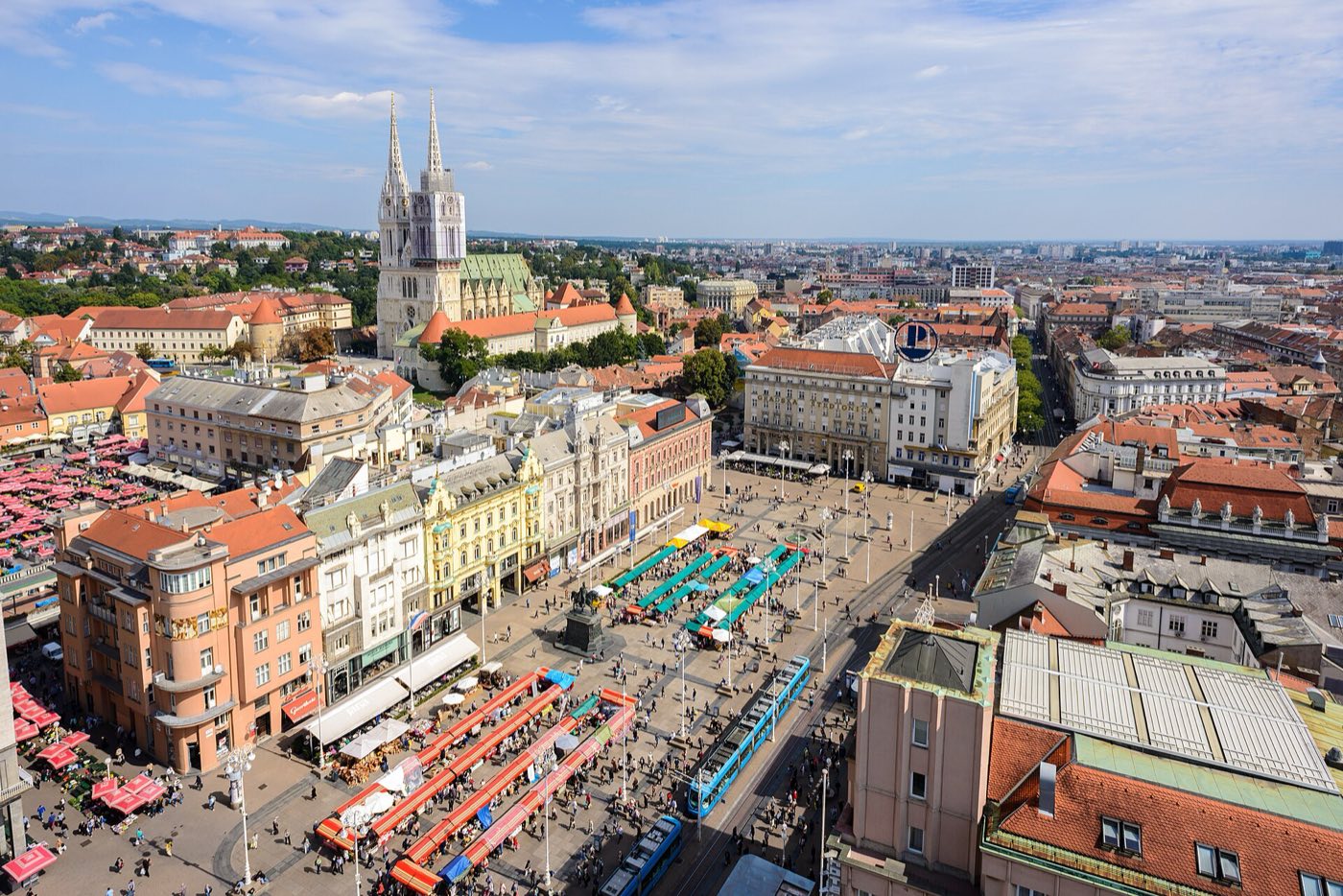
The capital gets skipped by coast-bound travelers, which is their loss. Zagreb's Gornji Grad is a compact hilltop of pastel facades, the St. Mark's Church tiled roof, and the Museum of Broken Relationships — a genuinely affecting oddity built from donated objects and breakup stories. Below, Dolac market runs every morning under red umbrellas, selling plums and cheese and fresh sardines. The café culture here beats anywhere on the coast, and weekends at Cvjetni trg are a lesson in how Zagrebčani actually live.
When to Go
Late May through June and September into early October are the sweet spots — warm enough to swim, empty enough to enjoy Dubrovnik's walls without a queue, and cheap enough that a waterfront hotel won't wipe out the trip's budget. July and August are prime beach season with water in the mid-70s, but Dubrovnik gets five cruise ships a day and Hvar prices go Monaco-adjacent. April and late October are gambles — the sea is cold but the cities are yours. Winters are quiet and mild along the coast; inland, Plitvice in snow is genuinely beautiful but access gets tricky after heavy falls.
Getting Around
The coast is best driven — a rental car gives you Plitvice, Krka, inland vineyards, and the flexibility to park above a cove whenever one calls. The A1 motorway links Zagreb to Split fast and well, and the coastal road south of Split into Bosnian territory and onward to Dubrovnik is a slow but cinematic drive. Between the islands, Jadrolinija and Krilo ferries run frequent services from Split to Hvar, Brač, Vis, and Korčula; book foot-passenger fast ferries in summer, and reserve car ferries a few days ahead. Within Dubrovnik and Split Old Towns everything is walkable, and city buses handle the outer neighborhoods cheaply. Zagreb has trams. Long-distance buses cover what trains don't, which is most of the country.
Cost & Currency
Croatia joined the euro in 2023, so you can leave the old kuna calculations behind. The country is no longer the bargain it was in the 2010s — Dubrovnik in August now runs close to Italian coastal prices — but away from the marquee destinations it remains reasonable. Expect €2–€3 for a coffee on a small-town square, €12–€20 for a konoba lunch of grilled sardines and blitva, and €90–€160 a night for a mid-range room on the coast in shoulder season (double that in July in Dubrovnik). Cards work nearly everywhere in cities; carry €40–€50 cash for ferries, markets, and smaller island restaurants. Tipping runs 10% at sit-down dinners where service was good, and rounding up suffices elsewhere.
Frequently Asked Questions
- Do I need a visa to visit Croatia?
- Most Western travelers — including US, UK, Canadian, Australian, and EU citizens — do not need a visa for stays up to 90 days. Croatia is now part of the Schengen Area, so your Schengen day count applies. From 2025 onward the ETIAS pre-authorization will apply to visa-exempt non-EU travelers, similar to the US ESTA.
- Is Croatia safe for travelers?
- Yes — Croatia is one of Europe's safer destinations, with very low violent crime and well-patrolled tourist areas. Watch for pickpockets in summer crowds around Dubrovnik's Pile Gate and on the busier Split ferry lines, and take standard care with rental cars parked overnight. Swimming is generally safe but respect posted warnings on exposed Adriatic stretches where currents can surprise.
- How much time do I need for a first trip?
- Ten days gives you a comfortable introduction — two nights in Dubrovnik, three or four on the islands (Hvar plus one of Vis, Korčula, or Mljet), two in Split with a day at Krka, and a night or two at Plitvice. A week is doable if you pick between north and south; two weeks lets you add Istria and the Zagreb scene without rushing.
- Is the tap water safe to drink?
- Yes, tap water is safe and of very high quality across Croatia, including on the islands. In Zagreb the water comes from an unusually pure karst aquifer and outperforms most bottled brands. You'll see locals drinking it everywhere, and refilling from taps or public fountains is normal practice.
- Do I need to rent a car?
- Depends on your route. If you're sticking to Dubrovnik, Split, and the islands, the bus-and-ferry combination covers everything and parking in the old towns is more trouble than it's worth. If you want Plitvice, Krka, the Istrian peninsula, or any inland vineyards and hill towns, renting a car for part of the trip is the right call — pick it up for the overland legs and drop it before an island-hopping week.
Plan a Trip to Croatia
Have you been to Croatia?
Track 195 countries, 50 states & 63 national parks on your map