National Park · AZ · Est. 1962
Petrified Forest
Overview
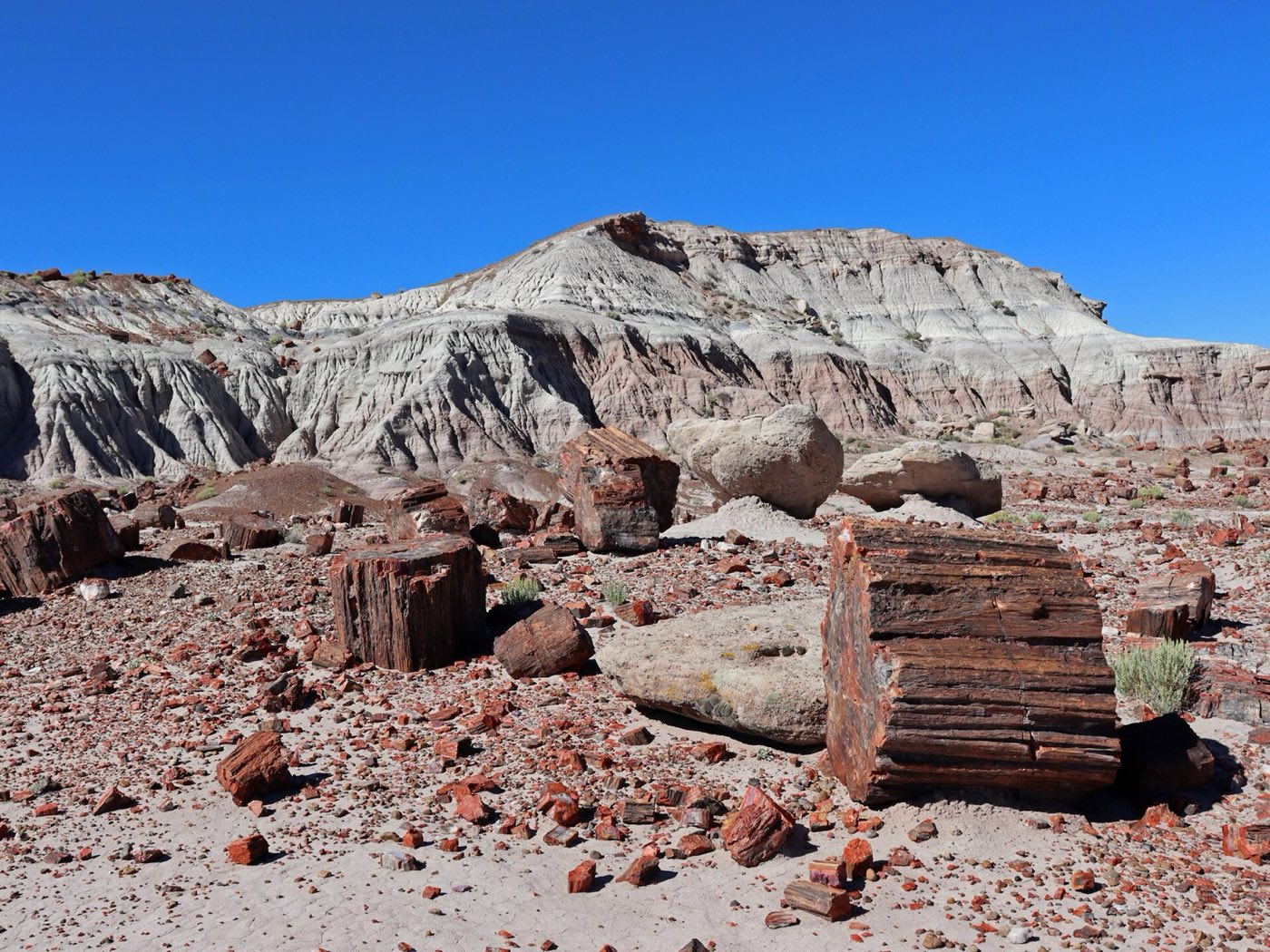
Petrified Forest protects one of the largest and most colorful concentrations of petrified wood on Earth — 225-million-year-old conifer trees that fell in a Triassic floodplain, got buried in volcanic ash, and over millions of years had their wood cells replaced molecule by molecule with quartz. What you walk through now isn't really a forest — it's a field of stone logs lying broken in the desert, some of them three feet thick and rainbow-colored where iron, manganese, and carbon trace-minerals stained the silica. The park sits in eastern Arizona along Interstate 40, between Holbrook and Gallup, and gets nowhere near the visitor numbers of nearby Grand Canyon. That's part of its charm. A 28-mile park road runs north-south between two entrances and connects all the major sights; you can drive it in a few hours with pullouts, or spend a full day walking short trails among fossil logs, Puebloan ruins, and the banded badlands of the Painted Desert at the park's north end. The park closes at sunset — there's no camping or after-dark access in the main park, which makes every visit a day trip. Come prepared with water, sunscreen, and a tolerance for wind; the Colorado Plateau here is treeless, high, and exposed.
What to See & Do
Crystal Forest trail among colorful petrified logs
A paved 0.75-mile loop off the main park road drops you into the largest concentration of complete petrified logs in the park — hundreds of them scattered across the desert floor, some still showing the curve of their original bark. The crystalline interiors catch the sun and throw back red, yellow, and purple flashes from the mineral inclusions. Go late afternoon for the best light. Don't touch, don't pocket — rangers check bags at the exits, and the park loses tons of petrified wood to theft every year.
Painted Desert overlooks along the northern park road
North of I-40, the park road runs along the rim of the Painted Desert, with a series of overlooks — Tiponi, Tawa, Kachina, Chinde — offering views across a vast erosional basin of banded red, purple, and gray mudstone. Sunrise and sunset are when the colors come alive; midday flattens them. The Painted Desert Inn, a restored 1930s adobe at Kachina Point, is worth walking through for its CCC-era architecture and WPA murals painted by Hopi artist Fred Kabotie.
Blue Mesa trail through banded badlands
A 1-mile paved loop descends from the mesa rim down into a maze of blue-gray badlands streaked with white and purple — the most otherworldly landscape in the park. Petrified logs balance on pedestals of softer clay eroding out from under them. The trail is steep in places and exposed; carry water and go early on hot days. The Blue Mesa road spur off the main park road has several pullouts with overlooks if you don't want to hike down.
Agate Bridge — a petrified log spanning a gully
A 110-foot petrified log lies across a small desert gully, forming a natural bridge. The park reinforced it with a concrete beam in 1917 because it was cracking; it still looks mostly natural. A short paved path from the parking area brings you right up to it. The stop takes 10 minutes and is a good quick pullout between the longer walks. Don't climb on the log — the concrete support is doing real work.
Puerco Pueblo ancestral Puebloan ruins and petroglyphs
Near the middle of the park, Puerco Pueblo is the partly excavated foundation of a 100-room village inhabited around 1250 to 1380 CE. A short paved loop walks past the ruins and down to a viewing area for a cluster of petroglyphs etched into a boulder wall — spirals, figures, and a pecked solar calendar that marks the summer solstice. Go early morning or late afternoon when shadows bring out the rock art; midday sun washes it flat.
Newspaper Rock petroglyph panel
An overlook between Puerco Pueblo and Blue Mesa gives you a view down onto a cluster of boulders covered in more than 650 petroglyphs — one of the densest rock art concentrations in the Southwest. Binoculars help; the viewing platform is set back for preservation reasons and the images are hundreds of feet away. Figures include animals, human shapes, and geometric designs carved over several centuries of ancestral Puebloan occupation.
Giant Logs trail behind the Rainbow Forest Museum
A 0.4-mile loop starting at the back door of the Rainbow Forest Museum takes you among the park's largest petrified logs — including Old Faithful, a 35-foot fragment nearly 10 feet across at the base. The museum itself is small but worth 20 minutes for the fossil displays, including a Phytosaur skull and a reconstruction of the Triassic ecosystem these trees once grew in. Good as your first or last stop in the park, depending on which entrance you use.
Getting There & When to Go
The park straddles Interstate 40 in eastern Arizona, with entrances on the north side off I-40 Exit 311 and the south side off Highway 180 near Holbrook. Flagstaff, two hours west, and Albuquerque, three hours east, are the nearest major airports. The 28-mile park road connects the two entrances — you can drive in either direction and exit through the other. March through May and September through November are the sweet spots for daytime temperatures; summer routinely hits 95°F on exposed trails. The park closes at sunset every day — no after-hours entry, no camping. Entrance is $25 per vehicle for seven days.
Where to Stay
There's no lodging inside the park and no campground — all visits are day trips. Holbrook, 20 miles west on I-40, is the closest base, with a string of chain motels and the kitschy Wigwam Motel whose 15 teepee-shaped rooms have been hosting Route 66 travelers since 1950. Winslow, 45 minutes west, has a more interesting lodging option in La Posada, a restored 1930 Fred Harvey hotel designed by Mary Colter. Gallup, New Mexico, an hour east, is larger with more variety. For a nicer base and access to other sights, Flagstaff two hours west combines Petrified Forest with the Grand Canyon, Sunset Crater, and Wupatki into a multi-park loop.
Frequently Asked Questions
- Is it illegal to take petrified wood from the park?
- Yes — taking any natural object, including petrified wood fragments, is a federal offense and rangers do enforce it. The park estimates visitors remove about a ton of petrified wood every month despite patrols and bag checks. If you want a piece to take home, gift shops just outside the park sell legally collected wood from private land at reasonable prices.
- Can I drive through the park on my way to somewhere else?
- Yes, and many people do — the 28-mile park road between I-40 on the north and Highway 180 on the south is essentially a scenic detour between the interstate and Holbrook. You'll still pay the entrance fee, but you can see the main overlooks and walk a trail or two in two to three hours if you're passing through. Plan a minimum of half a day to do it justice.
- When does the park close each day?
- Gates close at sunset every day, which varies from about 5 p.m. in winter to 7:30 p.m. in summer. Rangers sweep the park at closing time — if you're inside, you'll need to leave. The park is also closed on Christmas Day. Check the park's website for seasonal hours before you drive out.
- Is it safe to hike in summer?
- With precautions, yes — but summer daytime temperatures regularly exceed 95°F on exposed trails with no shade. Start hikes at sunrise, carry a quart of water per hour, wear a hat and long sleeves for sun protection, and skip the longer trails in July and August afternoons. Lightning is a real risk during monsoon thunderstorms from July through September; get off exposed ridges if storms build.
Plan Your Visit
Book Nearby HotelsHave you visited Petrified Forest?
Track all 63 national parks on your map