National Park · SD · Est. 1978
Badlands
Overview
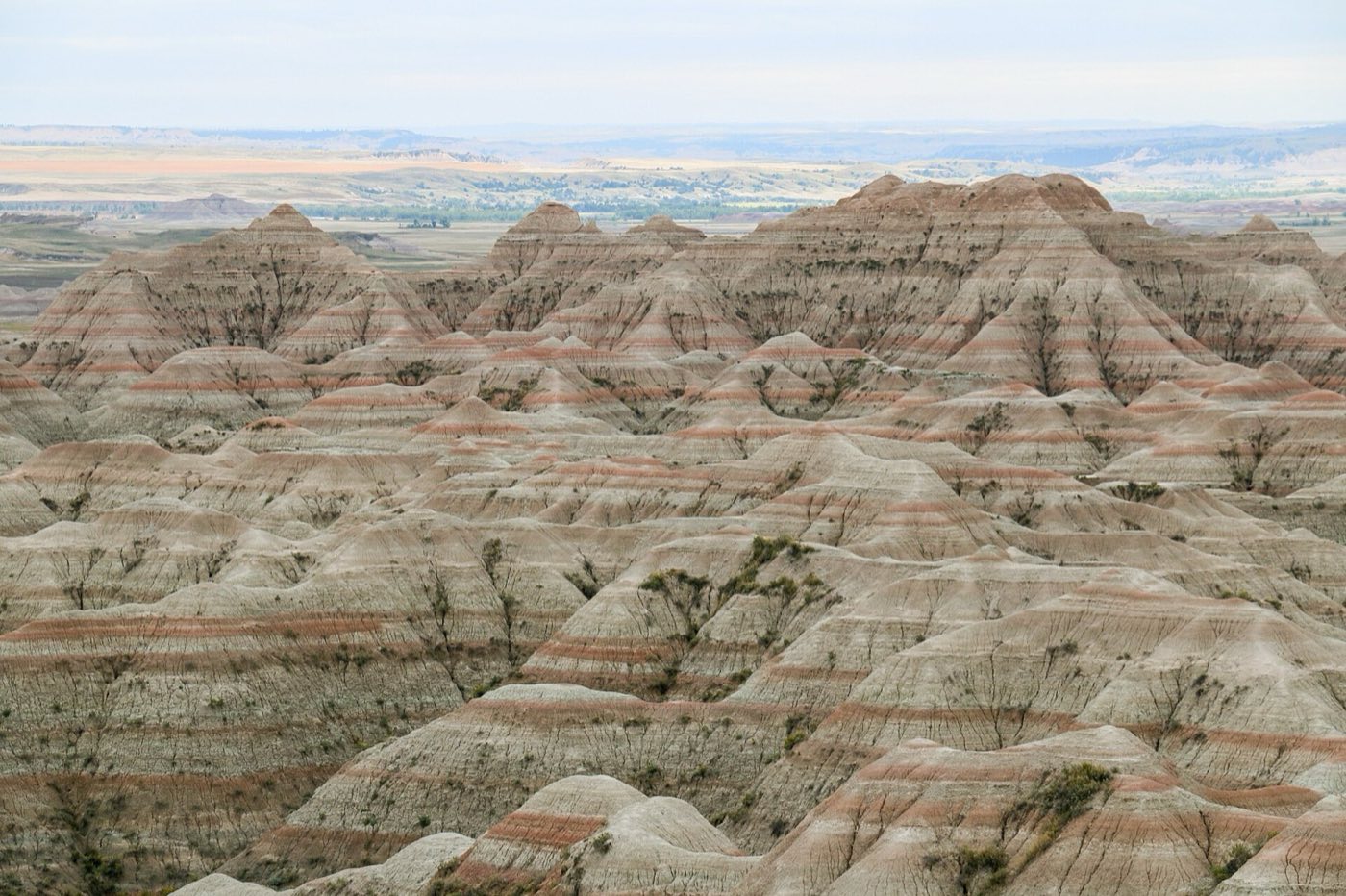
Badlands National Park protects 244,000 acres of eroded buttes, pinnacles, and spires rising abruptly from the mixed-grass prairie of southwestern South Dakota. The formations are 75 million years of layered sediment — volcanic ash, river mud, old seabed — that the last half-million years of freeze-thaw and rainstorm have carved into a landscape the Lakota named mako sica, "bad lands." The same erosion keeps exposing fossils; this is one of the richest Oligocene fossil beds in the world. What you notice first is the scale of the color change. At sunrise the buttes light up peach and coral; by noon they've gone bone-white and flat; by the hour before sunset they're stained red and purple with long shadows pouring out of every drainage. Between the formations, the open prairie of Sage Creek Wilderness holds free-roaming bison, pronghorn, and one of the only black-footed ferret populations left in the wild. The park has two units joined by Highway 240 — the Badlands Loop Road — which can be driven in 90 minutes if you never stop, or stretched across a full day with trail stops, a ranger talk at Ben Reifel Visitor Center, and a dusk drive through Sage Creek. Summer afternoons top 100°F and thunderstorms arrive fast; early-morning hiking is the move.
What to See & Do
Notch Trail's ladder climb to a canyon overlook
The Notch Trail is a 1.5-mile roundtrip that uses a wooden log ladder to climb a short cliff face, then traces a ledge to a canyon-edge viewpoint with the White River Valley falling away below. It's the most interesting short hike in the park — mild scrambling, a real sense of exposure in the ladder section, and a payoff view that earns its work. Skip the ladder if you don't love heights; the trail is genuinely exposed. Go in early morning before the rock heats up, and bring at least a liter of water per person.
Big Badlands Overlook at sunrise when the buttes glow orange and pink
Big Badlands Overlook is the first pullout inside the northeast entrance on Highway 240, and it's where you want to be 15 minutes before sunrise. The view drops across miles of eroded walls and grassland, and the sun comes up directly behind the formations to light them from the side — coral at first light, then orange, then the short pink-before-white moment as the sun rises higher. No trail, no crowds, just a low wall and a bench. Coffee from your thermos, layers against the prairie wind.
Sage Creek Wilderness for free-roaming bison herds
Sage Creek Rim Road splits off from the Badlands Loop and runs 11 miles of graded gravel through open prairie where the park's 1,200 bison roam freely. You'll see them from the car — groups of 20 to 80, often right next to the road — and you can hike cross-country in the 64,000-acre Sage Creek Wilderness if you want to get on their level. The road is 2WD-passable in dry weather but turns to impassable mud in rain. Dawn and dusk are best for bison activity, and you must stay 25 yards away on foot.
Fossil Exhibit Trail's ancient mammal replicas in situ
The Fossil Exhibit Trail is a quarter-mile paved boardwalk with interpretive panels and life-size bronze replicas of the Oligocene mammals that lived here 30 million years ago — saber-toothed cats, three-toed horses, rhino-like titanotheres, and the pig-like merycoidodon whose skeleton is the park's most common fossil. It's the best short walk for families with kids and for anyone who wants to understand why the park is a paleontological landmark. Pair it with a visit to the Fossil Preparation Lab at Ben Reifel Visitor Center during the summer season.
Door Trail's walk through a wall of badlands formations
The Door Trail passes through a natural break in the Badlands Wall and delivers you into the broken landscape beyond, where the marked trail ends after three-quarters of a mile and cross-country wandering begins. The first quarter-mile is boardwalk; past that, the route is marked with numbered posts over bare dirt and rock. It's the easiest way to get the sensation of being among the formations rather than looking at them from above. Stay aware of direction; the formations all start to look alike and it's easy to lose the return route.
Night sky viewing — one of the darkest skies in the lower 48
Badlands earned Dark Sky Park certification in 2020 and has sky quality in the Bortle 2 range — nearly as dark as Chaco Canyon. Rangers run a Night Sky program at the Cedar Pass amphitheater on summer evenings with laser-guided constellation tours and high-powered telescopes. If you prefer solo, drive 15 minutes out the Sage Creek Road after dark, pull off, let your eyes adjust for 20 minutes, and look up — the Milky Way is so bright you can read by it in late summer.
Roberts Prairie Dog Town
Roberts Prairie Dog Town sprawls across hundreds of acres along the Sage Creek Rim Road and hosts one of the largest remaining colonies of black-tailed prairie dogs in the country. You'll hear the sharp alarm chirps before you see the mounds, and if you watch long enough you'll see sentry dogs standing upright at every burrow. The town also supports the reintroduced black-footed ferret — the rarest mammal in North America, which eats prairie dogs exclusively. Ferrets are nocturnal, but a ranger-led spotlighting night-tour in summer gives you a real chance.
Getting There & When to Go
The closest airport is Rapid City Regional, about an hour west of the Pinnacles entrance. Most visitors arrive via Interstate 90 — take exit 110 (Wall) for the western Pinnacles entrance or exit 131 for the eastern entrance near Cedar Pass. Late April through early June and September through October are the ideal windows, with comfortable daytime highs in the 60s-80s, active wildlife, and fewer crowds. July and August bring 90-100°F heat and spectacular afternoon thunderstorms; winter brings solitude, snow-dusted buttes, and occasional road closures. The park entrance fee is $30 per vehicle, good for seven days.
Where to Stay
Inside the park, Cedar Pass Lodge offers 24 cabins from April through mid-October, booked through cedarpasslodge.com, and two campgrounds — Cedar Pass (bookable on recreation.gov) and Sage Creek (free, primitive, first-come-first-served among the bison). Outside the park, Wall is 8 miles north and the base of most visitors — home to the famous Wall Drug and a cluster of chain motels and diners. Rapid City, an hour west, offers the widest hotel selection and makes a good base for pairing Badlands with Mount Rushmore and Custer State Park. Interior, a tiny town at the southeast entrance, has a handful of motels and a working-class feel.
Frequently Asked Questions
- How much time do I need at Badlands?
- A half-day is enough to drive the Badlands Loop Road and do a short walk at Door or Notch Trail, which is what most I-90 road-trippers allot. A full day lets you add Sage Creek Wilderness, a ranger program, and sunrise or sunset at one of the overlooks. Two days with an overnight at Cedar Pass Lodge lets you do everything, including the dark-sky program after dark.
- Is it safe to hike off-trail?
- Yes — unlike most national parks, Badlands explicitly allows and encourages off-trail hiking in most areas. The terrain is open and navigation is straightforward in good visibility. The real hazards are heat, lack of water, flash floods in drainages during summer thunderstorms, and prairie rattlesnakes. Carry more water than you think you need, and turn around if storms are building on the western horizon.
- Will I see bison and other wildlife?
- Almost certainly. Bison are reliable along Sage Creek Rim Road, often right at the roadside in groups of 20 or more. Bighorn sheep frequent the Pinnacles overlook and the cliff faces around the Loop Road. Pronghorn antelope roam the prairies, and prairie dogs are unmissable at Roberts Prairie Dog Town. Stay at least 25 yards from bison and bighorn, and 100 yards from any predator.
- Can I collect fossils in the park?
- No — all fossils, rocks, plants, and cultural artifacts are federally protected, and removal is illegal and heavily enforced. If you find something that looks like a fossil, mark its location with a photo and GPS, leave it in place, and report it to a ranger at Ben Reifel Visitor Center. Paleontologists genuinely rely on visitor reports to document new finds.
Plan Your Visit
Book Nearby HotelsHave you visited Badlands?
Track all 63 national parks on your map