National Park · TX · Est. 1944
Big Bend
Overview
Big Bend is one of the largest and least visited national parks in the lower 48 — 801,000 acres of Chihuahuan Desert, the Chisos Mountains, and 118 miles of the Rio Grande tracing the U.S.-Mexico border. The park sits at the end of the road in far west Texas, and getting to it takes real commitment: the closest major airport is Midland-Odessa, a 3.5-hour drive away, and the last 100 miles cross emptiness that feels like its own planet. That remoteness is exactly what protects the experience. Three ecosystems stack on top of each other here. The river corridor holds cottonwoods, willows, and hot springs; the desert floor runs prickly pear and ocotillo up to 4,000 feet; the Chisos Mountains rise to 7,825 feet at Emory Peak with sky islands of oak and madrone that feel like a different park entirely. The biodiversity is extraordinary — more than 450 bird species pass through, and the park holds the only U.S. population of the Colima warbler. Summer days in the lowlands regularly exceed 110°F, which is why the real season runs November through April. Big Bend is an International Dark Sky Park with some of the darkest skies in North America — the Milky Way reading here is genuinely unforgettable, and it's the single best reason to stay in the park overnight rather than day-tripping.
What to See & Do
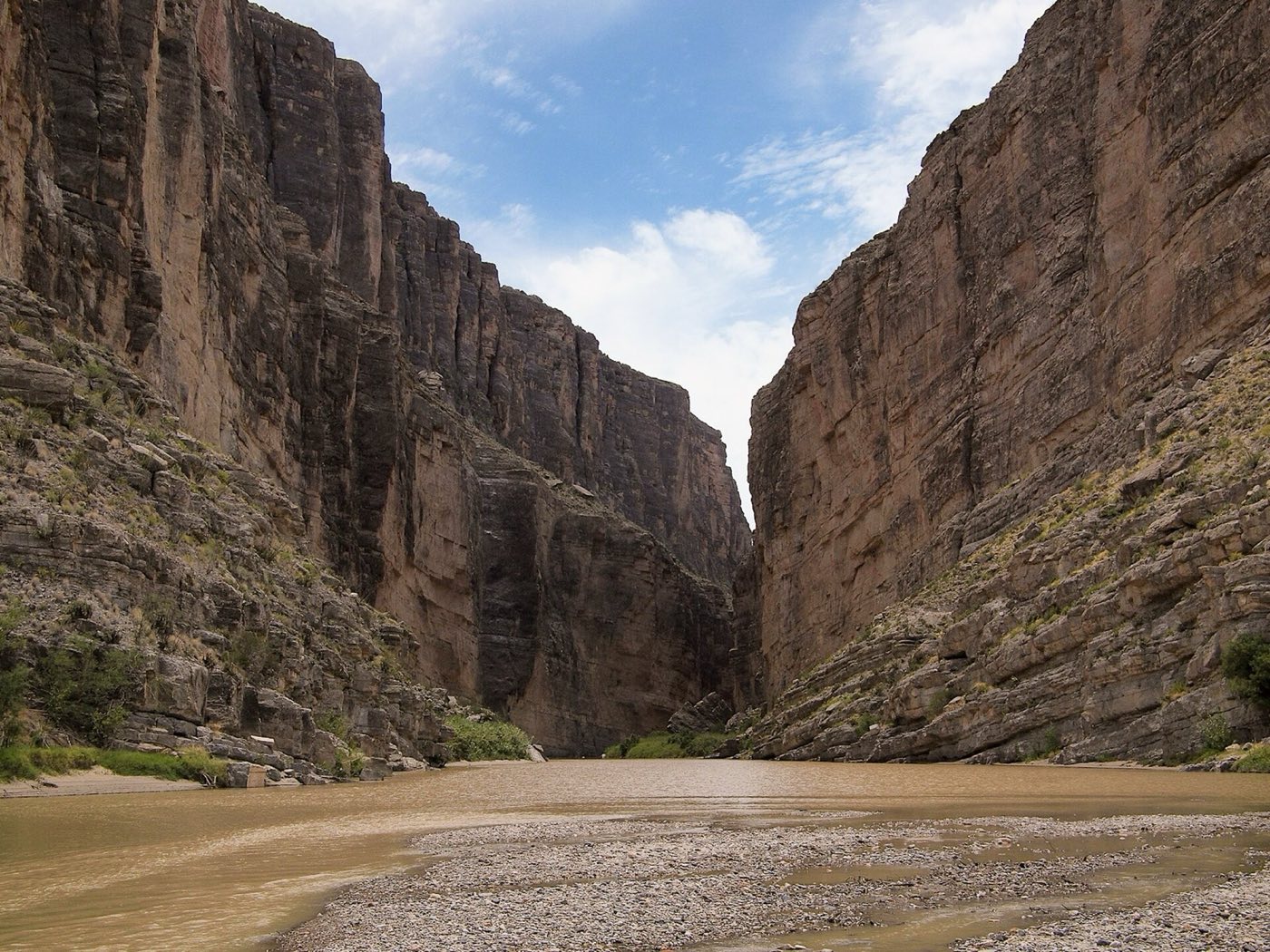
Santa Elena Canyon Trail into 1,500-foot limestone walls
The Santa Elena Canyon Trail is a 1.7-mile roundtrip that drops you into a slot where 1,500-foot limestone walls close in overhead and the Rio Grande — maybe 30 feet wide — runs between Mexico on the left bank and the U.S. on the right. You'll wade Terlingua Creek to reach the trailhead if water is flowing; it's usually ankle-deep. The acoustics inside the canyon are cathedral-like and the temperature drops 10 to 15 degrees from the desert floor. Mid-afternoon sun lights the far wall in reflected gold. For the full immersion, book a guided river float into the canyon from a Terlingua outfitter.
Langford Hot Springs soaking pools along the Rio Grande
At the end of a rough 2-mile gravel road off the River Road, a quarter-mile walk delivers you to a set of stone-walled 105°F soaking pools at the edge of the Rio Grande — the foundations of a 1909 health resort. You soak in the warm pool with your feet over the edge, the cool river running past, and the Chisos Mountains in one direction and Mexico in the other. Go at sunset, when the light hits the bluffs on the Mexican side, or before dawn when the steam drifts over the river in the first light. Bring a headlamp and water shoes.
South Rim Trail's 12-mile loop with sweeping desert panoramas
The South Rim is a 12-mile loop from the Chisos Basin trailhead up to the south-facing cliff edge of the mountains at 7,100 feet, with a panorama stretching 100 miles into Mexico. Plan 8 to 10 hours; bring 3 liters of water per person; start by 7 a.m. in warmer months. The climb is 2,000 vertical feet, and you can shorten the loop by going up via the Pinnacles Trail and down via Laguna Meadow for a 12.7-mile version. The view from Southeast Rim — the quieter eastern edge — is arguably better and less crowded.
Window Trail at sunset framing the Chisos Basin
The Window is a natural rock notch in the west wall of the Chisos Basin, and the 5.6-mile roundtrip trail descends 800 feet to stand at its polished-rock lip — a dropoff where Oak Creek pours out into the desert below. It's the iconic Big Bend photo, especially at sunset when the sun sets directly through the V of the Window. Leave the trailhead by 90 minutes before sunset, bring a headlamp for the uphill return in dusk, and watch your footing at the Window itself — the smooth rock is slick and the drop beyond is hundreds of feet.
Dark-sky stargazing — an International Dark Sky Park
Big Bend is Bortle Class 1, the darkest classification — you can see your shadow cast by the Milky Way on a moonless night, and the zodiacal light is visible after sunset in late winter. The best viewing spots are the parking lot at Panther Junction, the Persimmon Gap entrance, or anywhere along the Ross Maxwell Scenic Drive. Check the park calendar for ranger-led night sky programs in the cooler months. If you're overnighting, any site at the Chisos Basin Campground or the primitive backcountry sites delivers an unforgettable sky.
Boquillas Canyon and the cross-border village visit
From the Boquillas Canyon overlook, a 1.4-mile roundtrip trail drops you to the river where the canyon opens up. Nearby, the Boquillas Crossing Port of Entry allows a legal day trip to the Mexican village of Boquillas del Carmen: you take a rowboat across the river, ride a burro or walk the short distance into town, and eat lunch at one of the three restaurants. Bring your passport, $5 cash for the boat, and cash for the village — it's one of the most memorable hours you can spend in the park. The crossing is open Wednesday through Sunday.
Ross Maxwell Scenic Drive through volcanic geology
The Ross Maxwell Scenic Drive runs 30 miles from Panther Junction to Santa Elena Canyon, climbing and descending through exposed volcanic geology that tells the park's deeper story — dikes, basalt flows, and uplifted formations like the Mule Ears peaks and Tuff Canyon. Stop at Sotol Vista for the long view across the park, Tuff Canyon for a short descent into a volcanic-ash slot, and the Castolon Historic District. Budget 3 to 4 hours for the drive one-way with stops, and allow time at Santa Elena Canyon at the end.
Getting There & When to Go
The nearest airports are Midland-Odessa (3.5 hours northeast) and El Paso (5 hours northwest); most visitors drive from Texas cities — San Antonio is 7 hours, Austin 8. There are no gas stations between Fort Stockton and the park, so fill up in Marathon, Alpine, or Terlingua before entering. November through April is the prime season with daytime highs in the 60s-80s; summer temperatures exceed 110°F in the lowlands, though the Chisos Mountains stay 15-20°F cooler. The park fee is $30 per vehicle for seven days; no timed entry system. Cell service is essentially nonexistent inside the park — download maps and reservations before you arrive.
Where to Stay
The Chisos Mountains Lodge is the only in-park lodging — 72 motel-style rooms and stone cottages at 5,400 feet in the Chisos Basin, bookable up to a year in advance at chisosmountainslodge.com. It books out fast for November through April weekends. The park's developed campgrounds — Chisos Basin, Rio Grande Village, and Cottonwood — are on recreation.gov. Outside the park, Terlingua and Study Butte (5 miles from the west entrance) offer a range of quirky desert lodging from upscale resorts like Lajitas Golf Resort to cabins, yurts, and the famous Terlingua Ghost Town. Marathon, 40 miles from the north entrance, has the historic Gage Hotel for a more refined base.
Frequently Asked Questions
- Do I need a reservation to enter Big Bend?
- No — Big Bend is one of the few major national parks without a timed-entry system. Entry is first-come-first-served with the $30-per-vehicle fee good for seven days. However, Chisos Mountains Lodge rooms and campground sites inside the park book out months in advance for the November-to-April peak season, so plan lodging well ahead.
- Is Big Bend safe near the Mexican border?
- Yes — Big Bend is one of the safer national parks statistically, and the border issues that get national media attention happen hundreds of miles east in urban areas, not in this remote stretch. The one legal crossing at Boquillas is staffed by U.S. Customs and is safe and routine. Typical risks here are heat, dehydration, flash floods, and backcountry rescue delays — not violence.
- When can I see the Colima warbler?
- The Colima warbler is found nowhere else in the United States and arrives at the Chisos Mountains in mid-April for the breeding season. The best place to find one is along the Pinnacles Trail between Boot Springs and Laguna Meadow from late April through early July. Serious birders should plan a trip for the first two weeks of May when the birds are actively singing and easier to locate.
- Can I drive all the park roads in a regular car?
- Most of the scenic paved roads — Ross Maxwell Scenic Drive, the roads to Chisos Basin and Rio Grande Village — are accessible to any car. The 51-mile River Road and the roads to primitive backcountry sites require high-clearance 4WD and current knowledge of conditions from a ranger. Check current road status at the Panther Junction visitor center on arrival; conditions change with weather.
Plan Your Visit
Book Nearby HotelsHave you visited Big Bend?
Track all 63 national parks on your map