Tonga
- Capital
- Nuku'alofa
- Population
- 107K
- Currency
- TOP
- Languages
- Tongan, English
Overview
A Polynesian kingdom of 169 islands strung across a stretch of the South Pacific most travelers never reach, Tonga is the only Pacific nation that was never formally colonized by a European power — and the continuity shows in everything from Sunday church singing to the king's portrait still hanging in every shop. You feel the scale of the ocean here before you feel anything else. Flights come in low over reef water so clear the coral patterns are visible from the plane, and the capital, Nuku'alofa, is a low, low-rise town where nothing competes with the sky. Most visitors press on quickly to the outer groups — Ha'apai for the empty beaches, Vava'u for the whales — and that's the right instinct. The main island of Tongatapu is worth a couple of days for the blowholes and ancient stone trilithon, but Tonga's real reward is getting out on the water. What keeps travelers coming back is the whale season. From July through October, humpbacks arrive to calve and nurse in these warm shallows, and Tonga is one of the only countries that licenses operators to put swimmers in the water with them. Float on the surface while a mother and her calf pass fifteen feet below you, and the rest of the trip arranges itself around the memory.
Things to Do
Humpback whale swimming in Vava'u
From July to October, humpback mothers bring their newborn calves into the protected bays of the Vava'u group to nurse before the long migration back to Antarctica. A small fleet of licensed operators takes groups of four swimmers out each morning — you slip into the water quietly, fins on, and wait. When a curious calf circles in close with its mother hovering below, the experience is unlike anything else in ocean travel. Book well ahead; the permits are capped and the best operators sell out months in advance.
Ha'apai island group pristine beaches
The middle group of islands is Tonga at its quietest — a scatter of low coral cays and reef-fringed motus with sand so fine it squeaks underfoot. Flights from Tongatapu land on Lifuka, where a handful of simple beachfront guesthouses sit along empty coast. Spend days snorkeling over drop-offs, paddling between uninhabited islets, and reading on your porch while frigatebirds work the updraft. There is almost nothing to do in the tourist sense, which is exactly the point.
Ha'amonga 'a Maui trilithon stone arch
On the eastern end of Tongatapu stand three enormous coral-limestone slabs assembled into a trilithon sometime around 1200 CE — the lintel alone weighs nine tons and nobody is entirely sure how it was lifted. Local tradition holds the site was an astronomical marker for the solstices, and you can walk right up to the stones in a quiet clearing with a few interpretive signs. Pair it with the nearby Langi royal burial mounds for a morning of pre-European Tongan history.
Tongan feast and cultural shows
A traditional umu feast — meat, root vegetables, and fish steamed for hours under banana leaves and hot stones — is one of the genuine cultural experiences you can arrange on Tongatapu and in Vava'u. Evenings usually include string band music, lakalaka group dances, and the kava ceremony. Several hotels and community groups host them weekly; the ones run by villages rather than resorts feel the most lived-in.
Mapu 'a Vaea blowholes on Tongatapu
On the southwestern coast of the main island, a long stretch of raised coral cliff is pierced by hundreds of natural spouts that fire seawater thirty meters into the air on an incoming swell. Locals call the sight Mapu 'a Vaea, the Chief's Whistles. The best show happens at high tide with an easterly blowing, and a grassy cliff path lets you walk along the row for as long as you like. Bring a windbreaker — the spray carries far.
Swallows Cave on Kapa Island
A sea cave on the western side of Kapa Island in the Vava'u group, reached by boat from Neiafu in about thirty minutes. The entrance opens into a high-ceilinged chamber where light slanting through the water turns the interior a saturated blue, and nesting swallows wheel through the upper vault. Most tours include a swim inside the cave itself — the acoustics are surprising, and you can hear the birds overhead while you tread water.
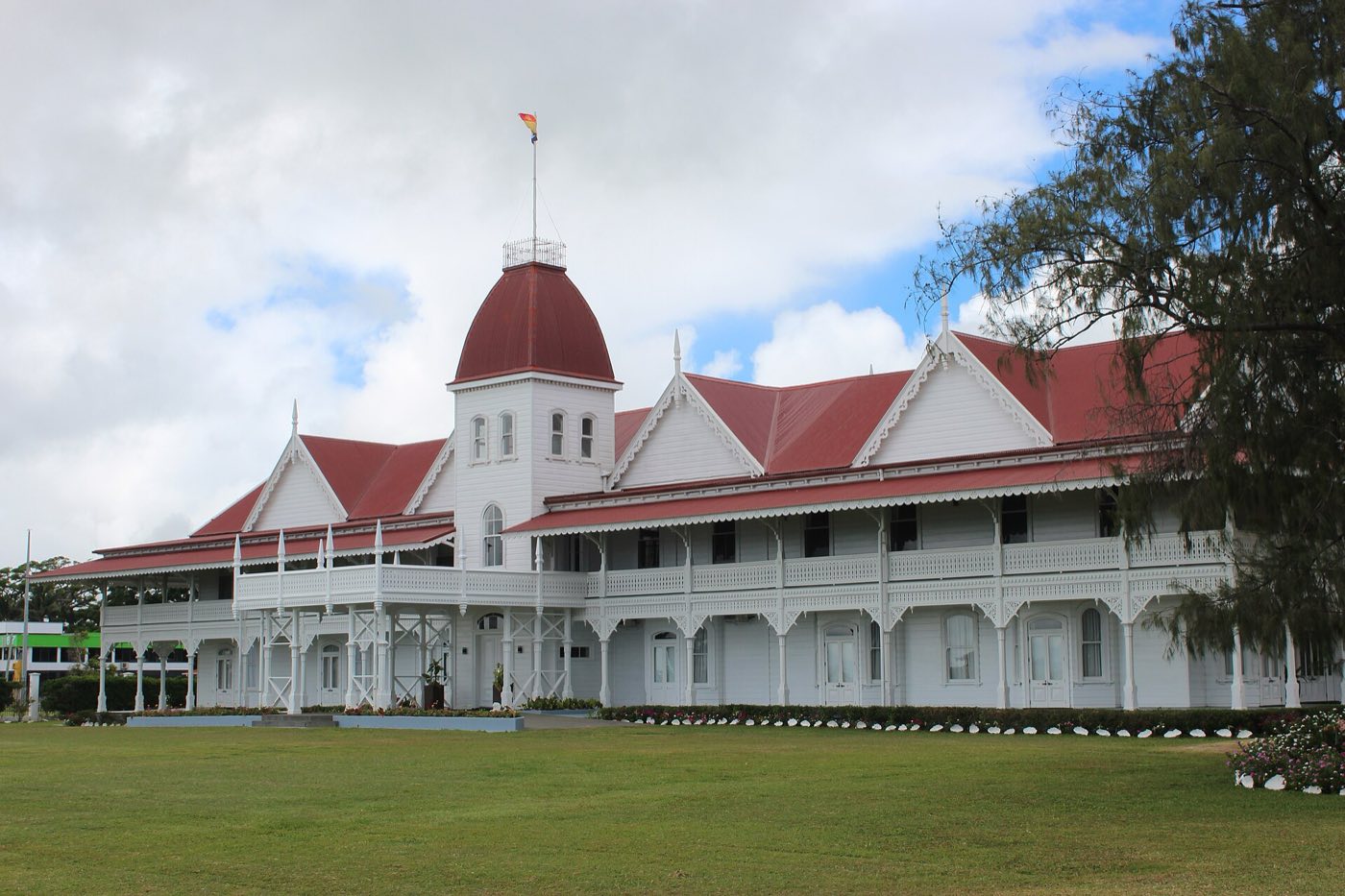
Royal Palace grounds in Nuku'alofa
The white weatherboard Royal Palace on the Nuku'alofa waterfront has been the seat of the Tongan monarchy since 1867 and is not open to the public, but the grounds are photogenic from the perimeter road and the small park alongside. Pair a walk past the palace with the nearby Royal Tombs and a stop at Talamahu Market for a morning on Tongatapu before heading out to the whales or the blowholes.
When to Go
May through October is the dry, cooler season and the stretch most travelers aim for, with July through October overlapping the humpback whale visit to Vava'u and Ha'apai. Temperatures stay comfortable in the mid-20s Celsius and trade winds keep evenings pleasant. December through April is warmer and wetter with a genuine cyclone risk, particularly February and March. If your trip centers on the whales, lock in dates between early August and late September when calves are most active near the surface and operators have their full roster running.
Getting Around
Domestic flights on the small national carrier connect Tongatapu to Vava'u and Ha'apai in roughly an hour each, and booking ahead is essential because schedules are thin and seats go quickly. Inter-island ferries run as well — cheaper, far longer, and weather-dependent. On the main islands, rental cars and scooters are available at modest daily rates, and roads on Tongatapu are paved and easy to drive. In Vava'u, many visitors base themselves in Neiafu and take day boats out from the harbor. Taxis are available in Nuku'alofa and Neiafu; agree on a fare before getting in.
Cost & Currency
Tonga uses the pa'anga (TOP), roughly pegged loosely to a basket of Pacific currencies and trading near 0.40 USD. Expect to pay 80–150 TOP for a mid-range guesthouse room, 25–45 TOP for a restaurant main, and 350–450 TOP for a three-swim day on a licensed whale boat in Vava'u — the whale excursions are the single largest line item in most budgets. Cash in small denominations is essential outside Nuku'alofa and Neiafu; card acceptance is spotty. Tipping is not traditional but appreciated for boat crews and guides after a good day on the water.
Frequently Asked Questions
- Do I need a visa to visit Tonga?
- Most nationalities receive a free visitor's visa on arrival for up to 31 days, extendable at the immigration office in Nuku'alofa. You will need an onward ticket, a passport valid for at least six months, and proof of accommodation. Rules occasionally change; confirm current requirements with your airline or the Tongan government site before flying.
- Is swimming with humpback whales safe and ethical?
- Tonga is one of only a few countries that permits licensed in-water encounters, and the program is tightly regulated — limited permits, four swimmers at a time, strict distance rules, and no touching. Choose an operator that holds a current permit and follows the code of conduct. Encounters are always on the whales' terms; if a mother moves off, the boat moves off.
- Is the tap water safe to drink?
- Tap water in Nuku'alofa is generally considered safe but many visitors and locals drink filtered or bottled water for taste and peace of mind. On outer islands and in smaller guesthouses, stick to bottled or filtered water. Rainwater tanks are common in the outer groups and are usually fine if your stomach handles local water well.
- How much time should I plan for a first trip?
- Ten to fourteen days is a comfortable first visit — two or three nights in Tongatapu for the blowholes and trilithon, then a week split between Vava'u for the whales and either Ha'apai for quieter beaches or more time in Vava'u for sailing and snorkeling. Shorter trips force hard choices between the island groups.
- What should I know about Sundays in Tonga?
- Sunday is a constitutionally protected day of rest — shops close, commercial flights don't operate, and most activities including swimming at public beaches are discouraged. Resorts and hotels continue to serve guests, and attending a Sunday morning church service to hear Tongan harmony singing is one of the cultural highlights of a trip. Plan island travel around this when booking.
Plan a Trip to Tonga
Have you been to Tonga?
Track 195 countries, 50 states & 63 national parks on your map