Kiribati
- Capital
- Tarawa
- Population
- 131K
- Currency
- AUD
- Languages
- English, Gilbertese
Overview
A scatter of 33 coral atolls strung across 3.5 million square kilometers of the central Pacific, Kiribati straddles the equator and the International Date Line — the only country on earth to sit in all four hemispheres at once. Its total land area barely exceeds 800 square kilometers. Its waters, the fishing grounds of one of the largest exclusive economic zones on the planet, stretch further than the distance from London to Tehran. Getting here is the first filter. Flights run once or twice weekly from Fiji or Brisbane to Tarawa, the main atoll, and onward island-hopping is a matter of Air Kiribati prop planes that sometimes fly when scheduled. You arrive and immediately understand the geography: the land is a few hundred meters wide at its broadest, the lagoon glass-flat on one side, open ocean breaking on the reef on the other, coconut palms running the entire length. Rising seas are a live concern, not a future one — villages have already moved back from the water, and the government has bought land in Fiji as insurance. Visitors who make the trip find Kiritimati (Christmas Island) offering some of the world's finest bonefishing, Tarawa carrying the sobering weight of its WWII battlefields, and outer atolls where the pace of life is set by tide and reef. Kiribati rewards a specific kind of traveler — independent, patient, interested in people and ocean rather than infrastructure. English is an official language and widely spoken, which helps enormously. Accommodation is basic outside a small handful of guesthouses. Alcohol is restricted in some islands and Sundays are genuinely observed. Go with flexible onward plans, cash in Australian dollars (the national currency), and the understanding that you are visiting a frontline climate country that may not exist in recognizable form a century from now.
Things to Do
Christmas Island (Kiritimati) bonefishing
The largest coral atoll in the world by land area, Kiritimati sits a thousand miles south of Hawaii and is internationally regarded as one of the top two or three bonefish destinations on the planet. The endless flats on the inside of the lagoon hold enormous schools of bones, many in the 4–6 pound range with shots at much larger fish, plus giant trevally on the outer reef. Lodges like The Villages and Ikari House arrange wading guides, skiff trips, and full-week packages — the 3.5-hour direct flight from Honolulu on Fiji Airways is the practical way in.
Tarawa Atoll WWII battle sites
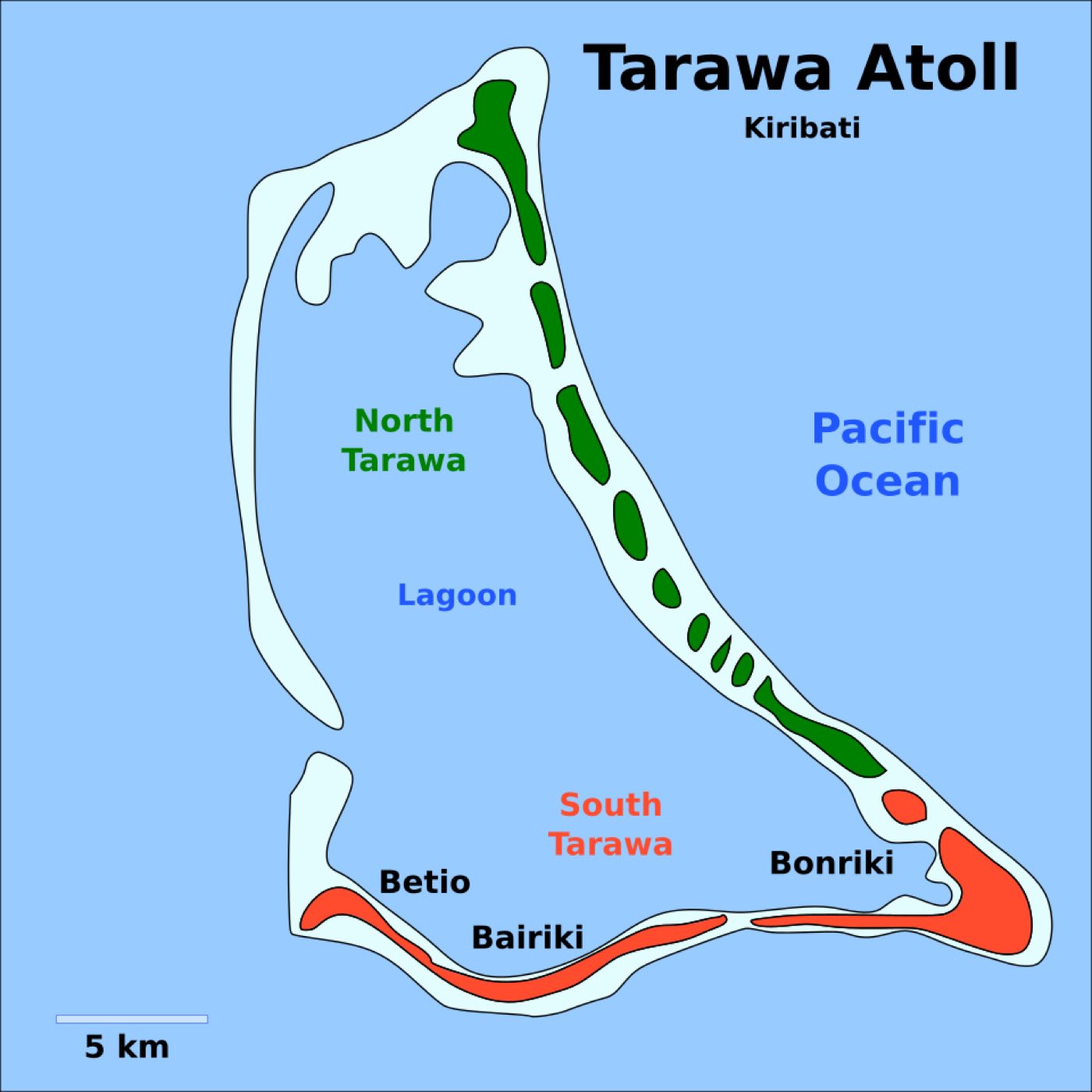
In November 1943, the 76-hour Battle of Tarawa cost over 1,000 American and 4,700 Japanese lives on Betio islet at the southern end of the atoll — one of the bloodiest amphibious assaults of the Pacific War. Rusted Japanese coastal guns, pillboxes, and the wreckage of US amtracs are still visible on the reef flats and among the village houses. A local guide from the Tarawa Memorial Committee can walk you through the key sites in a half day; what you come away with is both the scale of the fighting and the normalcy of the life that has rebuilt itself on the same few hundred meters of sand.
Millennium Island pristine coral reefs
Caroline Island, renamed Millennium Island for being the first land to see the year 2000, sits 2,300 kilometers from Tarawa and is effectively uninhabited. Reaching it means a chartered expedition boat out of Kiritimati and is serious remote travel, but for divers and ocean-literate visitors it offers some of the least-touched reef systems left in the Pacific. Expect giant clam beds, schooling grey reef sharks, humphead wrasse, and genuinely no other boats on the horizon. This is trip-of-a-lifetime logistics, not a casual add-on.
South Tarawa lagoon snorkeling
The protected lagoon inside Tarawa is calm, warm year-round, and alive with coral and reef fish within swimming distance of the shore in several villages. North of Bairiki, the causeway reef drop-offs hold good visibility and the occasional turtle; Bikenibeu has gentler conditions suitable for beginners. Bring your own mask and fins as rentals are limited and variable. Pair with a sunset walk on the lagoon side, where outriggers come in under sail and children swim in the last light.
Phoenix Islands Protected Area
One of the largest marine protected areas on the planet, the Phoenix Islands cover an ocean expanse roughly the size of California and hold some of the most intact coral and pelagic ecosystems left in the tropics. Human access is extremely restricted — no resident population, permit-only research and expedition visits — and getting out there is a matter of joining a scientific cruise or an occasional liveaboard. For most visitors, knowing PIPA exists and supporting its conservation via a donation or offset is the practical engagement; for a tiny minority, an expedition charter is one of the great remaining ocean experiences.
Traditional maneaba meeting houses
Every village in Kiribati is organized around a maneaba, a long open-sided meeting hall with a steep thatched roof supported by coral-stone columns, where community decisions have been made for generations. Visiting one is a matter of going with a local host — turn up uninvited and you'll feel the imposition immediately. Ask your guesthouse to arrange a visit during a community event or a dance practice. Te Mwaie, the traditional I-Kiribati dance, is often rehearsed in maneabas in the evenings, and being welcomed in to watch is one of the real privileges of travel here.
Abaiang Atoll village life
An hour by small plane or a day by boat north of Tarawa, Abaiang offers a much quieter glimpse of outer-island life — a long thin atoll with a handful of villages connected by a single coral road, one or two basic guesthouses, and a pace of life that is genuinely pre-industrial. Snorkeling on the lagoon side is excellent, the church services on Sunday morning are a cultural experience in themselves, and the food is whatever came in off the reef that morning. Come with no schedule beyond your flight back.
When to Go
April to October is the drier, calmer half of the year across most of Kiribati, with lighter winds, better visibility on the reefs, and more reliable domestic flights. Christmas Island has reasonable weather year-round and its bonefish flats fish twelve months a month — experienced anglers tend to favor April through July and again October through November. November to March is the wet season with heavier rain, rougher seas, and occasional tropical storms; this is not the time for outer-island plans unless you are prepared for delays. Sunday closure is strictly observed — plan transport and meals accordingly.
Getting Around
Internal travel in Kiribati is a genuine challenge and central to the experience. Air Kiribati operates small prop planes between Tarawa and the outer atolls of the Gilbert group several times a week, though flights are frequently delayed or cancelled for weather or mechanical reasons — always build slack into your itinerary. Fiji Airways flies the international route to Tarawa from Nadi twice a week, and to Kiritimati from Honolulu once a week. On Tarawa itself, the main road runs the length of the atoll and shared minibuses ply it for a few Australian dollars; taxis exist and are cheap. Between Tarawa and the distant Line and Phoenix groups (Kiritimati, Fanning, etc.), the only practical link is the weekly Fiji Airways flight via Nadi or Honolulu.
Cost & Currency
Kiribati uses the Australian dollar (AUD) as its national currency and does not have its own coinage beyond a few local pieces. The country is not cheap despite the basic infrastructure — imported food, limited accommodation, and expensive internal flights all push costs up. A week at a Kiritimati fishing lodge runs AUD 4,000–7,000 all-inclusive. On Tarawa, a guesthouse room costs AUD 100–200 a night, a simple meal AUD 15–25, and the Air Kiribati flight to Abaiang is about AUD 150 each way. Cards are accepted only at the larger Tarawa hotels and a few offices; bring Australian dollars in cash for everything else. Tipping is not expected and can occasionally cause awkwardness.
Frequently Asked Questions
- How do I actually get to Kiribati?
- Fiji Airways flies from Nadi (Fiji) to Tarawa twice a week, and from Honolulu to Kiritimati (Christmas Island) once a week. These are the only regular international flights. Connect through Fiji from Australia, New Zealand, or Asia, or through Honolulu from North America. Build a spare day into your return to absorb cancellations.
- Is Kiribati safe for travelers?
- Yes — violent crime is very rare, and I-Kiribati communities are welcoming to respectful visitors. Main hazards are ocean-related: strong reef currents, boat reliability on some inter-atoll routes, and the practical difficulty of medical evacuation if something goes wrong. Travel insurance with strong evacuation coverage is essential, and dengue fever occurs so bring repellent.
- What language is spoken?
- English is an official language and is widely spoken alongside Gilbertese (te taetae ni Kiribati). You will have no trouble communicating in hotels, guesthouses, and with guides. Learning a few Gilbertese greetings — mauri (hello) and ko rabwa (thank you) — goes a long way in villages and is genuinely appreciated.
- Can I drink the tap water?
- No — tap water on most atolls draws from shallow freshwater lenses that are vulnerable to contamination and increasingly to saltwater intrusion. Drink bottled or boiled water throughout your stay, and use bottled water to brush your teeth if you are sensitive. Guesthouses and lodges provide drinking water as standard.
- Is climate change really a threat here?
- Yes, and it is visible. Average elevation across the atolls is under two meters, coastal erosion is ongoing, saltwater has contaminated some freshwater supplies, and the government has bought land in Fiji as a potential relocation site. Visiting responsibly means traveling with awareness, supporting local businesses directly, and offsetting the significant aviation footprint of getting here.
Plan a Trip to Kiribati
Have you been to Kiribati?
Track 195 countries, 50 states & 63 national parks on your map