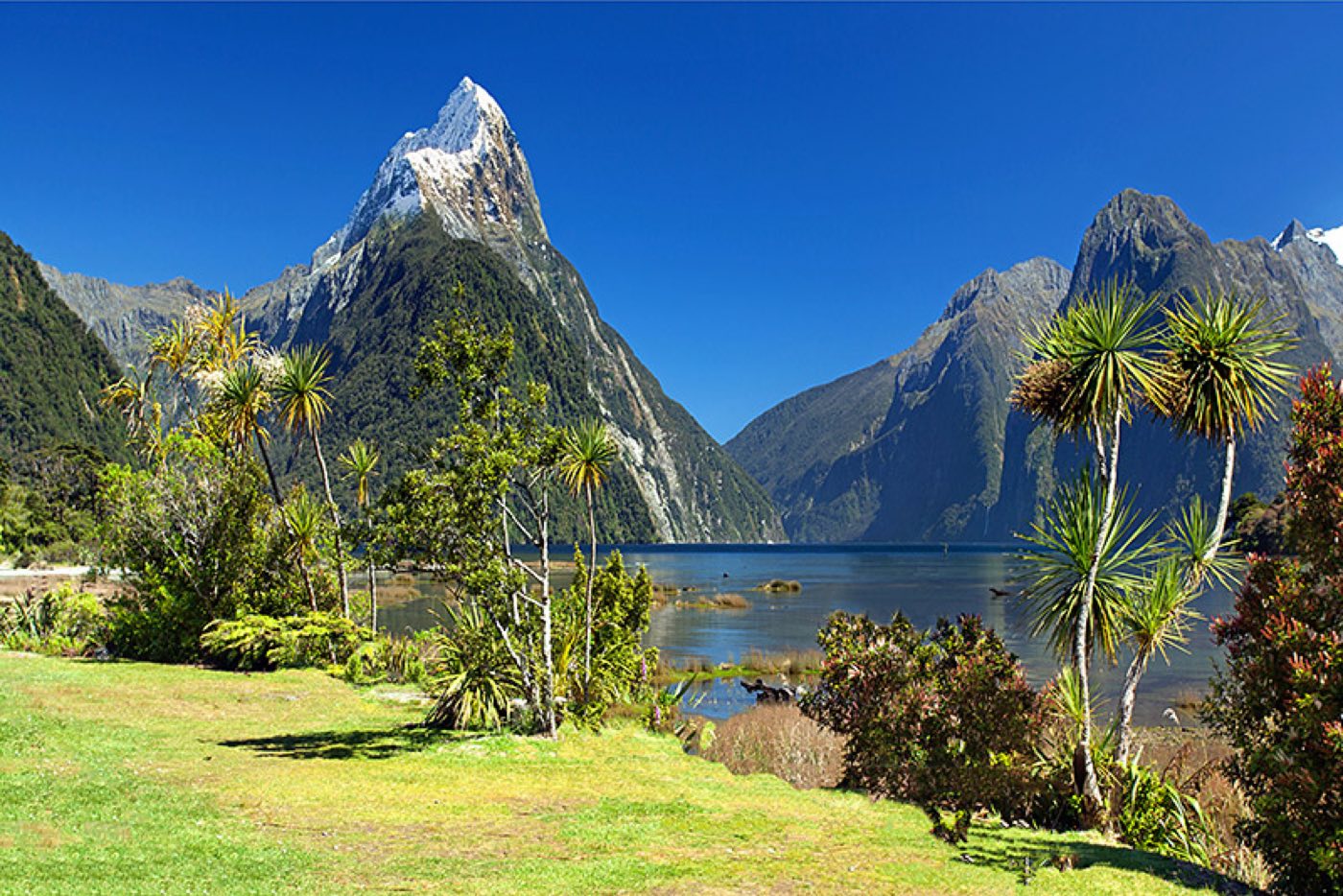
New Zealand
- Capital
- Wellington
- Population
- 5.2M
- Currency
- NZD
- Languages
- English, Māori
Overview
A long, thin Pacific nation of two main islands sitting astride the Southern Alps and the Pacific Ring of Fire, where fjords, active volcanoes, temperate rainforest, and wind-scoured beaches all fit into a country roughly the size of the United Kingdom. Travelers come for Milford Sound's vertical cliffs and waterfalls, Rotorua's geothermal steam, Queenstown's adventure sports, and the Maori cultural traditions woven through the whole country. The distances are real. The South Island in particular rewards slow driving — you can cover it in ten days but you will be moving every morning, and the West Coast road between Greymouth and Haast is one of those stretches where every headland earns a stop. North Island is denser with culture and geothermal geography — Rotorua, Taupo, Tongariro — while the South Island leans harder on the landscape, with Wanaka, Queenstown, Fiordland, and the stretch up to Abel Tasman each warranting their own days. New Zealand rewards travelers who like being outside and are willing to rearrange for weather — the country manufactures its own climate along the Southern Alps and a gray day in Queenstown is a blue-sky day two hours away on the east coast. Coming from the northern hemisphere, remember the seasons flip: summer runs December through February, and the Great Walks book out a year ahead for January. Rental vehicle, a flexible itinerary, and the willingness to detour when a road closes are the three things that turn a good trip here into a great one.
Things to Do
Milford Sound cruise through Fiordland
The drive into Milford from Te Anau is part of the experience — two hours through beech forest, alpine passes, and the Homer Tunnel that drops you into the sound itself. Two-hour cruises run several times a day past Mitre Peak, Stirling Falls, and the resident fur seal colony on Seal Rock. Overnight cruises in the summer let you swim in the fjord and watch the waterfalls at dawn. It rains about 200 days a year here, and honestly, the rain is part of the point — that is when the hundreds of temporary waterfalls appear.
Tongariro Alpine Crossing day hike
Nineteen kilometers across the saddle between Mount Tongariro and Mount Ngauruhoe — the volcano that stood in for Mount Doom in Peter Jackson's films. You start in beech forest at Mangatepopo, climb to the Red Crater at 1,886 meters, skirt the Emerald Lakes with their sulfurous green water, and descend through tussock to Ketetahi. Seven to eight hours if you are moving well. Shuttle buses run from National Park, Turangi, and Whakapapa — book the return transport before you walk. Clear weather is essential; it is above the treeline for most of the route.
Queenstown adventure capital and bungee jumping
The original commercial bungee operation started at the Kawarau Bridge outside Queenstown in 1988, and 38 years later you can still jump there for a starter 43-meter drop, or move up to the 134-meter Nevis from a cable car near the town. Beyond bungees the town runs jetboats up the Shotover, skydiving from 15,000 feet over Lake Wakatipu, paragliding from Coronet Peak, and the Skyline gondola for a more sedate mountain view. Pair with a day trip to Arrowtown for the old gold-mining stone cottages.
Rotorua geothermal parks and Maori culture
The Bay of Plenty city sits on a geothermal field and smells faintly of sulphur as a permanent condition. Whakarewarewa is the living Maori village where you see the Pohutu geyser, bubbling mud pools, and — in the evening — a hangi meal cooked in the ground and a cultural performance that is a working community tradition rather than staged for buses. Wai-O-Tapu down the road has the most colorful pools, including the Champagne Pool. Spend at least two nights; the region is also the North Island's trout-fishing center.
Abel Tasman coastal kayaking
The North Island's sunniest corner has a national park of golden-sand beaches, tidal lagoons, and clear turquoise water best explored on a three-to-five-day coastal track either walking, kayaking, or combining the two with water taxi drops. The four-day Great Walk runs 60 kilometers from Marahau to Wainui; shorter loops let you kayak to a beach for lunch and get picked up by boat in the afternoon. Fur seals, little blue penguins, and dolphins are regular — you will see at least one on most days. Book huts and transport well ahead.
Hobbiton Movie Set in Matamata
The Shire set built for the Lord of the Rings and Hobbit films was preserved and expanded after shooting wrapped, and the 12-acre sheep farm outside Matamata now hosts guided tours through 44 hobbit holes, the party tree, the Mill, and the Green Dragon Inn where the tour ends with a complimentary ale or ginger beer. Pre-book; walk-ups are rarely available. The site is more charming than you might expect even if you have never seen the films — it is a working movie set maintained with obsessive attention. Two hours from Auckland or Rotorua.
Franz Josef and Fox glaciers
Two of the only temperate-zone glaciers in the world to come down to 300 meters elevation through active rainforest, on the West Coast of the South Island. Both have retreated significantly and are no longer safe to walk onto from the terminal face; heli-hikes flying up to the icefall and walking the upper glacier are the way to see them now. Two operators in Franz Josef and Fox villages run daily trips weather-permitting. If weather grounds the helicopters, the valley walks to the terminal face still put you face to face with blue ice and moraine.
Bay of Islands dolphin encounters
North of Auckland in the subtropical top of the country, the Bay of Islands holds 144 islands across sheltered water where bottlenose and common dolphins are resident year-round. Licensed boats run from Paihia and Russell for swimming-with-dolphin trips when pods are found and not nursing young. Russell, the first European settlement in the country, is the charming village the Bay is organized around — old wooden houses, the Duke of Marlborough Hotel, and a ferry hop across from Paihia. The Waitangi Treaty Grounds just north of Paihia are the other essential stop, where modern New Zealand was founded in 1840.
When to Go
December through February is the summer high season — warm days, long daylight, Great Walks open and booked solid, and the beaches of the top of the South Island at their best. March and April are arguably the sweet spot, with autumn color in Arrowtown and Wanaka, warm-but-quieter conditions, and more reasonable accommodation prices. June through August is ski season in Queenstown, Wanaka, and the central North Island, with everything else quieter and the South Island fjords dramatic in winter light. September to November brings spring lambs, flowering pohutukawa, and rising temperatures — a fine shoulder season for everything except the ski fields, which are closing.
Getting Around
Driving is the way — distances are real and public transport outside Auckland, Wellington, and Christchurch is thin. Rental cars and campervans are available at every major airport; remember the country drives on the left and single-lane bridges are common in the South Island. The InterCity bus network covers most towns for travelers who prefer not to drive, and the TranzAlpine train from Christchurch to Greymouth across the Southern Alps is one of the world's scenic rail journeys. Domestic flights through Air New Zealand and Jetstar connect the two islands and the main cities cheaply; the Interislander and Bluebridge ferries between Wellington and Picton make the crossing in about 3.5 hours with vehicles.
Cost & Currency
New Zealand uses the New Zealand dollar (NZD), and prices sit between Australian and northern European levels — not cheap. Expect NZ$5–6 for a coffee, NZ$20–30 for a cafe lunch, NZ$150–250 a night for a mid-range hotel or motel room, and NZ$60–120 a day for a rental car plus fuel. Campervan rentals run NZ$120–300 a day depending on season and vehicle size. Adventure activities are expensive — a tandem skydive is around NZ$400, a bungee from NZ$200, a Milford Sound cruise NZ$100–150. Cards are accepted everywhere including small cafes and market stalls; contactless is the default. Tipping is genuinely not expected and is uncommon outside upscale restaurants.
Frequently Asked Questions
- Do I need a visa to visit New Zealand?
- Travelers from visa-waiver countries including the US, UK, Canada, most of Europe, and Japan need a New Zealand Electronic Travel Authority (NZeTA) plus an International Visitor Levy, applied for online before arrival. It costs around NZ$23 and is valid for multiple entries over two years. Australians do not need a visa or NZeTA. Longer stays and working holidays have separate visa categories.
- How long should I plan for a first trip?
- Two weeks minimum to see both islands at a reasonable pace, three weeks to do it well. A ten-day trip limits you realistically to one island — pick the South Island for landscape-driven travel, the North Island for geothermal, Maori culture, and beaches. Domestic flights make it technically possible to cover both in a week, but you will spend most of it moving rather than seeing.
- Is driving in New Zealand difficult?
- Straightforward but different from North America and mainland Europe. You drive on the left, roads are well signed, and highways are mostly two-lane rather than divided. Single-lane bridges are common in the South Island; give way to oncoming traffic if the sign on your side points at you with a smaller arrow. Allow more driving time than a map suggests — the roads are twisty and the views invite stops.
- When are the Great Walks and how do I book them?
- The ten Great Walks are the government-maintained multi-day tracks and bookings for the official huts and campsites open each year in May through the Department of Conservation (DOC) website. The popular ones — Milford, Routeburn, Kepler, Abel Tasman Coast — sell out for summer (December through February) within hours of release. Off-season walking is possible on some tracks but facilities are reduced and weather is a genuine factor.
- Is New Zealand safe for travelers?
- Yes, one of the safest countries in the world, with low violent crime and solid emergency services. The genuine risks are environmental — the weather changes fast in the mountains, the sun is fiercely strong because of the thin ozone layer, and rental-car theft in car parks at trailheads is a known issue. Do not leave valuables visible, check the forecast before any hike, and wear real sunscreen even on cloudy days.
Plan a Trip to New Zealand
Have you been to New Zealand?
Track 195 countries, 50 states & 63 national parks on your map