San Marino
- Capital
- San Marino
- Population
- 34K
- Currency
- EUR
- Languages
- Italian
Overview
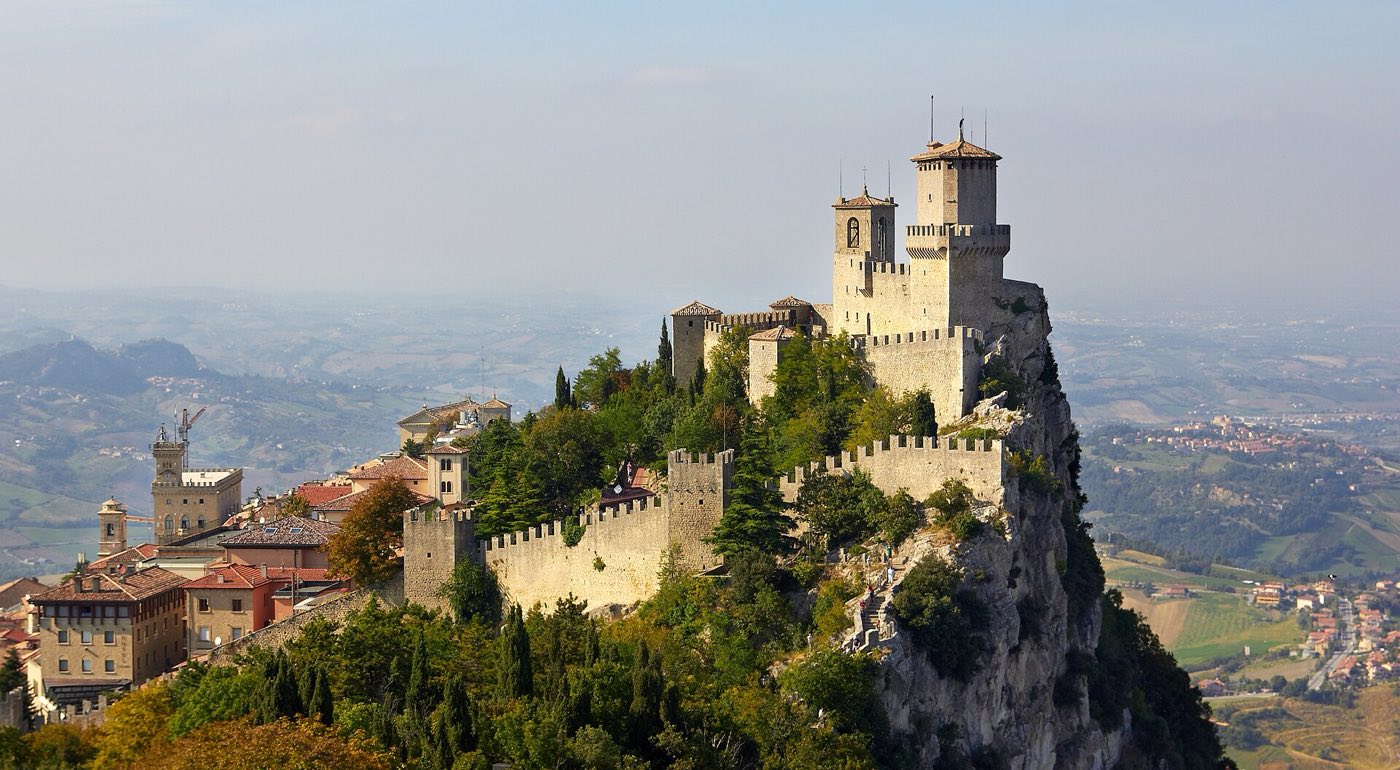
The world's oldest surviving republic — founded, by tradition, in the year 301 — and the fifth-smallest country on earth, San Marino crowns Mount Titano in north-central Italy and covers about 24 square miles of hilltop, ridge, and green valley. Travelers come for the three medieval towers of Guaita, Cesta, and Montale that dominate the skyline, for a compact UNESCO-listed historic center perched at 2,400 feet, and for the novelty of a genuine enclave state that has outlasted every larger neighbor that tried to swallow it. The country is almost entirely walkable, with a single public elevator and a short cable car from the parking lots at the base of the mountain up to the walled Città di San Marino. From there, stone lanes climb past government buildings, stamp shops, and espresso bars toward the towers at the top of the ridge, where the Adriatic coastline opens out to the east and the Apennines stretch behind you to the west. Most visitors treat it as a half-day stop from Rimini; a better approach is to stay the night after the day-trippers leave. Dinner in San Marino's old town, once the tour buses are gone, is the version of the country most people miss — a handful of trattorias serving piadina flatbread, nidi di rondine pasta, and torta tre monti, a local chocolate-wafer cake named after the three towers. Wine is from the surrounding Emilia-Romagna and the Marche, and prices are fractionally better than on the coast. Stay in a small hotel inside the walls and you'll have the ramparts to yourself at sunrise.
Things to Do
Three Towers of San Marino (Guaita, Cesta, Montale)
Strung along the ridge of Mount Titano, the three towers are the emblem of the republic and appear on its flag. Guaita, the oldest, dates from the 11th century and still has its prison cells and a small chapel; Cesta houses the Museum of Ancient Weapons; Montale sits apart on a lower peak and is closed to the interior, visible only from the ridge path. A combined ticket gets you into Guaita and Cesta, connected by the Passo delle Streghe (Witches' Pass) — a stone path along the cliff edge with the best views in the country.
Piazza della Libertà and Palazzo Pubblico
The heart of the walled city is an open stone square looking out over the Romagna plain, framed by the neo-Gothic Palazzo Pubblico where the republic's twin Captains Regent still govern on six-month rotations. Guards in green-and-red uniforms perform a changing ceremony every half hour from late morning through afternoon in the warmer months. Stand at the terrace wall for the postcard view: tiled roofs tumbling down to the valley, with Rimini and the Adriatic visible on clear days.
State Museum of San Marino
Housed in a 19th-century palazzo near Piazza della Libertà, the museum condenses the republic's thousand-year history into a walkable collection — archaeological finds from the earliest settlements, medieval weapons, Renaissance paintings, and documents including San Marino's treaty of friendship with Napoleon and, oddly, with Abraham Lincoln. Compact enough for an hour, substantial enough to anchor your sense of how such a small place kept its independence through two millennia of Italian upheaval.
Basilica di San Marino
The republic's principal church, rebuilt in neoclassical style in 1838 on the site of the original medieval parish, sits on Piazzale Domus Plebis with a colonnaded facade and a bright interior centered on an urn said to contain the relics of Saint Marinus himself — the stonecutter who, according to tradition, founded the community in 301 AD. Free entry, modest dress expected, and a quieter alternative to the tower crowds at midday.
Panoramic views to the Adriatic from Mount Titano
The walk from Guaita along the ridge to Cesta and down to the quieter paths around Montale takes about 90 minutes at a relaxed pace and delivers the full panorama — Adriatic coast and the resort strip of Rimini and Riccione to the east, the green hills of Emilia-Romagna rolling south, and, on very clear winter days, a thin line of Croatian coast across the water. Go at sunset; the low light picks out the tiled roofs and turns the stone gold.
Crossbow competition (September)
Every September, the Palio delle Balestre Grandi brings costumed archers from San Marino and neighboring Italian cities to compete in a medieval-style crossbow tournament in the old quarry arena below the towers. The event is the tail end of a full week of medieval reenactment — flag tossers, drummers, a historical procession through the old town — tied to the anniversary of the republic's foundation. If you're in the region in early September, it's the liveliest the country gets all year.
Museum of Curiosities and Torture Museum
San Marino leans into its kitschier side with two small, genuinely entertaining museums on the Contrada del Pianello: the Museum of Curiosities displays the world's tallest man, shortest woman, and a collection of oddities gathered from Guinness-style records, while the Torture Museum catalogues medieval implements with deadpan historical captions. Neither takes more than half an hour, both are worth the modest ticket price, and together they make a good rainy-afternoon alternative to the ramparts.
When to Go
April through October is the comfortable window — pleasant temperatures, long daylight, and the towers and museums at full hours. June through August is warmest and busiest, with peak day-tripper volume from the Rimini beach resorts; stay the night if you want the old town to yourself after 6 p.m. The early September medieval festival around the republic's foundation day is the cultural high point of the year. Winter is cold and often misty, with the ridge wrapped in cloud and some museums on reduced hours, but the towers dusted in snow have a look you won't find in summer brochures.
Getting Around
San Marino has no airport and no train station; the nearest is Rimini on the Italian Adriatic coast, 20 minutes away by car or an hourly Bonelli Bus (approximately 10 euros each way, about 50 minutes). From the lower town of Borgo Maggiore where most parking and the bus station are, a short funicular climbs to the walled historic center at the top of Mount Titano; it runs every 15 minutes and costs about 5 euros round trip. Inside the walled city, everything is on foot — streets are paved in stone, often steep, and closed to most vehicles. Wear shoes with grip; the old lanes are slippery in rain.
Cost & Currency
San Marino uses the euro and mints its own limited-run coins prized by collectors; you'll get standard eurozone coins in change along with the occasional Sammarinese piece. Prices are comparable to Emilia-Romagna, fractionally lower than the Rimini coast in peak season. Expect 2–3 euros for an espresso, 12–18 euros for a plate of pasta at a trattoria inside the walls, and 90–140 euros for a night at a comfortable hotel in the historic center. Combined tower and museum passes run about 10 euros and are sold at the tourist office on Piazza della Libertà. Cards are accepted almost everywhere; keep some cash for small cafes and the funicular ticket machines.
Frequently Asked Questions
- Do I need a separate visa for San Marino?
- No. San Marino is not in the European Union but has an open-border agreement with Italy, so if you can legally enter Italy — on a Schengen visa or visa-free — you can cross into San Marino without formalities. There's no border control and no passport stamp unless you ask for a commemorative one at the tourist office for a small fee.
- How much time do I need to see San Marino?
- A focused half-day covers the towers, Piazza della Libertà, and one museum. A full day lets you add the basilica, a long lunch, and an unhurried ridge walk at sunset. Staying overnight is the real upgrade — the old town empties of day-trippers after 6 p.m. and you get the walls and the views to yourself. Two nights is generous unless you're using it as a base for day trips into Emilia-Romagna.
- Is San Marino just a tourist trap?
- Partly. The main shopping streets are lined with duty-free perfume and electronics stores aimed at Italian day-trippers, and some of the museums lean kitschy. But the towers, the palazzo, the basilica, and the stone lanes off the main drag are genuine and beautifully maintained. Stay the night, eat where the locals eat, and the ratio shifts fast. The country has about 34,000 actual residents and a real civic life.
- What language do people speak?
- Italian is the official language and is used in government, business, and daily life. The local Romagnol dialect is spoken informally by older residents. Tourist-facing staff speak working English, French, and often German; a handful of Italian phrases — buongiorno, grazie, il conto — are always welcomed. Menus in the old town are typically available in English.
- Can I get San Marino stamps in my passport?
- Yes. The tourist office on Piazza della Libertà offers a commemorative passport stamp for a small fee — it has no legal standing for entry or exit but makes a good souvenir. The country also issues its own postage stamps and coins, which are sold throughout the old town and are genuinely collectible. Postcards mailed from San Marino take the usual Italian mail routes home.
Plan a Trip to San Marino
Have you been to San Marino?
Track 195 countries, 50 states & 63 national parks on your map