Poland
- Capital
- Warsaw
- Population
- 37.7M
- Currency
- PLN
- Languages
- Polish
Overview
A Central European nation of medieval walled cities, painful 20th-century history, and a contemporary food and arts scene that has rewritten what outsiders expect from Warsaw and Kraków. Travelers come for the royal cathedral at Wawel, the moral weight of Auschwitz-Birkenau, the rebuilt old town of Warsaw, Gdańsk's Hanseatic waterfront, and pierogi served hand-pinched at milk-bar counters. What stays with you in Poland is the layering. You walk a square that looks medieval and then read the plaque explaining it was rebuilt brick by brick from 1945 rubble. You eat a meal that would have fed a 19th-century peasant family and then find the same ingredients reworked into a ten-course tasting menu two streets away. The country has been through immense destruction within living memory, and yet it runs now as one of Europe's most dynamic economies, with Warsaw's glass towers rising over tenement courtyards. Poland rewards travelers who want more than a checklist. Kraków alone can fill four days between the castle, the Kazimierz Jewish quarter, the salt mines at Wieliczka, and the sobering day trip to Auschwitz. Add Warsaw for context on the 20th century, Gdańsk for the Solidarity story and Baltic light, and the Tatra mountains if you want genuine walking country. Prices run well below Western Europe, the trains connect the main cities cleanly, and the food — once you get past the cliché of just pierogi — is a genuine reason to come.
Things to Do
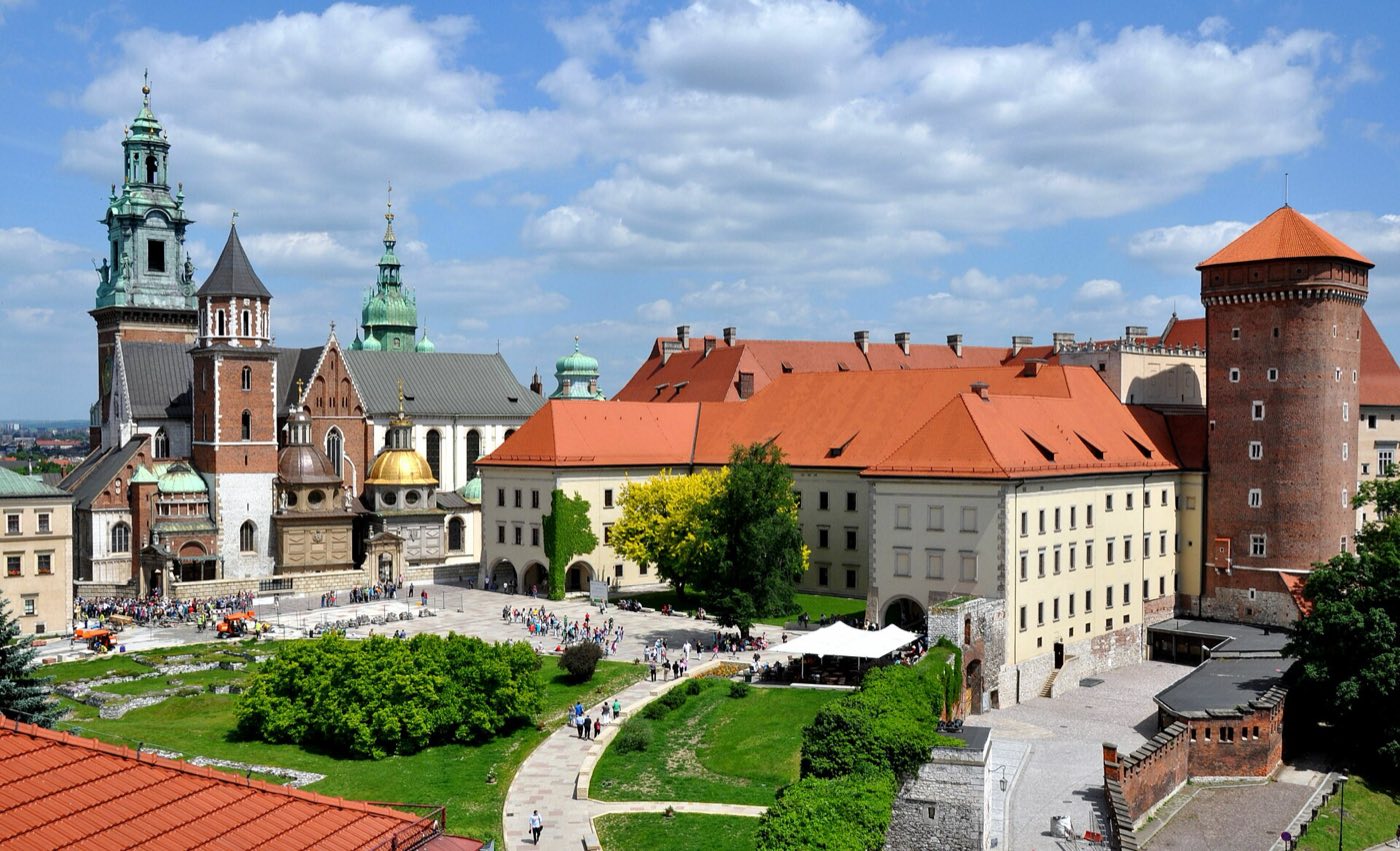
Kraków's Wawel Castle and Main Market Square
The former royal capital runs on two poles — the hilltop Wawel Castle and cathedral above the Vistula, and the Rynek Główny, Europe's largest medieval market square, five minutes' walk downhill. Spend a morning on Wawel for the state rooms and royal tombs, then come back down for lunch on the square under the Cloth Hall's arcades. Climb the Town Hall Tower at dusk and stay on the square to hear the hejnał bugler play at the top of each hour from St. Mary's spire.
Auschwitz-Birkenau Memorial
An hour and a half west of Kraków, the preserved grounds of the Nazi death camp at Oświęcim stand as one of Europe's most essential places to visit and one of its hardest. Guided tours run about three and a half hours across the two sites — Auschwitz I with its block-museum exhibits and Birkenau with the remains of the wooden barracks and railway ramp. Go with an official tour from Kraków or arrive early on your own; admission is free but reservation slots are required. Allow the rest of the day to sit with what you've seen.
Warsaw's rebuilt Old Town
Flattened in 1944 during the Warsaw Uprising, the old town was painstakingly reconstructed from surviving paintings and photographs and now carries UNESCO World Heritage status for the reconstruction itself. The Royal Castle, Market Square, and St. John's Cathedral all date from the 1950s to 70s in their current form. Pair a morning walk with the Warsaw Uprising Museum and POLIN Museum of the History of Polish Jews for the full 20th-century context that the old town alone doesn't tell.
Wieliczka Salt Mine
Twenty minutes outside Kraków, the Wieliczka salt mine has been worked continuously since the 13th century and goes more than 300 meters underground through chambers, lakes, and chapels carved entirely from salt — including the Chapel of St. Kinga, 101 meters down, with salt chandeliers and altarpieces. The standard tourist route runs about two hours and covers 3.5 kilometers of tunnels. Go with the first morning tour to beat the coach groups, and wear layers; it's cool underground year-round.
Gdańsk's colorful Long Market and Solidarity history
The Baltic port city rebuilt its Hanseatic waterfront after WWII with the same attention Warsaw gave its old town, and the pastel townhouses along ulica Długa and the Motława riverfront photograph beautifully at blue hour. Gdańsk is also where the Solidarity movement began at the Lenin Shipyard in 1980, and the European Solidarity Centre is the essential stop for understanding how Polish workers helped end the Cold War. Combine both with an afternoon at Westerplatte, where WWII began.
Białowieża Forest European bison reserve
On the Belarusian border five hours east of Warsaw, Białowieża is Europe's last remaining primeval lowland forest and home to around 800 European bison — the continent's heaviest land mammal, hunted to extinction in the wild by 1927 and reintroduced here. A guided walk into the strict-reserve zone requires a permit and a naturalist; the less-restricted areas are easier to access and still deliver bison sightings at dawn in the surrounding meadows. Stay two nights in the village of Białowieża itself for the best chance.
Tatra Mountains hiking at Morskie Oko
Two hours south of Kraków on the Slovak border, the Tatras are Poland's only alpine range and Morskie Oko — the Eye of the Sea — is the country's most famous mountain lake, a cold green pool ringed by granite peaks at 1,395 meters. The walk in from Palenica Białczańska is a paved nine-kilometer road you can hike both ways (a firm five hours) or ride horse carts partway. Start before 7 a.m. in summer or go midweek in shoulder season to avoid the crowds on the approach.
Wrocław's island cathedral and dwarf statues
The capital of Lower Silesia is built across 12 islands and 130 bridges on the Oder River, and its rebuilt old market square is one of Poland's prettiest after Kraków's. Cross the Tumski Bridge to the cathedral island at sunset when the lamplighter still lights the gas lanterns by hand. The city's unofficial mascots are more than 350 bronze dwarf statues scattered across the center — a playful tradition that dates to the 1980s anti-communist Orange Alternative movement.
When to Go
May through September is the comfortable stretch — warm days, long evenings, and a calendar full of festivals from Kraków's Wianki midsummer celebrations to Gdańsk's Dominican Fair in late July. June and early July are the sweet spot for cities before the August peak and before school holidays push prices up. Autumn from mid-September into October brings crisp light across the Tatra foothills and forest hues in Białowieża, plus the mushroom foraging that most Poles take seriously. Winter is cold and gray in the lowlands but excellent for Christmas markets — Kraków's is one of Europe's best — and skiing in Zakopane from January through early March.
Getting Around
Poland's intercity train network — run by PKP — connects the main cities cleanly and cheaply: Warsaw to Kraków on the Pendolino in about two and a half hours, Warsaw to Gdańsk in under three, and Kraków to Wrocław in three and a half. Book a few days ahead for cheaper tickets on the official site. Within cities, trams and metros (Warsaw only) cover the centers, and ride-hailing via Bolt and Uber is reliable and cheap. Renting a car makes sense for the Tatras, Białowieża, and rural Mazury lakes where trains don't reach, though parking in the historic centers of Kraków and Warsaw is restricted and expensive. Long-distance buses via Flixbus fill gaps and undercut train fares.
Cost & Currency
Poland uses the złoty (PLN) rather than the euro, and prices run well below Western Europe — roughly 30–40% cheaper than Germany or France on food and accommodations. Expect 30–50 zł for a milk-bar lunch of pierogi or barszcz, 60–100 zł for a mid-range restaurant dinner, and 300–500 zł a night for a comfortable hotel room in Kraków, Warsaw, or Gdańsk. Cards are accepted almost everywhere in cities, including contactless on trams and buses; keep 100–200 zł in cash for markets and small-town cafés. Tipping is modest — 10% at restaurants if service was warm, rounding up for taxis, and a few złoty in hand for hotel porters and tour guides.
Frequently Asked Questions
- Do I need a visa to visit Poland?
- Poland is in the Schengen Area, so most Western travelers — US, UK, Canada, Australia, EU — can enter visa-free for 90 days within any 180-day period. As of 2025, the EU ETIAS pre-authorization will apply to non-EU visitors; check the current status before booking, and ensure your passport is valid for at least three months beyond your departure date.
- Is Poland safe for travelers?
- Yes — Poland ranks among the safer countries in Europe, with low violent crime and tourist areas in Kraków, Warsaw, and Gdańsk well patrolled. Petty theft happens around major train stations and on busy trams, so keep your phone and wallet secure. The eastern border with Ukraine and Belarus is a restricted military zone; don't hike close to it without local guidance.
- How much time do I need in Poland?
- Seven to ten days is a comfortable first visit — three or four nights in Kraków (including the Wieliczka and Auschwitz day trips), two in Warsaw, and two in Gdańsk. Add three or four more if you want to include the Tatras around Zakopane, Wrocław, or the Białowieża forest. A long weekend in Kraków alone works well for shorter trips.
- Do people speak English in Poland?
- English is widely spoken in Kraków, Warsaw, and Gdańsk, particularly by anyone under 40 and in tourist-facing businesses. Smaller towns and older generations often prefer German or Russian as a second language, and a few Polish phrases — dzień dobry for good morning, dziękuję for thank you — go a long way. Menus and signage in major cities are routinely bilingual.
- How do I visit Auschwitz respectfully?
- Book a guided tour in advance through the official memorial website — English-language slots fill up days ahead in summer. Dress modestly, stay quiet during the tour, refrain from taking photos inside the hair-display room or the gas chamber, and give yourself mental space afterward. Most day tours from Kraków include transport plus the three-and-a-half-hour tour of both Auschwitz I and Birkenau.
Plan a Trip to Poland
Have you been to Poland?
Track 195 countries, 50 states & 63 national parks on your map