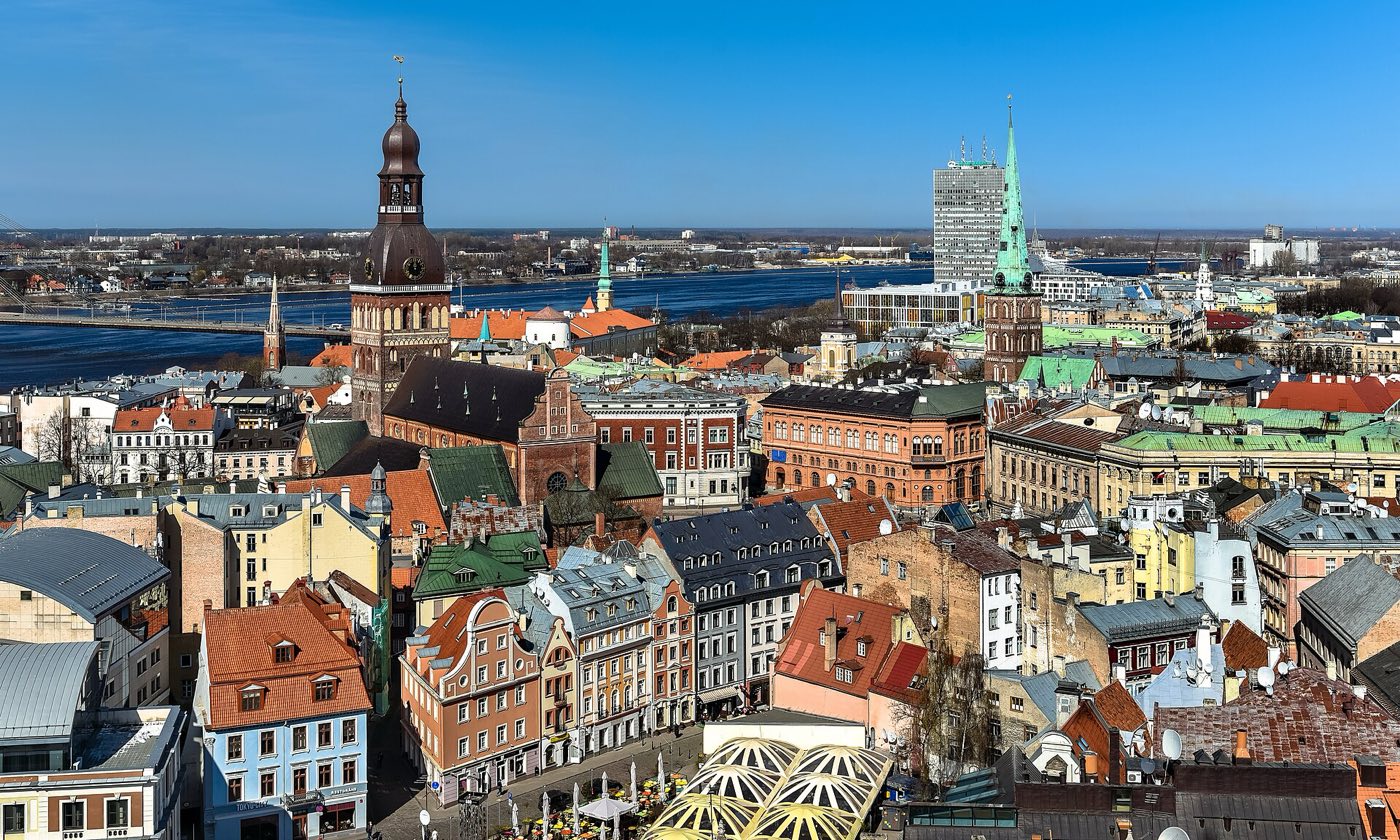
Latvia
- Capital
- Riga
- Population
- 1.8M
- Currency
- EUR
- Languages
- Latvian
Overview
The middle of the three Baltic states, Latvia is a country of long pine forests, quiet amber coastlines, and a capital that holds arguably the finest concentration of Art Nouveau buildings in Europe. Riga is the main draw and deserves more time than most travelers give it — not just the medieval old town but the Alberta iela district, whose facades are carved with sphinxes, masks, and floral ironwork in the florid Jugendstil of the early 1900s. Outside the capital the country opens into forest. About half of Latvia's land surface is woodland, threaded by slow rivers and Soviet-era country roads, and the Gauja Valley an hour northeast of Riga has the castles, the sandstone cliffs, and the cable car at Sigulda that make up the classic day trip. The Baltic coast is endless and almost empty: Jūrmala is the resort strip, but drive two more hours north to Kolka and you have a cape where the Gulf of Riga meets the open sea and the only sound is wind in the pines. Latvia rewards travelers who like their European cities walkable and uncrowded, their food built around rye bread and smoked fish, and their history layered without apology. It is an EU member with the euro, excellent English in Riga, and a small enough size that you can see the highlights in five days or spend two weeks and barely dent the forest interior. Go for the architecture; stay for the way Latvians take their woods seriously.
Things to Do
Riga's Art Nouveau district
The half-square-kilometer block of streets around Alberta iela, Elizabetes, and Strēlnieku holds more than seven hundred Art Nouveau buildings — the largest concentration in Europe and a UNESCO-recognized part of Riga's heritage. Walk up Alberta iela slowly: number 4 by Mikhail Eisenstein (father of the filmmaker) has the screaming faces and pharaonic figures that end up in every guidebook, but the quieter facades on Elizabetes 33 and Strēlnieku 4a reward you more. The Art Nouveau Museum inside architect Konstantīns Pēkšēns's own apartment gives you the inside of one of these buildings preserved in its 1903 original state.
Riga Old Town and House of the Blackheads
The walled medieval core of the capital is small enough to walk across in fifteen minutes and dense enough to hold you for two days. The House of the Blackheads — a 14th-century merchant guild hall, flattened in World War Two and rebuilt stone by stone in the 1990s — sits on Town Hall Square with its bright ornamental facade; the tours inside walk you through restored chambers and a basement kept as museum. Climb St. Peter's Church spire for the city view, spend an hour in the Cat House courtyard, and eat grey peas with bacon at Folkklubs Ala cellar before moving on.
Jūrmala beach resort
Twenty minutes by commuter train from Riga, Jūrmala is thirty kilometers of white sand and pine forest along the Gulf of Riga, backed by wooden villas built as summer houses by the Russian aristocracy before the revolution. The main drag at Jomas iela runs parallel to the beach and fills with outdoor cafes from May through September; the water is shallow and warm enough to swim in from mid-June through August. Rent a bike and ride the forest paths east toward Ķemeri National Park, where the boardwalk through the Great Kemeri Bog is a different kind of landscape entirely.
Gauja National Park and Turaida Castle
An hour's drive or train ride northeast of Riga, the Gauja Valley cuts a sandstone gorge through pine forest that has been protected as Latvia's largest national park since 1973. Sigulda is the main base, with an old Livonian Order castle ruin, a 19th-century reconstruction called Sigulda New Castle, and a Soviet-era cable car strung across the valley. Across the river at Turaida the red-brick castle tower is climbable and the grounds hold a folk sculpture park; the short trail down to Gūtmaņa cave (the largest in the Baltics) is worth the detour. Pair it with a lunch of beaver stew in the old town.
Rundāle Palace — Latvia's Versailles
Ninety minutes south of Riga toward the Lithuanian border, Rundāle Palace is a sprawling baroque complex designed in the 1730s by Bartolomeo Rastrelli — the Italian architect who later built the Winter Palace in St Petersburg — as the summer residence of the Duke of Courland. The interiors have been painstakingly restored over the past forty years: the gilded Golden Hall, the painted ceilings of the White Hall, the Duke's private study with its silk-lined walls. The formal gardens behind the palace cover ten hectares and are at their best in late June when the rose varieties — five hundred and fifty of them — are in full bloom.
Sigulda's medieval castle ruins and cable car
Sigulda is the adventure hub of the Gauja Valley, and the cable car that crosses the 42-meter-deep river gorge has been running since 1969 in what is essentially a Soviet relic still in regular service. In summer there is bungee jumping from the car; in winter it carries skiers over to the small slopes at Reiņa trase. The Livonian Order castle ruin above the town dates to 1207 and its wooden viewing towers along the rampart deliver the valley view. Combine it with the bobsleigh track just outside town — the old Soviet Olympic training facility now open for public runs — for a bracing afternoon.
Riga Central Market in historic Zeppelin hangars
Five enormous arched pavilions just south of the old town were originally built in the 1920s as zeppelin hangars and converted in 1930 into what became one of Europe's largest food markets — a role it still plays daily. Each pavilion has its specialty: fish, meat, dairy, produce, baked goods. The fish hall in particular is worth an hour, with smoked sprats, lamprey, and Baltic herring sold from stalls run by the same families for generations. Eat rye bread and grey peas at a counter, buy a jar of sea buckthorn preserve to take home, and walk out along the river.
When to Go
June through August is the comfortable window, with long daylight — White Nights in late June mean it never fully gets dark in Riga — and Baltic Sea water warm enough to swim in. June 23rd's Jāņi midsummer festival is the country's biggest and worth building a trip around; Latvians leave the cities for their country houses and light bonfires through the short night. May and September are quieter shoulder months with cool but workable weather and far fewer tour groups in the old town. Winter is cold and dark — Riga temperatures stay below freezing from December through February — but the Christmas market on Doma laukums and the sheer silence of the snowy forests have their own appeal for a different kind of trip.
Getting Around
Riga is compact enough to walk, and the tram and trolleybus system covers everything within and beyond the old town for one or two euros a ride. Suburban trains run from Riga Central to Jūrmala (twenty minutes), Sigulda (an hour and ten), and Cēsis (ninety minutes), making most of the Gauja Valley and the coast doable as day trips. For the more scattered parts of the country — Kolka, Rundāle, the Kurzeme coast — a rental car is the realistic choice, and roads are generally well maintained with light traffic outside the capital. Long-distance buses run by Lux Express and Ecolines connect Riga to Tallinn in about four and a half hours and Vilnius in about four. Uber works in Riga but Bolt is more common and often cheaper.
Cost & Currency
Latvia uses the euro, and remains one of the cheaper capitals to visit in the EU — roughly on par with Portugal, well below Paris or Stockholm. A cup of coffee at a Riga cafe runs 2.50–3.50 euros, a sit-down lunch of grey peas, pork, or fish at a traditional restaurant 10–16 euros, and a comfortable mid-range hotel in Riga 70–110 euros a night. Jūrmala runs slightly higher in July and August. Cards are accepted almost everywhere — even market stalls increasingly take contactless — and you can realistically travel the country without touching cash, though it is worth carrying twenty or thirty euros for small-town bakeries and village buses. Tipping is modest: round up at a coffee bar, leave 5–10 percent at a sit-down dinner if the service was warm.
Frequently Asked Questions
- Do I need a visa to visit Latvia?
- Latvia is a Schengen Area member, so citizens of the United States, United Kingdom, Canada, Australia, New Zealand, Japan, and the European Union can enter for up to 90 days within any 180-day period without a visa. Your passport should be valid for at least three months beyond your planned departure. From 2025 onward the new EU ETIAS pre-authorization system applies to most visa-exempt non-EU nationals — check your status before flying.
- How many days do I need in Latvia?
- Three to four days covers Riga and one of the nearby excursions, either Jūrmala or the Sigulda-Cēsis stretch of the Gauja Valley. Five days lets you add Rundāle Palace comfortably. A week opens the country up — drive to the Kolka cape, the Kurzeme coast, and the hilly southeast Latgale region with its Orthodox traditions and lake country. Combined Baltic trips typically give Latvia three nights and pair it with three in each of Estonia and Lithuania.
- Is English widely spoken?
- Yes, English is widely spoken in Riga, Jūrmala, Sigulda, and any tourist-facing business, especially among Latvians under forty. Russian is the second language you will hear on the street — used by the roughly quarter of the population from Russian-speaking families — and older Latvians outside the capital sometimes switch to Russian more readily than English. A few words of Latvian (paldies for thank you, lūdzu for please) go over well.
- Is Latvia safe for travelers?
- Yes, Latvia is safe by European standards, with low violent crime and a well-patrolled capital. The main concerns are standard: pickpocketing in crowded parts of the old town and Central Market, occasional bar scams in Riga aimed at solo male travelers (avoid touts offering to take you to strip clubs), and car break-ins in unattended parking lots. The country borders Russia and Belarus; those border zones are sensitive and not a place to wander, though the routine tourist trail sits nowhere near them.
- Can I do a Baltic states road trip from Riga?
- Easily — Riga is the middle capital of the three and a logical base for a loop. Tallinn is four and a half hours north by car or bus, Vilnius four hours south, and the stretch between them takes in some of the best natural sites: the Estonian islands of Saaremaa and Hiiumaa, the Curonian Spit sand dunes on the Lithuanian-Russian border, and Trakai castle outside Vilnius. Ten days to two weeks is enough for all three capitals plus a real look at the countryside in between. Rental cars from Riga airport start around thirty-five euros a day.
Plan a Trip to Latvia
Have you been to Latvia?
Track 195 countries, 50 states & 63 national parks on your map