Colombia
- Capital
- Bogotá
- Population
- 52.1M
- Currency
- COP
- Languages
- Spanish
Overview
A country that packs the Caribbean, the Andes, the Pacific, the Amazon, and the Llanos plains into a single territory, Colombia is one of the most geographically varied nations in the Americas. Travelers come for Cartagena's bougainvillea-draped colonial walls, the coffee farms of the Zona Cafetera, the four-day trek to Ciudad Perdida through the Sierra Nevada, and Medellín's remarkable reinvention from the city it was thirty years ago. What stays with you is the warmth. Colombians are unreserved in a way that surprises travelers used to colder cultures — strangers strike up conversations on buses, taxi drivers offer recommendations you did not ask for, and the fruit seller on the corner will insist you try the guanábana before you buy it. You feel it most in Medellín on a weekday evening in Parque Lleras, or in a Cartagena plaza when the accordion player sets up around eight and the whole square starts to sway. Colombia rewards travelers willing to go beyond the coast. The Coffee Triangle, the Tatacoa Desert, the Amazon port of Leticia, the whale-watching villages on the Pacific at Nuquí — none of these are hard to reach anymore, and all pay back the flight or bus ride many times over. Safety has improved enormously across the traveled corridors; still, the country has regions you should skip and a few cities where ordinary city-street caution applies more sharply. Ask locals, trust hotel staff, and you will have the kind of trip that keeps pulling you back.
Things to Do
Cartagena's walled old city
The walls went up over two centuries starting in 1586 to keep out English pirates, and inside them sits one of the most intact colonial cities in the Americas — ocher, mustard, and rose facades draped in bougainvillea, horse-drawn carriages clattering past in the evening, balconies heavy with flowers. Walk the top of the murallas at dusk from Baluarte de San Francisco Javier around to Café del Mar for the sunset. Getsemaní, just outside the old wall, is where the street art, rooftop bars, and better-value restaurants sit — stay there over the more polished Centro if you want the city's current pulse.
Coffee Triangle (Salento and Cocora Valley)
Three departments in the central Andes — Caldas, Quindío, and Risaralda — produce some of the best arabica on earth, and the hub for travelers is the painted-facade town of Salento in Quindío. Spend a morning on a working finca learning how the cherries are picked, fermented, and roasted (El Ocaso runs a good English-language tour), then head out to the Cocora Valley for a day hike through cloud forest past Colombia's national tree, the wax palm, which grows up to sixty meters tall. A willys jeep ride to the trailhead is half the fun.
Medellín's Comuna 13 street art and cable cars
Twenty years ago Comuna 13 was the most dangerous neighborhood in what was then the most dangerous city in the world. Today a set of outdoor escalators climbs the hillside, the walls are covered in political murals, and the community runs walking tours led by locals who lived through the transformation. Take the metro to San Javier, join a tour in the late afternoon, and stay for sunset. Afterward, ride the Metrocable up to Parque Arví at the top of the valley for a different angle on the city's geography and a quiet forest reserve at the summit.
Ciudad Perdida (Lost City) trek
A four- or five-day guided trek through the Sierra Nevada de Santa Marta brings you to the stone terraces of a Tayrona city built around 800 AD and abandoned three centuries before Machu Picchu was built. The route runs through indigenous Kogi and Wiwa territory — only four licensed operators are allowed to run it — and the final climb up 1,200 moss-covered stone steps deposits you on a terraced summit most days still shrouded in cloud forest mist. It is humid, steep, and worth every hour. Book in Santa Marta or online with Magic Tour or Expotur.
Tayrona National Park beaches
On the Caribbean coast east of Santa Marta, the park protects a stretch of jungle meeting sea, with bays of white sand fringed by granite boulders and palms that lean out over the water. The hike in from the El Zaino entrance takes about two hours through coastal forest to Cabo San Juan, the postcard bay where most visitors swim and sling a hammock for the night. The swim at Playa Cristal is calmer; the currents at Arrecifes are dangerous so watch the warning flags. Close by late January and early February each year for indigenous cultural cleansing.
Bogotá's Museo del Oro and La Candelaria
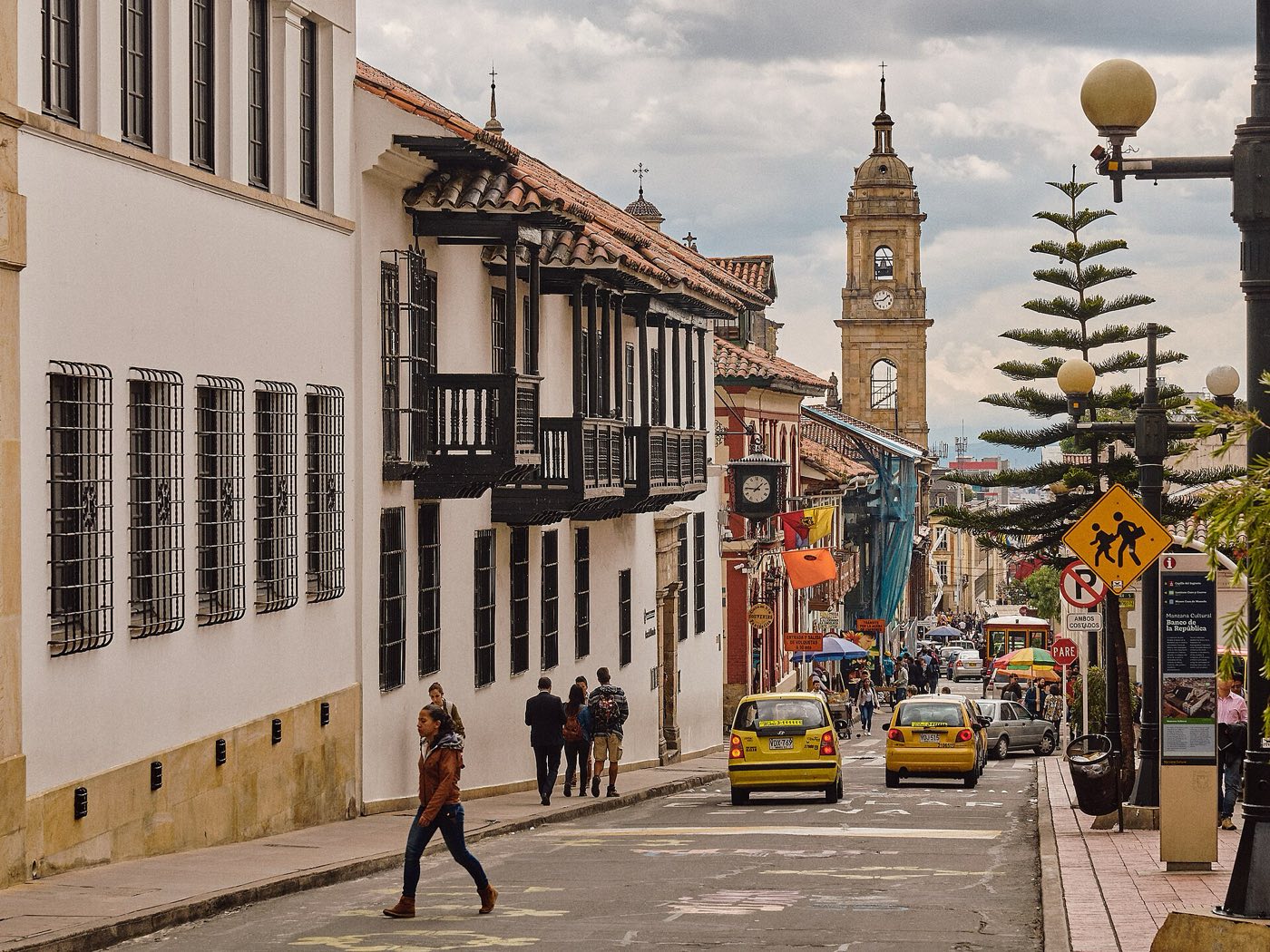
The Gold Museum in the capital holds more than fifty thousand pieces of pre-Columbian goldwork from the Quimbaya, Tairona, Muisca, and other cultures — the Muisca raft alone, which inspired the El Dorado legend, is worth the entry. Pair it with a morning wandering La Candelaria, the colonial quarter where Bolívar and Santander plotted independence, and climb Cerro de Monserrate in the afternoon either by funicular or cable car for a view over Bogotá's sprawl to the green savanna beyond. Finish with ajiaco and a copa de vino in a small restaurant on Carrera 7.
Caño Cristales rainbow river
For a few months each year — roughly July through November — a stretch of a river in the Serranía de la Macarena turns red, yellow, green, blue, and black all at once, the colors produced by an aquatic plant called Macarenia clavigera blooming in the current. You reach it only via a short flight from Villavicencio or Medellín to La Macarena, then a guided trip through FARC-decommissioned jungle that opened to tourism after the 2016 peace process. Swim in the pools where allowed, photograph the rest, and treat it as the rare and fragile ecosystem it is.
San Andrés Island Caribbean waters
An hour and a half by plane northwest of mainland Colombia, the island of San Andrés sits in what locals call the Sea of Seven Colors for the way the shallows fade from clear to deep cobalt. The vibe is Creole-Caribbean — English and Spanish mixing in the streets — and the beaches at Spratt Bight and Rocky Cay are easy half-day swims. Rent a mule (a small buggy) to circle the island in a few hours, dive at the wreck of the Blue Diamond, and eat rondón — a coconut-milk seafood stew — at a place off the main tourist strip.
When to Go
December to March is the driest stretch for most of the country and the sweet spot for the Caribbean coast. July and August give you a second dry window across much of the Andes and are the best months for the Cocora Valley and Coffee Triangle. The rainbow bloom at Caño Cristales runs roughly July to November. April, May, October, and early November bring the heaviest rain and some road closures in the mountains; the coast stays warm year-round but hurricane-season tropical storms can brush the San Andrés archipelago from August through October.
Getting Around
Domestic flights are cheap by Latin American standards and save enormous amounts of time: Bogotá to Cartagena is an hour and costs $40–$80 one-way, Bogotá to Medellín the same. Avianca, LATAM, and Wingo cover the main routes. Long-distance buses connect everywhere the planes do not and operate reliably out of large modern terminals; buy tickets same-day at the terminal rather than through resellers. Within cities, Uber works (though operates in a legal gray zone), Didi is an alternative, and yellow taxis are fine if you use a hotel to call one or the inDrive app. Medellín and Bogotá both have well-run metro and bus-rapid-transit networks.
Cost & Currency
Colombia uses the Colombian peso (COP) and remains one of the better travel values in South America. Budget accommodation in hostels runs 50,000–90,000 COP a night, mid-range hotels in Medellín or Cartagena 200,000–400,000 COP. A full lunch menú del día costs 15,000–25,000 COP, a sit-down dinner with a drink 50,000–90,000 COP, an espresso 5,000–8,000 COP. Cards are widely accepted in cities but cash is useful for street food, taxis, and rural areas — most ATMs dispense 300,000 to 600,000 per withdrawal. Tipping is a 10% servicio voluntario added to restaurant bills, which you can accept or decline; round up taxi fares, and 15,000–20,000 COP a day for a good trekking porter is fair.
Frequently Asked Questions
- Is Colombia safe for travelers?
- The main tourist corridors — Bogotá, Medellín, Cartagena, the Coffee Triangle, Tayrona — are safer than they have been in a generation and receive millions of visitors a year. Use common urban caution: registered taxis or ride apps at night, no expensive jewelry on the street, no venturing into unfamiliar comunas alone. Some regions, particularly parts of Cauca, Nariño, and the Catatumbo, still have active armed-group activity — check your government's current travel advisory before planning routes there.
- Do I need a visa to visit Colombia?
- Most travelers from the US, Canada, the UK, the EU, and Australia do not — you get a 90-day tourist stamp on arrival that can be extended once for another 90. Your passport must be valid for at least six months beyond your entry date, and Colombian immigration sometimes asks for proof of onward travel. Check current rules for your specific passport before booking.
- Do I need to speak Spanish?
- You will have a smoother, deeper trip if you do. English is spoken in the higher-end hotels, established tour operators, and parts of Cartagena and San Andrés, but falls off quickly elsewhere, including in a lot of Bogotá and Medellín. Colombian Spanish is notably clear and well-pronounced, which makes it a good country to practice in — bring a phrasebook and a translation app for the gaps.
- Is the tap water safe to drink?
- Bogotá and Medellín's municipal tap water is generally safe and locals drink it straight. Cartagena, the coast, and rural areas are more variable — stick to bottled or filtered water along the Caribbean and in smaller towns. Most hotels provide bottled water or a filtered dispenser in the lobby, and restaurants use purified water for ice and juices.
- How long should I plan for a first trip?
- Two weeks lets you sample three regions without rushing — typically Cartagena and the Caribbean coast, the Coffee Triangle, and either Medellín or Bogotá. Ten days is workable if you pick two regions and fly between them. Three weeks unlocks the Sierra Nevada, Tayrona, and either the Amazon at Leticia or the Pacific coast at Nuquí. The country is genuinely varied, so resist the temptation to cram in more than two geographies per week.
Plan a Trip to Colombia
Have you been to Colombia?
Track 195 countries, 50 states & 63 national parks on your map