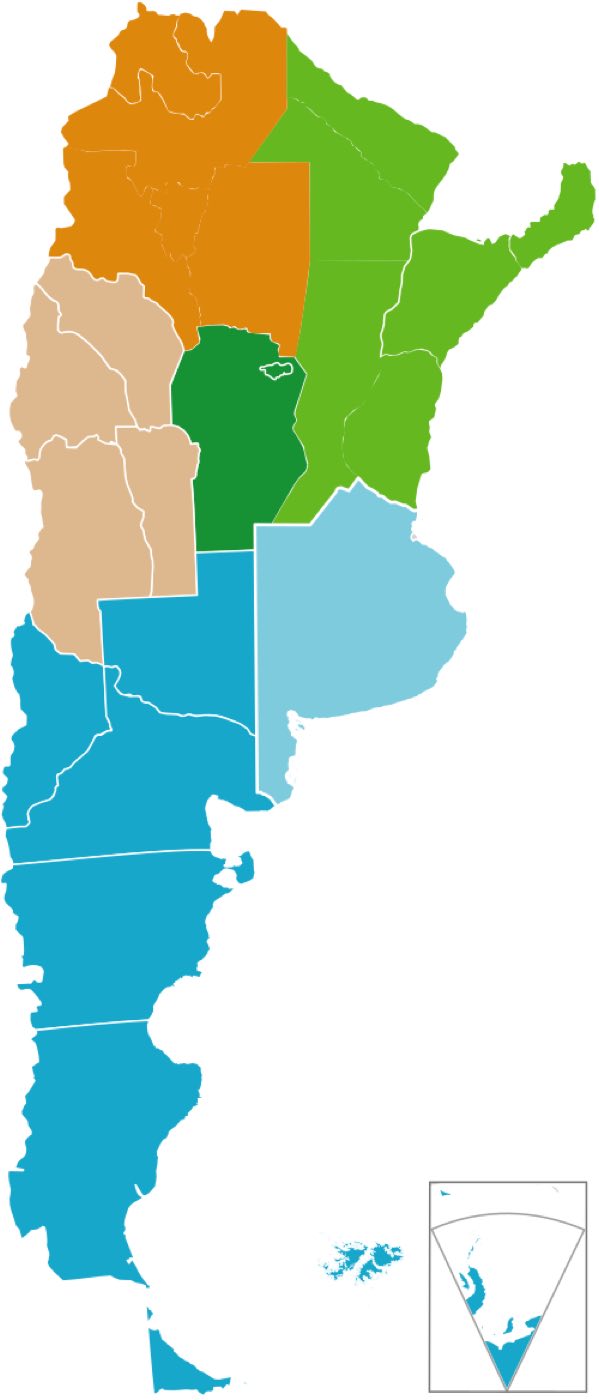
Argentina
- Capital
- Buenos Aires
- Population
- 46.7M
- Currency
- ARS
- Languages
- Spanish
Overview
A country of staggering geographic range, stretching from subtropical rainforest at Iguazú down through the wine country of Mendoza and the endless horizon of the Pampas to the ice fields and granite spires of Patagonia. Travelers come to drink Malbec under the Andes, dance tango in Buenos Aires, watch glaciers calve into turquoise lakes, and hike in the shadow of Fitz Roy. Argentina rearranges your sense of scale. Distances are continental — a flight from Buenos Aires to El Calafate takes three and a half hours and you are still in the same country — and the landscapes shift as completely as the weather. Porteños, as Buenos Aires residents call themselves, keep European hours in a Latin American city: dinner at 10 pm, milonga dance halls running until 4 am, and a coffee culture that treats a single cortado as the right thing to do for an hour. Head to Patagonia and the rhythm flips entirely — small towns, early starts, wind that runs so hard it stops you mid-sentence. Argentina rewards travelers who give it room. You cannot do Iguazú, Buenos Aires, Mendoza, and Patagonia in a single week without feeling shortchanged by all of them. Pick two regions, build in the long transit days, and lean into the slow meals, the late nights, and the long horizons. The country will repay every extra day you give it.
Things to Do
Iguazú Falls
On the Brazilian border in the country's subtropical northeast, 275 individual waterfalls drop through rainforest along a nearly two-mile rim — a scale and complexity that makes Niagara look tidy by comparison. Walk the Argentine side's steel catwalks that put you directly above the Devil's Throat, the horseshoe-shaped main drop, and the spray comes up the back of your neck. Cross to the Brazilian side the next day for the panoramic view. Give it two full days and expect to be soaked.
Perito Moreno Glacier
A 19-mile-long river of ice that flows down from the Southern Patagonian Ice Field and meets Lago Argentino with a blue wall nearly 200 feet high, still advancing while most of the world's glaciers retreat. Viewing platforms on the opposite shore let you spend a morning watching chunks the size of houses shear off into the lake with a crack that arrives a second after you see the ice fall. Guided mini-trek tours strap crampons on and walk you across the surface.
Buenos Aires tango and San Telmo market
The tango is everywhere in the capital, but the honest version is in the milongas — neighborhood dance halls where porteños in their 60s and 70s still dance four nights a week to recorded orchestras from the 1940s. Confitería Ideal and Salón Canning are two to try. Sunday morning, the San Telmo Sunday market fills Plaza Dorrego and the surrounding cobblestone blocks with antique dealers, street performers, and leather goods — arrive by 10 before the tourist crowds thicken.
Mendoza wine country
At the foot of the Andes in the country's dry west, the Mendoza region produces the Malbec that launched Argentine wine onto global lists, and the high-altitude vineyards of the Uco Valley are where the most serious producers now cluster. Rent a car or hire a driver for a three-bodega day, with a long lunch at a winery like Bodega Salentein or Andeluna. The snowcapped Cordón del Plata forms the backdrop to every tasting. Go March through May for harvest.
Fitz Roy and Los Glaciares National Park
The granite tower of Monte Fitz Roy rises 11,000 feet straight out of the Patagonian steppe, and the trailhead for the classic day hike to Laguna de los Tres starts from the village of El Chaltén. It is a ten-mile round trip, the last mile a steep scramble, and the payoff is a glacial lake directly under the peaks with reflections on calm mornings that make every photograph look unreal. Go early — Patagonian weather turns fast, and the peak often cloaks itself by noon.
Ushuaia and the Beagle Channel
The southernmost city in the world sits on the shore of the Beagle Channel, framed by the last of the Andes before they drop into the Drake Passage. Half-day catamaran trips run out along the channel to the Les Éclaireurs lighthouse and the sea lion and cormorant colonies that cluster on its offshore rocks. The city itself is worth a day for the End of the World museum and the old prison that is now a naval museum. Most Antarctic cruises depart from the port here.
Bariloche and the Lake District
On the Chilean border in northern Patagonia, Bariloche sits on the shore of Lago Nahuel Huapi and is the hub for the region's alpine lakes, Swiss-style villages, and some of South America's best skiing at Cerro Catedral. Summer brings sailing, trout fishing, and the Circuito Chico drive around the peninsula. Stop for chocolate on the main drag — the town's German-Swiss settler heritage made it the country's chocolate capital — and expect the scenery to feel more Alps than Andes.
Quebrada de Humahuaca
A 96-mile-long canyon in the country's far northwest where the Andes fold into layered red, green, and ochre rock and small Quechua villages preserve pre-Columbian traditions that predate the Spanish. Purmamarca sits below the Hill of Seven Colors; Tilcara has its reconstructed Inca fortress; Humahuaca itself feels further from Buenos Aires than any distance on a map. A UNESCO-protected stretch, and a reminder that Argentina is not only Patagonia and porteño cafés.
When to Go
The country's length means you need to match the region to the season. October through April suits Patagonia, with the long daylight and relatively stable weather of December through February the prime trekking window. Buenos Aires is comfortable from April to June and September to November; the summer months of January and February are hot and the city half-empties for the coast. Mendoza's wine harvest runs late February through April. Iguazú is spectacular year-round but peaks in March and April. Bariloche skiing runs June through September. Avoid Patagonia in the southern winter — most lodges close, and the wind is punishing.
Getting Around
Argentina is too big to drive across on a short trip. Aerolíneas Argentinas and a handful of budget carriers connect Buenos Aires to Iguazú, Mendoza, El Calafate, Bariloche, Ushuaia, and Salta — book a few weeks out for reasonable fares, and expect the occasional rescheduled flight. Long-distance buses are genuinely comfortable at the cama (sleeper) level and a reasonable overnight option between Buenos Aires and Mendoza or Bariloche. Within Buenos Aires, the Subte metro and taxis cover most needs; ride-hailing works through apps. For Patagonia's national parks, rent a car in El Calafate or Bariloche — distances between towns are long and the roads are generally well paved.
Cost & Currency
Argentina uses the Argentine peso (ARS), a currency that has seen triple-digit inflation in recent years and whose exchange rate changes meaningfully week to week. The unofficial blue-dollar rate is significantly better than the official one — bring fresh US$100 bills and change them through a reputable casa de cambio or the Western Union network, which in 2026 still offers the better rate for most travelers. Expect roughly US$8–$15 for a steak dinner outside Buenos Aires, US$20–$40 in a tourist-facing parrilla in Palermo, and US$60–$150 a night for a mid-range hotel room. Cards are widely accepted but often apply the less favorable official rate — cash is king. Tipping is 10% at restaurants.
Frequently Asked Questions
- Do I need a visa to visit Argentina?
- Citizens of the US, Canada, the UK, Australia, New Zealand, the EU, and many other countries do not need a visa for tourist stays of up to 90 days — a valid passport and an onward ticket are enough at the border. Rules change periodically, so check with your nearest Argentine consulate a few weeks before departure.
- Is Argentina safe for travelers?
- Argentina is generally safe for visitors, with Buenos Aires comparable to a large European capital in terms of day-to-day risk. Pickpocketing and bag-snatching happen in tourist areas like La Boca, Retiro, and around the Obelisco — stay aware, keep your phone in an inside pocket, and do not walk with valuables visible at night. Violent crime against tourists is rare.
- What's the best way to handle money in Argentina?
- Bring fresh, unmarked US$100 bills and change them as you go through Western Union or a recommended casa de cambio, which gives you the unofficial blue-dollar rate — considerably better than the bank rate most credit cards apply. Some foreign Visa and Mastercard transactions now get a special tourist rate, but cash remains the most reliable way to stretch your budget.
- How long should I plan for a first trip?
- Ten to fourteen days is the practical minimum for a first visit — three or four nights in Buenos Aires, three at Iguazú Falls or in Mendoza, and four or five in Patagonia (El Calafate plus El Chaltén). Longer trips let you add Ushuaia, Bariloche, or the northwest. Under a week you are really only looking at Buenos Aires and one other region.
- Do I need to speak Spanish?
- English is spoken at most hotels, tourist-facing restaurants, and by younger Argentines in Buenos Aires, but elsewhere — and especially in Patagonia's small towns and the northwest — Spanish goes a long way. Argentine Spanish has its own accent (the double-l sounds like sh) and plenty of slang, but basic phrases and a translation app are enough for almost any situation.
Plan a Trip to Argentina
Have you been to Argentina?
Track 195 countries, 50 states & 63 national parks on your map