Paraguay
- Capital
- Asunción
- Population
- 6.8M
- Currency
- PYG
- Languages
- Spanish, Guaraní
Overview
A landlocked South American country wedged between Argentina, Brazil, and Bolivia, Paraguay runs on two languages — Spanish and Guaraní — and keeps a lower profile than any of its neighbors. Travelers come for the sandstone Jesuit reduction ruins at Trinidad and Jesús, the Chaco wilderness, and the slow colonial streets of Asunción. The rhythm here is different. Afternoons stretch long; tereré — cold mate sipped through a metal straw from a leather-wrapped thermos — gets passed in offices, on park benches, and across truck hoods from 9 a.m. onward. Guaraní is the more commonly spoken tongue on the street, and you'll hear it mixed into Spanish in a way that takes a few days to tune your ear to. People are direct, warm, a little shy with outsiders at first, and genuinely pleased to find you've bothered to come. Paraguay rewards travelers who like their travel uncrowded and their history legible on the ground. You can stand alone inside the pink-sandstone nave at Trinidad at dusk, drive two hours through Chaco scrub without meeting another car, and eat grilled beef the size of your forearm for eight dollars. It's not polished for tourists, and that's exactly the point — come for a week and you'll leave with the country largely to yourself.
Things to Do
Jesuit Mission ruins at Trinidad and Jesús UNESCO sites
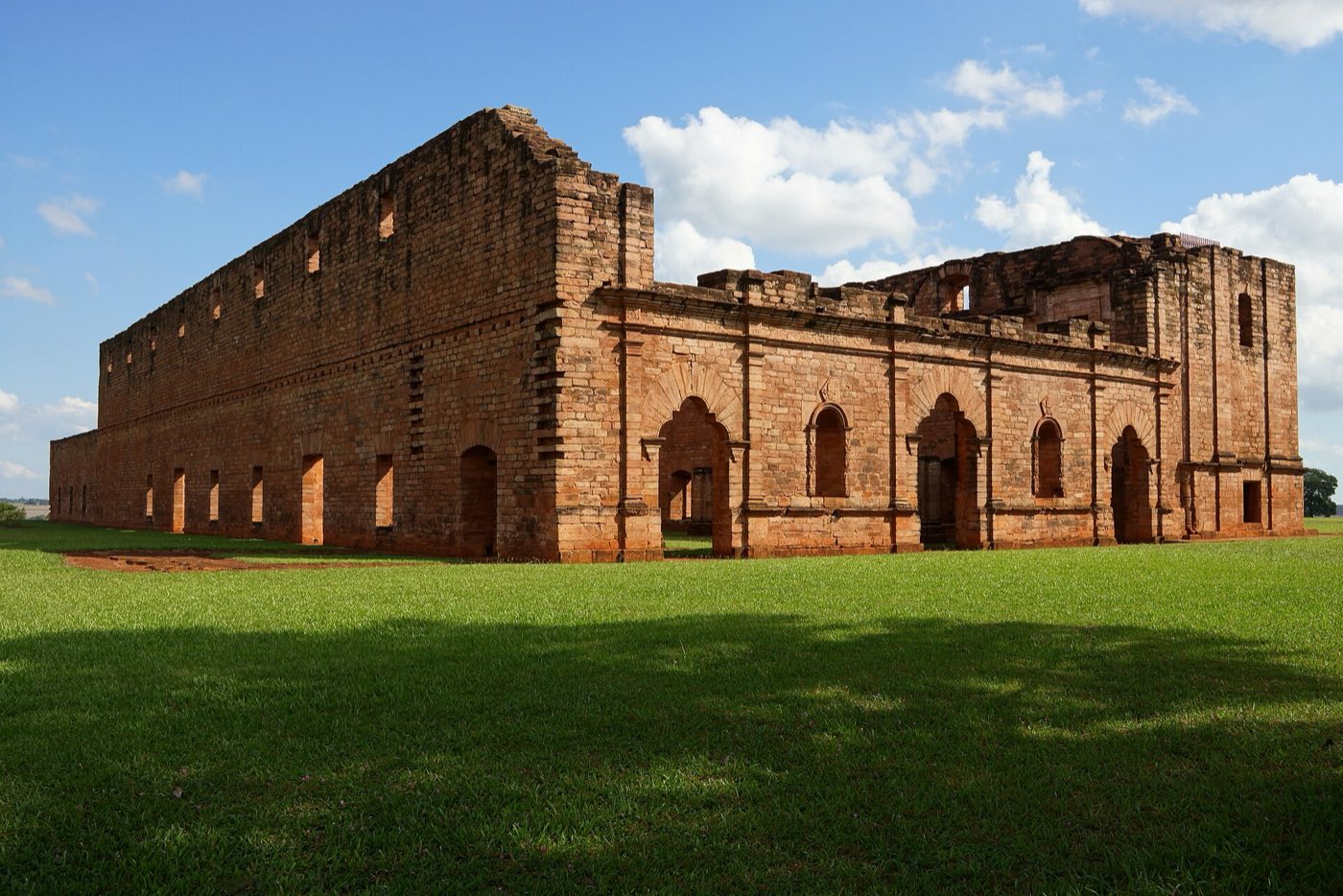
Forty minutes from Encarnación on a rolling two-lane highway, the 17th- and 18th-century reductions of Trinidad and Jesús de Tavarangue stand as the best-preserved Jesuit mission ruins in South America. Pink sandstone walls, carved angel friezes, and the empty church naves sit on grassy plateaus above the surrounding farmland. Go late in the afternoon when the stone warms to orange and the light-and-sound show fires up at Trinidad after dark — a cheap evening ticket that few other visitors will be sharing with you.
Asunción's Panteón Nacional and Loma San Jerónimo
The capital's riverfront center is low-slung and easy to walk, punctuated by the domed Panteón Nacional de los Héroes where honor guards rotate in crisp white. A few blocks east, the Loma San Jerónimo barrio has been painted block by block in saturated blues, reds, and yellows — a working neighborhood that now doubles as an open-air gallery. Pair the two with a tereré stop on Plaza Uruguaya and you've got a gentle half-day on foot.
Itaipú Dam — world's largest hydroelectric facility
At the Brazilian border near Ciudad del Este, the Itaipú complex pushes out more energy annually than any other dam on Earth, edging out China's Three Gorges in most years. Free guided tours from the visitor center walk you across the top of the structure and down into the turbine hall, where the floor vibrates underfoot. Combine it with a morning at Iguazú Falls on the Argentine or Brazilian side for one of the continent's most compressed engineering-and-nature days.
Chaco wilderness and Mennonite colonies
West of the Paraguay River, the Gran Chaco opens into thornscrub, wetlands, and cattle ranches that run to the Bolivian border. The Mennonite colonies of Filadelfia and Loma Plata — German-speaking farming communities founded in the 1920s and 30s — make unlikely but useful bases with clean lodging and excellent bread. Hire a local guide for the Defensores del Chaco national park; jaguar, puma, and giant anteaters all live here, and the birdlife alone justifies the drive.
Ñeembucú wetlands birdwatching
South of Asunción, the Ñeembucú wetlands are a flooded landscape of lagoons, grasslands, and ibera-style reed channels that ranks among South America's quieter birding destinations. Jabiru storks, roseate spoonbills, maned wolves, and southern screamers all appear on a morning boat with a local guide out of Pilar. Accommodations are simple estancia-style stays; go on a full-moon night and the frog chorus runs until dawn.
San Bernardino lakeside resort town
An hour east of Asunción on Lake Ypacaraí, San Bernardino is the weekend escape for the capital — a 19th-century German-settled town of wooden bungalows, lakefront restaurants, and summer beach clubs that fills up from December through February. Go off-season and you'll find empty terraces, cold beer, and grilled surubí river fish served with mandioca. The drive in, past strawberry stands and chipa bakeries, is half the pleasure.
Saltos del Monday waterfall
On the edge of Ciudad del Este, the Monday Falls drop 40 meters in a wide horseshoe and draw a fraction of the crowds Iguazú pulls a few kilometers away. A short network of platforms and a zipline run out over the gorge, and the surrounding park keeps capuchin monkeys and toucans in easy view. Worth a two-hour stop if you're already heading to Itaipú or the Brazilian border — a quieter counterpoint to the bigger falls downstream.
When to Go
April through September is the stretch to aim for — cooler, drier weather that makes the ruins, wetlands, and Chaco genuinely comfortable to explore. May through August is peak dry-Chaco season and the only safe window for interior tracks. Summers from December through February push temperatures past 40°C with heavy humidity, and while the lake towns come alive, inland travel becomes punishing. The Trinidad light-and-sound evenings run year-round, and the Festival del Ñandutí lace-making in Itauguá falls in July, at the heart of the best weather.
Getting Around
Long-distance buses are the backbone of Paraguayan travel and the quality is better than outsiders expect — overnight semi-cama services link Asunción with Encarnación, Ciudad del Este, and Filadelfia in the Chaco, and seats are cheap enough to book on the day. Renting a car makes sense for the Jesuit missions circuit and the Ñeembucú wetlands, and the main highways are paved and well signed. In the Chaco, a 4x4 is non-negotiable; the Trans-Chaco cuts through but secondary tracks turn to deep dust or thick mud depending on the season. Within Asunción, ride-hailing (Uber, Bolt, MUV) works well; taxis in smaller towns require negotiating the fare before you start.
Cost & Currency
Paraguay uses the guaraní (PYG), one of South America's weaker currencies against the dollar, and almost everything is priced accordingly. Expect 30,000–50,000 PYG (roughly $4–$7) for a full lunch of grilled beef with mandioca and salad, 200,000–400,000 PYG for a comfortable mid-range hotel room in Asunción or Encarnación, and 10,000–15,000 PYG for a long city bus ride. Cards are accepted at most Asunción hotels and supermarkets but cash is still king outside the capital; ATMs are reliable in cities and scarce in the Chaco. Tipping is gentle — 10% at sit-down restaurants is generous, rounding up is standard for cabs and cafés.
Frequently Asked Questions
- Do I need a visa to visit Paraguay?
- Most Western passports — US, EU, UK, Canada, Australia — can enter Paraguay visa-free for 90 days, and the stamp is given on arrival at Silvio Pettirossi International Airport in Asunción or at the main land borders. Always confirm current rules with the Paraguayan consulate before you travel, as reciprocity requirements have shifted in recent years.
- Is Paraguay safe for travelers?
- Paraguay is broadly safe for visitors, with Asunción, Encarnación, and the Jesuit mission circuit among the calmest areas. Petty theft happens around Ciudad del Este and Mercado 4 in Asunción, so keep valuables discreet and use a money belt. The far northeast near the Brazilian border has had drug-related incidents; stick to the main tourist routes and you'll have no trouble.
- Do people speak English in Paraguay?
- English is limited outside major hotels and tour operators in Asunción and at the Jesuit ruins. Spanish will carry you almost everywhere, and a few Guaraní phrases — mba'éichapa for hello, aguyje for thank you — are warmly received. Offline translation apps fill the gaps; outside the capital, be ready to point at menus and use your hands.
- Is the tap water safe to drink?
- Tap water in Asunción and major cities is generally treated and considered safe, though most locals drink filtered or bottled water and visitors usually do the same for the first few days. In the Chaco and rural areas stick to bottled water, and avoid ice in roadside stands that use untreated sources.
- How many days do I need in Paraguay?
- Five to seven days covers the essentials — two in Asunción, two around Encarnación and the Jesuit ruins, and a day at Itaipú and the Monday Falls near Ciudad del Este. Add three or four more if you want to explore the Chaco or the Ñeembucú wetlands, both of which deserve an unhurried stay rather than a day trip.
Plan a Trip to Paraguay
Have you been to Paraguay?
Track 195 countries, 50 states & 63 national parks on your map