National Park · WY · Est. 1872
Yellowstone
Overview
America's first national park sits atop the world's largest supervolcano, powering the most extraordinary concentration of geothermal features on Earth. Visitors come to watch Old Faithful erupt on the hour, walk the prismatic Grand Prismatic Spring, and spot grizzly bears, wolves, and bison in one of North America's greatest wildlife refuges. What you don't appreciate from pictures is the scale. The park sprawls across 2.2 million acres of Wyoming, Montana, and Idaho, and you'll spend serious hours driving between its main basins — Old Faithful to Mammoth Hot Springs is close to two hours on a good day, longer when a bison herd decides to take the road. The geothermal features get the photos, but what lingers is the middle-distance stuff between them: the herd of elk you round a bend into, the sulfur steam drifting across a lodgepole pine forest, the weirdly yellow light on the canyon walls at Artist Point. Come with time to be patient — wildlife, weather, and summer road construction all run on their own schedules here.
What to See & Do
Old Faithful and Upper Geyser Basin
The park's most famous geyser erupts on roughly a 90-minute cycle, shooting 130 to 180 feet for two to five minutes. Arrive 20 minutes early for a seat on the benches facing the cone. When you're done, walk the wooden boardwalks through the Upper Geyser Basin beyond it — Castle, Grand, and Riverside Geysers all erupt on their own schedules posted at the visitor center, and you can easily spend three or four hours wandering among the 150 thermal features here.
Grand Prismatic Spring overlook from the Fairy Falls trail
The boardwalks that ring Grand Prismatic put you at eye level with the steam, which obscures the famous rainbow of thermophiles. For the postcard shot, take the Fairy Falls trailhead a mile south and climb the spur trail to the overlook platform — the spring's full color ring is only readable from above. Go in late afternoon when the steam thins and the sun hits the hot spring at an angle.
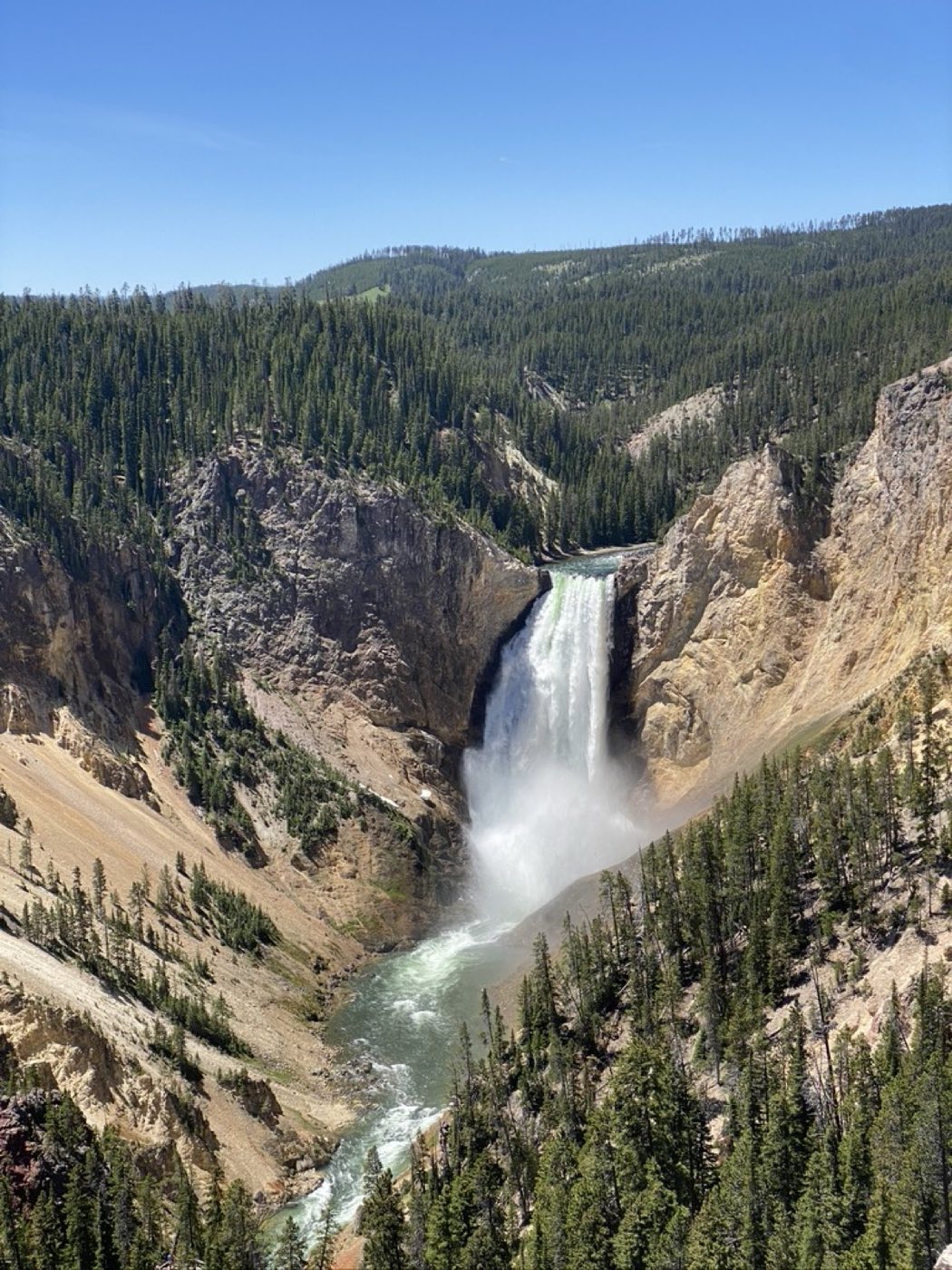
Yellowstone Grand Canyon and Lower Falls from Artist Point
The Yellowstone River carves a 20-mile canyon through rhyolite walls stained yellow, pink, and orange by hot-spring chemistry. Artist Point on the South Rim frames the 308-foot Lower Falls in the way Thomas Moran painted it in 1872 — and that painting helped convince Congress to establish the park. Walk the rim trail for more angles, or take the Uncle Tom's Trail stairs down toward the falls for the mist and roar up close.
Lamar Valley wolf and wildlife watching at dawn
In the park's quiet northeast corner, Lamar Valley is the best place in the lower 48 to see a wolf in the wild. Set an alarm for 4:30 a.m., drive to one of the pullouts before first light, and look for clusters of spotting scopes — that's where the wolves are. Bison herds are constant, grizzlies hunt elk calves in spring, and the morning light across the valley is worth the early hour on its own.
Mammoth Hot Springs travertine terraces
At the park's north entrance, hot water bubbling up through limestone has built a set of creamy-white terraces over thousands of years — still actively growing and dying in real time. The boardwalks loop across an Upper and Lower Terrace; both reward a slow walk. Stay on the boardwalks — the thin crust over scalding water has killed dozens of tourists who stepped off, and the thermal areas are uneven under the surface.
Hayden Valley bison herds and grizzly sightings
Between Yellowstone Lake and the Canyon area, Hayden Valley is where the park's largest bison herd gathers in summer to calf. Plan on being delayed by a bison jam at some point — just turn off the engine and watch. Grizzlies are frequently spotted on the valley's grassy slopes, especially at dawn and dusk; pull over safely and use binoculars from a distance.
Norris Geyser Basin — the hottest and most dynamic thermal area
Norris is the oldest and hottest geyser basin in the park, with ground temperatures that regularly exceed 200°F and features that can change overnight. Steamboat Geyser, when it decides to erupt, throws water higher than any other geyser on Earth — up to 380 feet. The Porcelain Basin loop takes an hour and feels like walking across another planet, with opalescent runoff and sulfur steam drifting over pale sinter.
Getting There & When to Go
The closest airports are Bozeman, Montana, and Jackson, Wyoming, both roughly 90 minutes' drive from a park entrance. Most visitors fly into Bozeman and enter through the North or West entrance; Jackson sets you up for the South entrance and the drive up through Grand Teton. The park is essentially open from late May through early September, when all roads and lodges are running; winter from December through March closes the roads but opens snowcoach and snowmobile tours into a quiet, steaming-white version of the same landscape. Book lodges and campgrounds 12 months ahead — they sell out the day reservations open. Lamar Valley wolf watching is best January through March at dawn.
Where to Stay
Inside the park, Old Faithful Inn is the 1904 log-and-stone classic, with a seven-story atrium built around a stone fireplace — staying here is its own travel experience. Canyon Lodge, Lake Yellowstone Hotel, and Mammoth Hot Springs Hotel each anchor a different region of the park and cut hours off your drives. All in-park lodging books out a year in advance through Xanterra. Gateway towns give you more flexibility: Gardiner at the North entrance, West Yellowstone by the West entrance, and Cody about an hour east each offer a wider range of hotels, cabins, and vacation rentals at a wider range of prices — and they all put you back inside the park within 30 minutes of breakfast.
Frequently Asked Questions
- Do I need a reservation to enter Yellowstone?
- No — entry is first-come-first-served with the standard National Park pass or a $35 per-vehicle fee good for seven days. Lodging and campground reservations inside the park, however, book out 12 months in advance and are essential in summer.
- Can I see Old Faithful erupt predictably?
- Yes — rangers post the next projected eruption on signs at the Old Faithful Visitor Center and on the NPS app, accurate to within about 10 minutes. Eruptions happen roughly every 90 minutes around the clock.
- Are pets allowed in the park?
- Pets are allowed only in parking lots, campgrounds, and within 100 feet of roads — never on trails or boardwalks. The thermal features, wildlife, and thin sinter crust make off-leash or off-road pets dangerous for both the dog and the ecosystem.
- Is it safe to approach the wildlife?
- No — stay 100 yards from bears and wolves, and 25 yards from bison, elk, and everything else. Bison injure more visitors each year than any other animal in the park, almost always because someone got too close for a photo.
Plan Your Visit
Book Nearby HotelsYellowstone Planning Guides
Compare focused Yellowstone National Park lodging, itinerary, and activity guides before you book.
Where to stay
Where to Stay Near Yellowstone National Park
Compare the best places to stay near Yellowstone National Park, including in-park lodges, West Yellowstone, Gardiner, Cody, and Jackson.
Itinerary
Yellowstone National Park Itinerary
Plan a Yellowstone National Park itinerary for one, two, three, or four days with geysers, canyon viewpoints, wildlife valleys, and lodging bases.
Things to do
Things to Do in Yellowstone National Park
Explore the best things to do in Yellowstone National Park, including Old Faithful, Grand Prismatic, Lamar Valley, the canyon, Mammoth, and Yellowstone Lake.
Best time to visit
Best Time to Visit Yellowstone National Park
Compare the best time to visit Yellowstone National Park by weather, road access, wildlife, crowds, lodging availability, and seasonal tradeoffs.
Have you visited Yellowstone?
Track all 63 national parks on your map