Spain
- Capital
- Madrid
- Population
- 47.8M
- Currency
- EUR
- Languages
- Spanish
Overview
A country of seventeen autonomous regions stitched together over centuries, where Basque Country tastes nothing like Andalusia and Catalan feels nothing like Galicia. Travelers come for Gaudí's Barcelona, flamenco in Seville, the Alhambra's Moorish courtyards, Madrid's late dinners and world-class art museums, the northern pintxos bars of San Sebastián, and a coastline that runs the Mediterranean from Cap de Creus down to the Strait of Gibraltar. Timing is the thing visitors most often get wrong. Spain runs late — lunch starts at two, dinner rarely before nine, and the country's best hours are after dark in summer when the heat breaks and plazas fill. Sleep in, take a proper lunch, nap during siesta, and you'll find the rhythm within a day or two. Most of what makes Spain itself happens on the street: the paseo at dusk, the ritual of a small beer and a plate of olives standing at a bar, the sudden burst of children playing in a plaza after school. The regional range is what makes a second and third trip easy to justify. Andalusia in spring is jacaranda-lined streets and Holy Week processions; Asturias and Galicia in summer are green hillsides and cold Atlantic beaches the coach tours never reach; the Canary Islands hold year-round warm water and volcanic trails closer to Morocco than to Madrid. Ten days covers one region thoroughly or three cities at a sprint — either way, plan to come back.
Things to Do
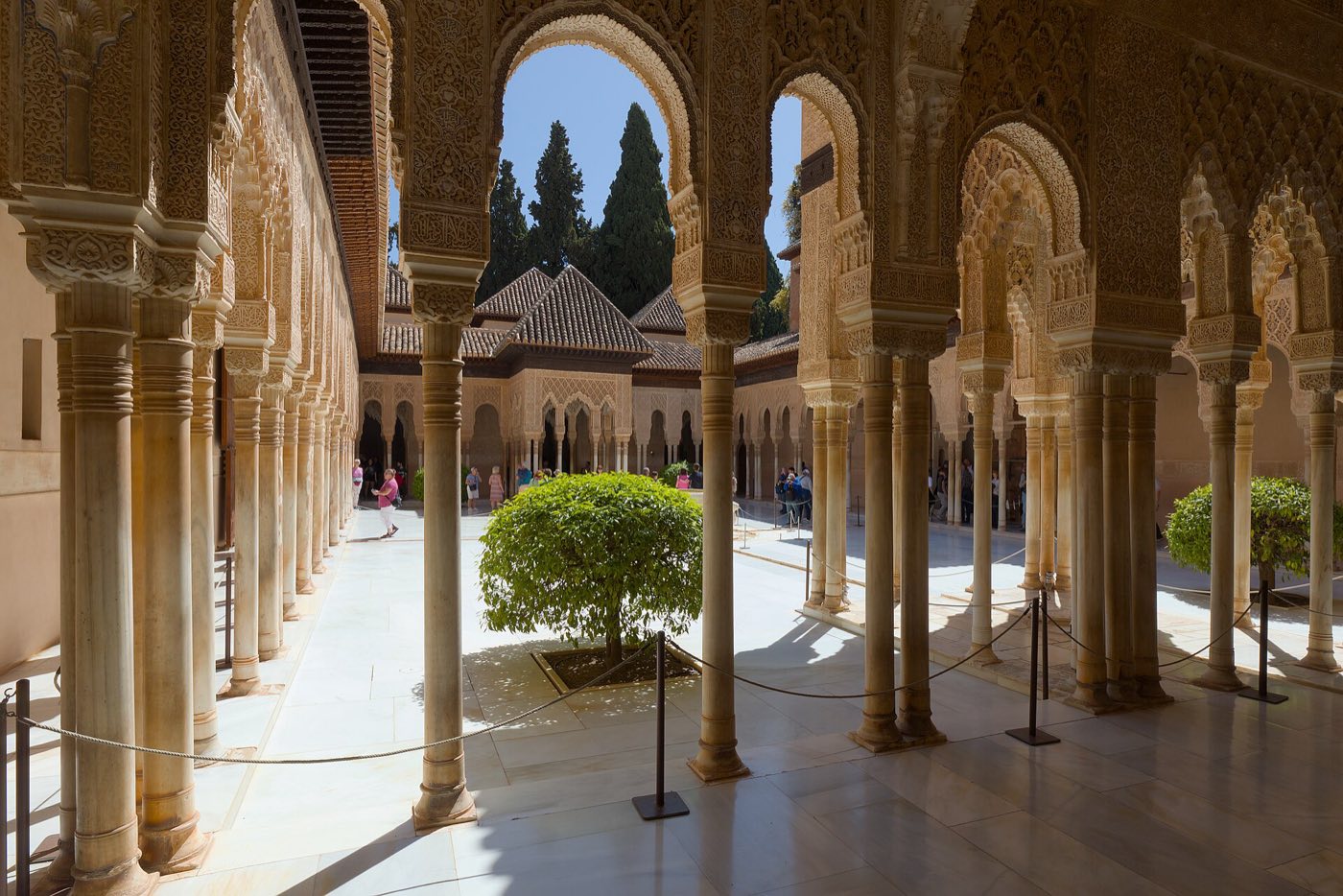
Alhambra and Generalife Gardens in Granada
The last Moorish palace complex in Western Europe sits on a ridge above Granada and feels like a piece of Damascus or Fez accidentally left behind when the Catholic monarchs took the city in 1492. The Nasrid Palaces — timed-entry ticket, book weeks ahead — are the highlight, with carved stucco walls, muqarnas vaults, and reflecting pools that turn the afternoon light silver. Pair it with the Generalife summer gardens next door and climb to the Albaicín neighborhood opposite at sunset for the iconic view.
Sagrada Família and Park Güell in Barcelona
Antoni Gaudí's still-unfinished basilica — construction started in 1882, completion now projected around 2033 — is unlike any church you've seen, with stone columns that branch into a forest canopy and stained glass that turns the nave into a light-show at sunset. Book timed entry online in advance. Park Güell, up on the hill above Gràcia, is where Gaudí ran his full architectural imagination off the leash: mosaic-tiled benches, gingerbread-style gatehouses, and views back over the city toward the sea.
Madrid's Prado Museum and Retiro Park
The Prado holds one of the great painting collections in the world — Velázquez's Las Meninas, Goya's black paintings, Bosch's Garden of Earthly Delights — and rewards a full morning with a coffee break mid-visit. Entry is free in the last two hours of each day. Walk out the east side into the Retiro, Madrid's central park, where Sunday afternoons bring drum circles, tarot readers, rowboats on the lake, and the Crystal Palace reflecting in its pond. Lunch at nearby Malasaña or La Latina rounds out a very Madrid day.
Seville's Royal Alcázar and Flamenco shows
The Alcázar is a royal palace that evolved under successive Muslim and Christian rulers from the tenth century onward, producing an extraordinary Mudéjar complex of carved stucco halls, tiled patios, and terraced gardens (used as Dorne in Game of Thrones, if that's a reference point). Book ahead. In the evening, a small tablao — La Casa de la Memoria or Casa de la Guitarra are reliable — delivers an intimate flamenco performance of cante, guitar, and dance that's closer to the form's raw roots than any arena show.
Camino de Santiago pilgrimage route
The most-walked of the medieval pilgrimage routes runs roughly 800 km across northern Spain from Saint-Jean-Pied-de-Port in France to Santiago de Compostela in Galicia, and has been reborn over the last twenty years as a slow-travel tradition that attracts a half-million walkers a year. Most people walk the last 115 km from Sarria in five or six days to earn a Compostela certificate, but the full Camino Francés takes roughly five weeks. Shoulder months — May or September — are the sweet spot for weather and trail company.
San Sebastián pintxos bar crawl
The Basque seaside city of San Sebastián (Donostia in Basque) is the best eating town in Spain, and the ritual is the pintxos crawl through the Parte Vieja — the old town — where small bars line every street and the counter is stacked with skewered small plates. Order one pintxo and a txakoli (the local white wine, poured from a height) at each place, then move on. Favorites include La Cuchara de San Telmo, Borda Berri, and Ganbara — go between 7 and 10 p.m. on a weeknight for peak atmosphere.
Ibiza nightlife and beaches
The largest of the Balearic Islands has two lives — a legendary clubbing scene from mid-May to early October at venues like Pacha, DC-10, and Ushuaïa, and a quieter, surprisingly beautiful island of coves, pine-covered hills, and Phoenician-era hilltop villages. If the clubs aren't your thing, base yourself in the north around Sant Joan and spend your days on Cala d'en Serra or Benirràs Beach, where Sunday sunset drum circles have run for decades. Shoulder months (May and September) are the smart compromise.
Mallorca's Serra de Tramuntana
The mountain range along Mallorca's northwest coast is a UNESCO-listed cultural landscape of stone-terraced olive groves, villages that tumble down to the sea, and a coastal road that has become one of Europe's great drives. Base yourself in Deià or Sóller, hike the Camí de Castellitx, and eat at one of the small sea-level restaurants in Port de Sóller or Cala de Deià. The island is an hour's flight from Madrid or Barcelona and feels like a different country for the three or four days you'll want.
When to Go
May to mid-June and September to October are the sweet spots — warm days, long evenings, manageable crowds, and shoulder prices. Summer (July and August) brings 35–40°C+ heat across Madrid and Andalusia; locals flee to the coast and many small-town restaurants close for two or three weeks. The Mediterranean beaches are at their best from June through early October. Winter is mild on the south coast and in the Canary Islands, cold and wet in the north, and brings excellent skiing at Baqueira-Beret in the Pyrenees and Sierra Nevada above Granada. Holy Week (Semana Santa, late March or April) and the Feria de Abril in Seville fall just before high season and are worth planning around.
Getting Around
The AVE high-speed train network is excellent and connects the main cities — Madrid to Barcelona in 2h30m, Madrid to Seville in 2h30m, Madrid to Valencia in under two hours. Book through Renfe's site (or a reseller like Omio) a few weeks ahead for the cheaper fares. Within cities, metros in Madrid, Barcelona, Valencia, and Bilbao are inexpensive and extensive; ride-hailing (Cabify, FreeNow) fills gaps. Rent a car for Andalusian hill villages, the Serra de Tramuntana on Mallorca, or parts of Galicia and Asturias, but skip driving in the big cities. Highway tolls are being phased out on most main routes; fuel runs around €1.60–€1.80 per liter.
Cost & Currency
Spain uses the euro and remains one of Western Europe's better travel values. Expect €1.80–€2.80 for a café con leche at the bar, €12–€18 for the menú del día (lunch prix-fixe with a drink) anywhere in the country, €25–€45 per person for a proper tapas dinner with wine, and €90–€160 a night for a comfortable mid-range hotel in Madrid, Barcelona, or Seville. Cards are accepted essentially everywhere; carry €30–€50 cash for small markets and the occasional rural bar. Tipping is light — round up at cafés, leave 5–10% on a sit-down dinner if the service was attentive, and don't feel obligated beyond that.
Frequently Asked Questions
- Do I need a visa to visit Spain?
- US, UK, Canadian, Australian, and most Western passport holders can enter Spain (and the wider Schengen Area) visa-free for up to 90 days in any 180-day period. From mid-2025 the EU's ETIAS pre-authorization will apply — a €7 online form valid for three years — so check before you book.
- Is Spain safe for travelers?
- Yes — Spain is broadly safe, with very low violent crime. The main risk is pickpocketing in Barcelona's Las Ramblas, Madrid's Puerta del Sol, and on the metro, where organized crews target distracted tourists. Keep your phone in your front pocket, your bag zipped and in front of you on the train, and you'll be fine.
- How much Spanish do I need to speak?
- English is widely spoken in tourist areas of Barcelona, Madrid, Seville, and on the coast, but thins out quickly in small towns and northern regions. A basic Spanish phrasebook or translation app covers most situations, and a few polite phrases (hola, gracias, una caña por favor) are always appreciated. In Catalonia and the Basque Country, locals speak regional languages at home but switch to Spanish or English with visitors.
- When do restaurants actually serve dinner?
- Kitchens typically open around 8 p.m. at the earliest and get busy from 9:30 to 11 p.m. Showing up at 7 p.m. expecting dinner will usually fail outside heavily touristed areas. For an earlier meal, have a proper lunch (1:30 to 4 p.m. is normal) and pick at tapas in the early evening.
- Is it worth visiting in August?
- Only conditionally. August brings peak heat (often 40°C in Madrid, Córdoba, and Seville) and many Spaniards leave the cities for the coast, meaning some restaurants and small shops close for two or three weeks. If you stick to the coast, the Balearics, or cooler northern regions like Galicia and Asturias, August works well — it's the interior and south you want to avoid mid-month.
Plan a Trip to Spain
Have you been to Spain?
Track 195 countries, 50 states & 63 national parks on your map