South Korea
- Capital
- Seoul
- Population
- 51.7M
- Currency
- KRW
- Languages
- Korean
Overview
An East Asian peninsula where 600-year-old palaces sit three subway stops from the neon of Gangnam, and where the pace of a single day can swing from a mountain temple stay to a 2 a.m. fried-chicken-and-beer crawl. Travelers come for Seoul's royal compounds and street-food alleys, Jeju Island's volcanic trails, the tea country around Boseong, and a pop-culture machine — K-drama, K-pop, Korean cinema — that now reaches almost every corner of the globe. What surprises most first-time visitors is how thoroughly Korea rewards curiosity. The country is small, the trains are fast, and a week will comfortably cover Seoul, Gyeongju, and Busan without feeling rushed. Food is the through-line — a sit-down Korean BBQ dinner with a dozen side dishes, a late-night bowl of jjigae in a market stall, a morning bowl of beef-bone soup that cures whatever the soju did the night before. South Korea is efficient in a way you notice within an hour of landing: airport-to-city trains that leave on the minute, subway announcements in four languages, contactless payment on buses, taxis, and convenience-store rice balls alike. What stays with you is the layering — palace roofs against glass towers, grandmothers in hiking gear on the morning subway, stone Buddhas above a digital skyline. You'll leave wanting to come back before the plane has landed.
Things to Do
Gyeongbokgung Palace in Seoul
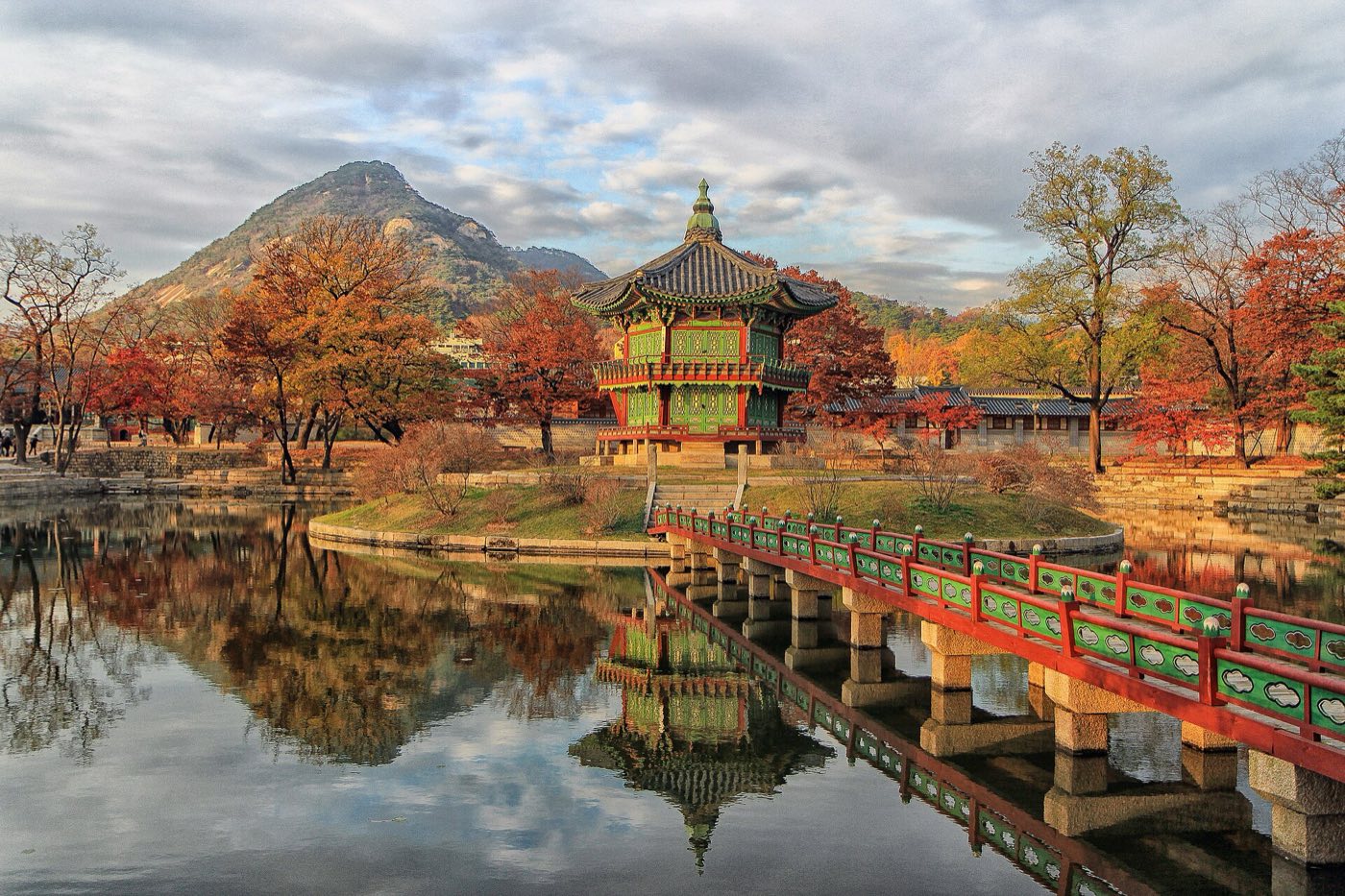
The largest of the Joseon Dynasty's five palaces sits at the top of the main boulevard in central Seoul, backed by Bugaksan Mountain and guarded by a changing-of-the-ceremonial-guard twice daily. Go early — the grounds open at 9 a.m. and the crowds arrive by ten. If you rent a hanbok (traditional dress) from one of the shops outside the gate, your entry fee is waived. Walk the full length north through the throne hall to the pavilion on the lotus pond behind it, where kings once held state banquets.
Bukchon Hanok Village traditional houses
A pocket of roughly 900 preserved wooden hanok houses tucked between Gyeongbokgung and Changdeokgung, where the narrow alleys and tile roofs give you a sense of what upper-class Seoul looked like a century ago. People still live here, so keep your voice down and stay off private thresholds. The viewpoint on Bukchon-ro 11-gil gives you the signature shot: cascading roofs stepping down toward the modern skyline of the central business district in the distance.
Jeju Island volcanic landscapes and Hallasan
A one-hour flight south of Seoul drops you on a subtropical island built around a 1,947-meter shield volcano. The full Hallasan summit hike takes eight to ten hours round-trip and requires a dawn start, but shorter trails to the Yeongsil cliffs or Eoseungsaengak crater deliver the views without the day's commitment. Around the coast, the Seongsan Ilchulbong sunrise peak, the Manjanggul lava tubes, and the black-sand beaches at Samyang reward a three- to four-day loop by rental car.
DMZ and Korean border tour
The 250-kilometer Demilitarized Zone between North and South Korea is the most heavily fortified border on earth, and most visitors see it on a half-day tour from Seoul. The standard itinerary stops at the Third Infiltration Tunnel, Dora Observatory, and Imjingak peace park, with the Joint Security Area at Panmunjom requiring a separate tour and passport check. Expect strict dress and photography rules, a briefing film, and a sobering hour or two that puts the rest of the trip in perspective.
Gwangjang Market street food in Seoul
One of the oldest permanent markets in Korea, Gwangjang is best visited in the late afternoon when the food alley hits full stride. Grab a stool at a bindaetteok (mung-bean pancake) counter or order live octopus sliced at the table if you're feeling brave. The mayak gimbap — small sesame-oil-brushed rice rolls nicknamed for how addictive they are — are the safer gateway, along with tteokbokki in spicy red sauce and hot mandu dumplings straight from the steamer basket.
Gyeongju museum without walls
The thousand-year capital of the Silla Kingdom is now a low-rise city scattered with royal burial mounds, temple ruins, and stone pagodas you stumble across while walking to lunch. Bulguksa Temple and Seokguram Grotto, both UNESCO-listed, are the marquee stops and deserve a half-day between them. Tumuli Park at the city center holds twenty-three grass-covered tombs you can walk among at dusk — arrive with the light low and the place turns quietly spectacular.
Busan's Gamcheon Culture Village and Jagalchi Fish Market
Korea's second city sits on the southern coast and feels looser and more maritime than Seoul. Gamcheon Culture Village tumbles down a hillside in pastel blocks, originally a refugee settlement from the Korean War and now painted into one of the most photographed neighborhoods in the country. Down at the water, Jagalchi Fish Market runs the length of the Nampo-dong waterfront — pick a fish from a tank on the ground floor, carry it upstairs, and the restaurant above will serve it back to you as sashimi within fifteen minutes.
Nami Island and Petite France
A ninety-minute train ride northeast of Seoul gets you to Nami Island, a small half-moon-shaped river island with tree-lined avenues made famous by the K-drama Winter Sonata. Pair it with Petite France, a small French-themed village further up the road, or the nearby Garden of Morning Calm for a day trip that pulls you out of Seoul's pace. Autumn, when the metasequoia avenue on Nami turns copper, is the peak season — which means the weekend crowds match the views.
When to Go
April to early June and September through November are the prime windows — cherry blossoms in Seoul and Jeju around early April, autumn foliage peaking in the mountains in late October. Summer (late June through August) brings heat, humidity, and the East Asian monsoon; winters are dry and cold with reliable snow at the northern ski resorts from December through February. The Chuseok harvest holiday in September and Lunar New Year in late January or early February both close shops and fill trains, so book ahead if your dates land there. Jeju stays several degrees warmer year-round and is hikeable even in December.
Getting Around
The KTX high-speed train is the backbone of long-distance travel — Seoul to Busan in under two and a half hours, Seoul to Gyeongju in roughly two. Book through Korail's English-language site or at the station; there's rarely a reason to fly domestically except to Jeju. Within Seoul, Busan, and Daegu the metro networks are fast, clean, and fully bilingual; buy a T-money card at any convenience store and it works on buses, subway, and most taxis nationwide. Taxis are plentiful and metered — Kakao T (Korea's ride-hailing app) works in English. A rental car makes sense only on Jeju and around the southern coast; skip driving in Seoul.
Cost & Currency
South Korea uses the Korean won (KRW) and sits roughly in the middle for developed-Asia pricing — cheaper than Japan, noticeably more than Thailand or Vietnam. Expect ₩8,000–₩12,000 for a solid bowl of ramyeon or bibimbap at a neighborhood spot, ₩30,000–₩50,000 per person for a proper Korean BBQ dinner with drinks, and ₩90,000–₩160,000 a night for a comfortable mid-range hotel in Seoul or Busan. Cards are accepted everywhere including most street-food stalls and taxis; carry ₩50,000 in cash for small markets and temple admission. Tipping is not expected and can cause mild confusion — service is included and the math is final.
Frequently Asked Questions
- Do I need a visa to visit South Korea?
- Most Western passport holders can enter visa-free for 60 to 90 days, but you must apply for K-ETA (Korea Electronic Travel Authorization) online at least 72 hours before departure. It costs roughly ₩10,000, is valid for multiple entries over three years, and a confirmation must be printed or saved to your phone for check-in.
- Is South Korea safe for solo travelers?
- Yes — Korea is one of the safest countries in the world for solo travel, with extremely low violent crime and reliable late-night infrastructure. Women routinely walk home alone after midnight in Seoul and Busan. The main risks are minor: pickpocketing in crowded markets, occasional aggressive driving, and too much soju on a Friday night.
- How much Korean do I need to speak?
- Less than you'd think. Subway signage, transit apps, major restaurants, and most city-center staff operate in some English, and Google Translate handles menus well. Learning to read Hangul — the Korean alphabet, designed to be learnable in a weekend — pays off immediately, since most signs and menus then become phonetically readable.
- What's the best way to get from Seoul to Busan?
- Take the KTX high-speed train from Seoul Station. It runs every 15 to 30 minutes, takes about 2 hours 15 minutes, and costs ₩60,000 in standard class. Book a day or two ahead on weekends and holidays. Flights are the same total door-to-door time once you factor in airports, and cost more.
- Is the tap water safe to drink?
- Technically yes — Seoul's tap water passes international standards — but most Koreans drink filtered or bottled water out of preference, and restaurants always serve filtered cold water for free. Bottled water is cheap at convenience stores (₩1,000 for a 500ml bottle) if you want to match the local habit.
Plan a Trip to South Korea
Have you been to South Korea?
Track 195 countries, 50 states & 63 national parks on your map