Norway
- Capital
- Oslo
- Population
- 5.5M
- Currency
- NOK
- Languages
- Norwegian
Overview
Norway is a long, narrow country of fjords, mountains, and Arctic light — a coastline that, measured with all its inlets and islands, would wrap around the equator and back — and one of the most reliable places in the world to see the aurora borealis. Travelers come for Geirangerfjord's waterfalls and Trolltunga's clifftop ledge, for Northern Lights nights above Tromsø and midnight sun in the Lofoten Islands, and for the slow, scenic rail and ferry routes that connect it all. Most trips start in Oslo or Bergen and then fan out. Oslo is the quieter capital — understated, design-literate, pleasantly walkable, and lately one of the more interesting food cities in Europe. Bergen on the west coast is where the fjord country begins: the colored wooden houses of the Bryggen wharf, daily rain, and ferries and scenic trains departing up the coast and inland toward Flåm. From either city you can be deep in serious mountain scenery within three hours, and the Norwegian habit of marking every trail with red-painted T's on the rocks means you can hike confidently in terrain that would feel remote almost anywhere else. What defines Norway as a travel destination is light, more than anything else. In high summer north of the Arctic Circle the sun does not set for weeks, and you can hike at midnight in full daylight. In winter above Tromsø the sun does not rise at all for parts of December and January, but the dark is repeatedly broken by aurora curtains overhead. Norway is expensive, there is no working around that, but the public infrastructure — trains, ferries, national park cabins, rental cars — is superb, and it is a country that rewards planning and pays it back in moments you do not forget.
Things to Do
Geirangerfjord cruise
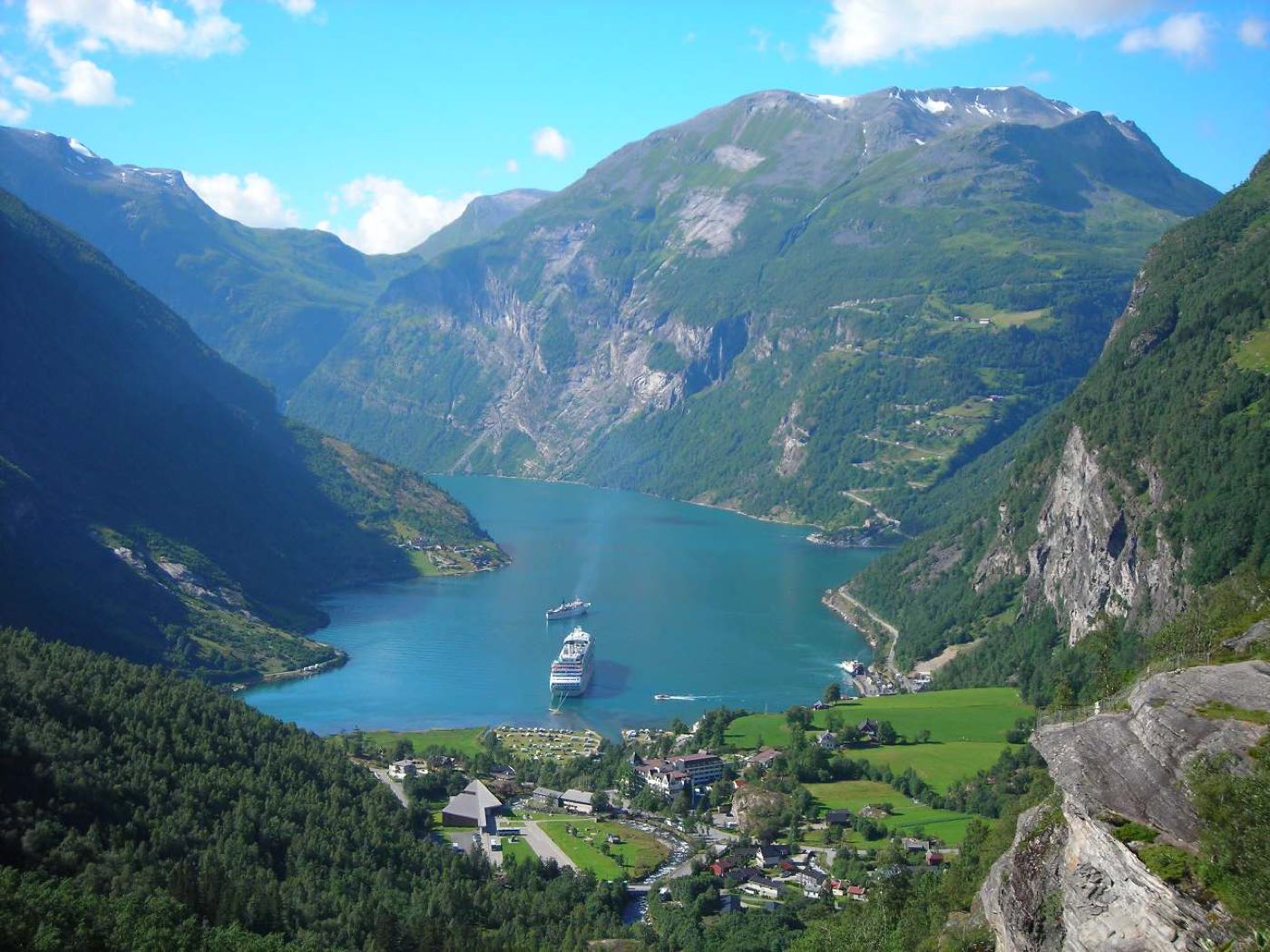
A deep, narrow arm of the Sunnmøre coast, Geirangerfjord is the most photographed fjord in Norway — 15 kilometers of vertical walls threaded with the Seven Sisters waterfall on one side, the Suitor on the other, and abandoned cliffside farms clinging on at impossible angles. The small village of Geiranger at the head of the fjord is the main departure point; a return ferry to Hellesylt takes about an hour each way. Better, take the Trollstigen mountain road in from Åndalsnes for the approach, which is a drive you will remember.
Trolltunga cliff hike
The flat tongue of rock jutting out over Lake Ringedalsvatnet at 700 meters above the water is the country's most famous single view and a genuinely demanding hike — 28 kilometers round trip with 800 meters of elevation gain from the lower parking in Skjeggedal, typically 10 to 12 hours of walking. The hike is straightforward in good summer weather (June through September) but requires winter skills and a guide outside those months. Start at 5 AM to beat the queue for the photograph at the end.
Northern Lights viewing in Tromsø
At 69° north, Tromsø sits under the auroral oval and has become the aurora-chasing capital of Scandinavia. The season runs from late September through late March, peaking around the equinoxes, and the best nights are clear, cold, and away from city light. Book a small-group tour with a guide who chases the weather — operators like Tromsø Friluftsenter and Chasing Lights know when to drive inland toward Finland or down the coast to find holes in the cloud. Three nights gives you reasonable odds; a week gives you strong ones.
Preikestolen (Pulpit Rock)
The flat granite platform 604 meters straight up above Lysefjord near Stavanger is the more accessible of Norway's great fjord-cliff viewpoints. The hike in from the Preikestolen parking is about 8 kilometers round trip with 500 meters of climbing — maybe 4 hours at a moderate pace, and manageable in proper footwear without technical skills. The rock itself is a 25 by 25 meter slab with no railing, and the drop is sheer. Go early or go in shoulder season; midday in July the trail is a conga line.
Bergen's Bryggen wharf and fish market
The row of wooden commercial buildings along the harbour in Bergen has been a UNESCO site since 1979 and a working merchant quarter since the 14th-century Hanseatic League traded dried cod from the same warehouses. The alleys behind Bryggen's painted facades are leaning, creaky, and full of small galleries and coffee shops. Down the quay, the open-air fish market sells king crab, salmon, and whale sausage — touristy, expensive, but worth stopping for a fish soup at lunch and the Fløibanen funicular up to Mount Fløyen afterward.
Lofoten Islands fishing villages and beaches
The Lofoten archipelago juts from the northern Norwegian coast in a jagged line of granite peaks rising straight out of the Arctic water. The island chain is connected by a single road with bridges and tunnels, and you drive from Å at the southern tip up through Reine, Hamnøy, and Henningsvær — postcard fishing villages of red rorbuer (fisherman's cabins) built on stilts over the sea. White-sand beaches like Haukland and Kvalvika sit in north-facing bays where the Arctic water is freezing cold but the summer light stays all night.
Oslo's Munch Museum and Viking Ship Museum
The newer Munch Museum on the harborfront at Bjørvika opened in 2021 and holds the world's largest collection of Edvard Munch's work — several versions of The Scream rotated through the top floor, and deep dives into his lesser-known landscapes and self-portraits. Across town on the Bygdøy peninsula, the Viking Ship Museum is closed for rebuilding through at least 2027 and will reopen as the Museum of the Viking Age; check the current status. The Fram polar ship museum and the Kon-Tiki nearby are both excellent in the meantime.
Flåm Railway scenic journey
The Flåm Railway is a 20-kilometer mountain railway from the high plateau at Myrdal down to the Aurlandsfjord village of Flåm, dropping 866 meters through 20 tunnels in a journey of just under an hour. It is the steepest standard-gauge railway in Northern Europe and one of the best short train rides in the world — the train stops at Kjosfossen waterfall partway down so passengers can get out and stand in the spray. Combine it with the Bergen Railway and a fjord ferry for the classic Norway in a Nutshell day trip from Oslo or Bergen.
When to Go
Late June through mid-August is the summer window — long daylight, all mountain passes open, fjord ferries running on full schedules, and north of the Arctic Circle the midnight sun holds roughly from May 20 through July 20. This is peak season and the most expensive time to visit. Late September through late March is aurora season, centered on Tromsø and the Lofotens; October and March are the sweet spots when the nights are long enough for lights but not yet brutally cold. Winter also brings dogsledding, whale watching off Tromsø, and ski touring. Shoulder seasons (May and September) are quieter and often more scenically interesting than high summer.
Getting Around
Norway has one of the best public transport networks in Europe considering its terrain. The main rail lines — Oslo to Bergen across the Hardangervidda plateau, Oslo to Trondheim, Trondheim to Bodø — are scenic journeys in their own right; book on Vy.no for advance fares. Norwegian Air and SAS run domestic flights that are often no more expensive than the train and save a full day between Oslo and Tromsø. Coastal ferries on the Hurtigruten route connect Bergen to Kirkenes along the full western coast, and shorter car ferries fill in the gaps across the fjords. Renting a car is the right call for the Lofotens, the fjord country between Bergen and Ålesund, and Arctic routes; roads are excellent but mountain passes can close in winter.
Cost & Currency
Norway uses the Norwegian krone (NOK), with recent rates of roughly 10.5 NOK to the US dollar and 12 NOK to the euro. It is one of the more expensive countries in Europe for travelers: expect 200–350 NOK for a basic restaurant main, 1,500–2,500 NOK a night for a comfortable mid-range hotel room, 100–130 NOK for a pint of beer, and 20–30 NOK per liter for diesel. Cards are accepted essentially everywhere, including in remote fishing villages and mountain huts, and Norway is close to cashless — you may go a two-week trip without using paper money. Tipping is not expected in restaurants; rounding up 5–10% for genuinely good service is appreciated but not customary. Self-catering from Rema 1000 or Kiwi supermarkets saves significant money on longer trips.
Frequently Asked Questions
- When is the best time to see the Northern Lights in Norway?
- Late September through late March, with September-October and February-March striking the best balance between long dark nights and not-too-brutal cold. Tromsø, Alta, and the Lofoten Islands are the three most reliable aurora destinations. Plan at least three clear nights in one location to give yourself decent odds — cloud cover is the main obstacle, not solar activity, and a good guided tour will chase breaks in the weather.
- Do I need a car to see the fjords?
- Not for the main sights — you can do Geirangerfjord, Nærøyfjord, and Lysefjord with public transport, ferries, and organized day trips from Bergen, Ålesund, or Stavanger. A car is worth it for the Lofoten Islands, for the Atlantic Road, and for any off-the-main-route fjord exploration in the Sunnmøre or Hardanger regions. Rental cars are expensive in Norway; booking in advance and picking up in a smaller city like Bergen or Trondheim rather than Oslo can save money.
- How much does a trip to Norway actually cost?
- Plan for around €150–€250 per person per day on a mid-range trip outside the very cheap end — mid-range hotels, restaurant meals for at least one meal a day, and reserved train or ferry tickets. Budget travelers can cut that significantly with DNT mountain cabins, self-catering from supermarkets, and camping (legal under the allemannsretten right-to-roam). Alcohol is punishingly expensive and heavily taxed. Buy wine and spirits duty-free on arrival if you want them in the hotel room.
- Is Norway safe for solo travelers?
- Yes — Norway consistently ranks among the safest countries in the world, with very low violent crime, excellent infrastructure, and a strong culture of leaving people to themselves while being helpful when asked. Oslo and Bergen have some petty theft around the central train stations but nothing out of the ordinary. The bigger safety consideration is hiking weather — conditions in the mountains shift fast, and the Norwegian Mountain Code (fjellvettreglene) is worth reading before any multi-day trek.
- Can I see the fjords and the Northern Lights on one trip?
- Yes, but it stretches the itinerary. Fjord season is at its best in summer (June-August) when the Northern Lights are invisible because the nights stay too bright. In the shoulder season — late September or late March — you can combine fjord scenery around Bergen with an aurora stop in Tromsø, linked by a 2-hour domestic flight. Expect some fjord routes (mountain passes, ferries to cabin areas) to be closed or reduced outside the June-August window.
Plan a Trip to Norway
Have you been to Norway?
Track 195 countries, 50 states & 63 national parks on your map