Finland
- Capital
- Helsinki
- Population
- 5.6M
- Currency
- EUR
- Languages
- Finnish, Swedish
Overview
A Nordic country of 188,000 lakes, old-growth forests, and an Arctic quarter where the sun never sets in June and never rises in December. Travelers come to glide through Lapland snow behind huskies, watch the aurora over a glass-roofed cabin, swim in a summer lake and immediately retreat to a 90-degree sauna, and spend a weekend on the designer-shaped streets of Helsinki. What strikes you first is the quiet. Finnish cities are calm even by Scandinavian standards, and once you head north or east of Helsinki the emptiness takes over — pine forest, birch, lakes stitched together by narrow rivers, and long stretches of highway where yours is the only car. The culture rewards patience and directness; small talk is optional, silence is comfortable, and the sauna does the social work that pubs do elsewhere. You will be invited into one, often naked, within your first few days if you are lucky. Finland is two different countries depending on when you come. In winter, the draw is Lapland — Rovaniemi, Saariselkä, Levi — and the Arctic package of snow, huskies, reindeer, Santa, and the northern lights. In summer, it is Lakeland — the southeastern region around Savonlinna — and the Helsinki archipelago, with cottage culture, long evenings on wooden piers, and berries picked straight from the roadside. Either version works; both are worth the trip; combining them across a single visit is harder because of the seasons.
Things to Do
Rovaniemi and Santa Claus Village in Lapland
The capital of Finnish Lapland and the official home of Santa Claus — the village sits directly on the Arctic Circle and is open every day of the year, with Santa himself in residence behind a desk greeting visitors. It is tourist infrastructure, unapologetic and often crowded in December, but the photograph of your crossing-the-Arctic-Circle certificate with a reindeer in the background is part of the Finland experience. Beyond the village, Rovaniemi proper has the excellent Arktikum museum on Sami and Arctic history and a revitalized old town destroyed in the war.
Northern Lights viewing in Finnish Lapland
From late August through early April, Finnish Lapland is one of the most reliable places on earth to see the aurora borealis, with roughly two hundred clear nights per season above the Arctic Circle. Glass-igloo accommodation at Kakslauttanen, Levi, and Saariselkä puts you under the sky from a warm bed; aurora-hunting tours with snowmobile or husky transport take you to lakeshores away from town lights. Download an aurora alert app and be prepared to get out of a sauna at 1 a.m. when the sky goes green — this is how it tends to happen.
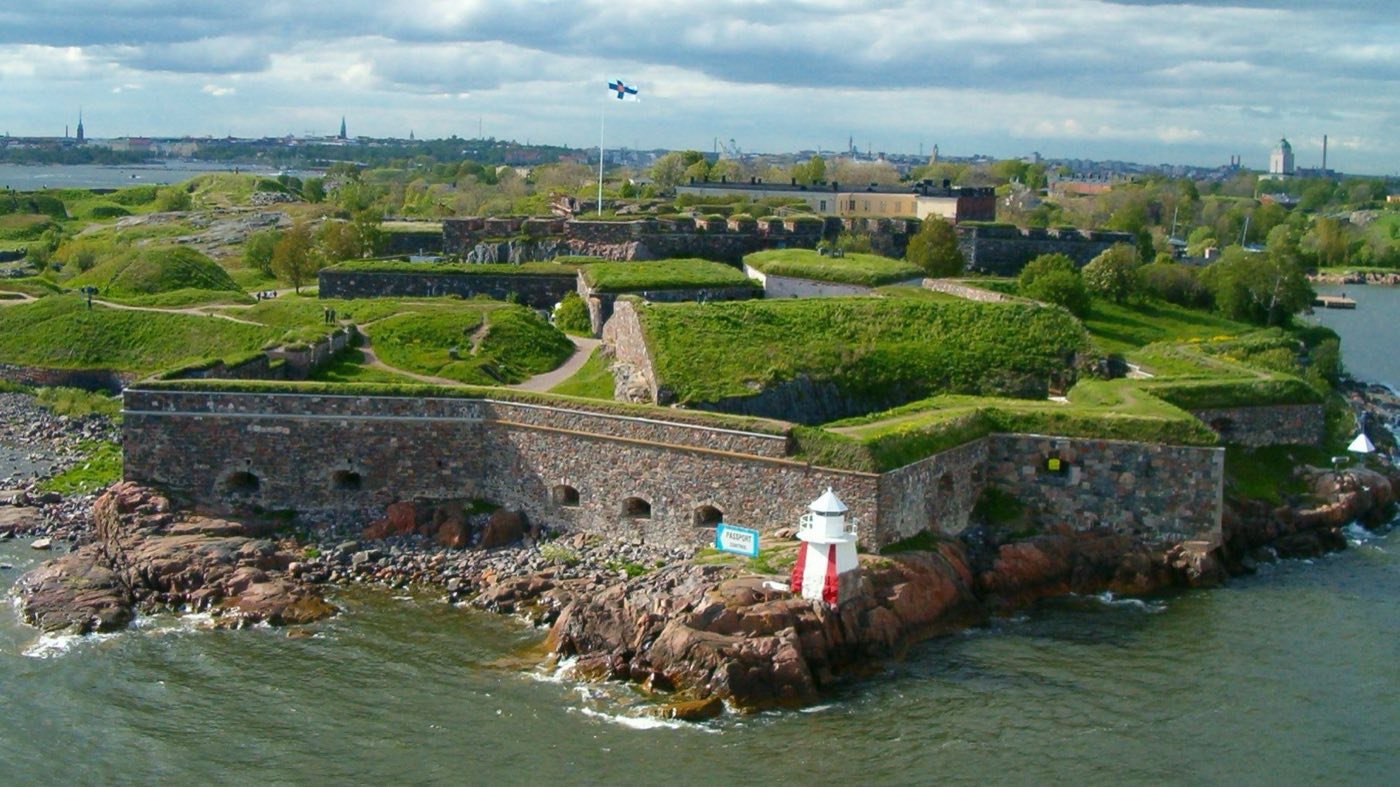
Helsinki's Suomenlinna sea fortress
A UNESCO-listed sea fortress spread across six linked islands at the mouth of Helsinki harbor, a fifteen-minute public-ferry ride from Market Square. Originally built by Sweden in the 1740s to defend the empire's eastern flank, captured by Russia, then handed to Finland at independence — the layered history is written in the walls and the cannon emplacements. It makes a long half-day of walking, with cafes, microbreweries, and a submarine museum along the way. In summer, locals picnic on the ramparts; in winter, the walk across the islands with wind off the Baltic is bracing and uncrowded.
Lakeland Region sauna and cottage culture
The Finnish Lakeland — a dense tangle of waterways centered on Savonlinna, Mikkeli, and Kuopio in the southeast — is where the country comes to spend its summer weekends in red wooden mokki cottages. Rent one for three or four nights, the door will be unlocked, there will be a wood-fired sauna at the lake's edge, and the whole routine is simple: sauna, jump in the lake, drink a beer, repeat until hungry. Savonlinna's medieval Olavinlinna castle hosts an international opera festival in July that pairs well with the region.
Levi and Saariselkä ski resorts
Levi is Finland's largest ski resort, two hours north of Rovaniemi, with slopes gentle by Alpine standards but wide and well groomed, a strong snowpark, and a village that has real restaurants and après-ski. Saariselkä sits further north near Urho Kekkonen National Park and appeals to cross-country skiers and winter hikers more than downhill-focused visitors. Both have comprehensive husky, reindeer, snowmobile, and aurora tour offerings, and both are cheaper than equivalent Norwegian or Swedish resorts while delivering a more Arctic-feeling winter.
Husky and reindeer sled safaris
Every ski resort and most Lapland towns run half-day husky and reindeer safaris that put you behind a team of dogs — or in a reindeer-drawn sled — for a one- or two-hour ride through snow-covered forest. The husky experience is the more active of the two, with you controlling a brake on a small sled and learning to lean into the curves; the reindeer option is slower, quieter, and usually run by Sami families who share stories and a cup of hot berry juice at a turnaround point. Both require a thermal layer under the provided snowsuit.
Oulu's air guitar championships and design scene
The west-coast city of Oulu hosts the Air Guitar World Championships every August — a genuinely funny international festival with a straight-faced commitment to the craft that only Finland could pull off. Beyond the event, Oulu has quietly become a pole of Nordic design and tech, with a walkable center, a market hall worth an afternoon, and the Nallikari sandy beach on the Bothnian Bay that is a real thing in July. Three hours north of Helsinki by train and the stop most itineraries skip and later regret.
When to Go
December through March for Arctic winter — snow is reliable, the sun is low or absent, the aurora is likely, and every northern town runs on the winter program. Mid-December to early January is peak for the Santa and Christmas-market trade and books up a year in advance. June through August is the summer season, with the midnight sun north of the Arctic Circle, lake swimming from mid-June, and Helsinki at its most alive. The shoulder stretches — late September when the ruska autumn colors peak and early April when the snow is deep but the light is returning — are underrated.
Getting Around
The VR train network connects Helsinki with Tampere, Turku, Oulu, and Rovaniemi on fast, comfortable intercity services — the overnight Santa Claus Express from Helsinki to Rovaniemi is a Finland-trip set-piece and comes with sleeper cabins and a car-carriage. For Lapland destinations north of Rovaniemi, rent a car or use Matkahuolto long-distance buses; winter driving with studded tires is straightforward if you respect the conditions. Within Helsinki, trams, metro, and buses all run on a single HSL ticket and ferries to Suomenlinna are part of the same system. Domestic flights on Finnair serve Ivalo, Kittila, and Kuusamo in Lapland if time is short.
Cost & Currency
Finland uses the euro and is on the expensive end of Europe, roughly on par with Norway but below Iceland. Expect €4–€5 for coffee at a city cafe, €18–€28 for a lunch special at a sit-down restaurant, and €130–€200 a night for a mid-range hotel room in Helsinki. Lapland during peak winter runs higher — €250–€500 per night for glass-igloo and cabin accommodation is routine. Cards are accepted absolutely everywhere, from market stalls to sauna ticketing, and cash is increasingly rare; you can travel a week without carrying any euros. Tipping is not expected — service is included — though rounding up a restaurant bill or leaving a euro or two for good service is appreciated.
Frequently Asked Questions
- When is the best time to see the Northern Lights in Finland?
- From late August through early April, with peak darkness and peak probability between December and March. The further north you go the better the odds, with Saariselkä and Utsjoki more reliable than Rovaniemi. Aim for three to four nights in Lapland to give yourself multiple chances — a single clear night during a solar-active period is typically enough, and glass-igloo accommodation lets you watch without leaving your bed.
- Do I need special clothing for a winter visit?
- Yes — winter in Lapland regularly runs to minus 20 Celsius and can go much colder. Most tour operators provide full thermal suits, gloves, and boots for husky, reindeer, and snowmobile activities; you still need a proper base layer, hat, and wool socks of your own. In Helsinki and southern cities a good winter coat, gloves, and hat are sufficient. Dry cold is more manageable than wet cold once you are dressed for it, but the gap between dressed and underdressed is serious.
- Is Helsinki worth a visit on its own, or only as a stopover?
- On its own for two to three nights is well spent. The Design District, the covered market, Temppeliaukio rock church, Suomenlinna, and the Kamppi Chapel of Silence are all close together. In summer, ferries to archipelago islands like Vallisaari and a boat out to Porvoo extend the itinerary. In winter, the Allas Sea Pool's outdoor saunas and heated pools on the harbor are an unusually good afternoon.
- How does sauna etiquette work?
- Finnish sauna is usually nude and often gender-separated — hotels and public saunas have scheduled men's and women's sessions, mixed-gender times, or both. You sit on a small towel to protect the wooden bench, throw water on the stones (loyly) when you want more heat, and leave when you are ready — no minimum or maximum time. If a Finn invites you into their private sauna, swimsuits are optional; follow the host's lead. A cold plunge or snow roll between rounds is normal.
- Can I drink the tap water?
- Yes — Finnish tap water is among the cleanest in the world, tested constantly, and comes straight from groundwater sources across most of the country. Helsinki's water has won international taste awards. Bottled water is widely sold but entirely unnecessary; bring a reusable bottle and refill from any tap.
Plan a Trip to Finland
Have you been to Finland?
Track 195 countries, 50 states & 63 national parks on your map