Cyprus
- Capital
- Nicosia
- Population
- 1.3M
- Currency
- EUR
- Languages
- Greek, Turkish
Overview
The third-largest Mediterranean island, Cyprus sits closer to Beirut and Alexandria than to Athens, and the culture shows it — Greek island language and food layered with Levantine, Venetian, Ottoman, and British influences stacked on top. Travelers come for the Roman mosaics and harbor of Paphos, the painted Byzantine churches tucked into Troodos mountain villages, the ruins at Kourion, and the unhurried beach life along the southern coast. The other thing about Cyprus: the island is divided. Since 1974 a UN buffer zone has cut across Nicosia and run coast to coast. The Republic of Cyprus (Greek-speaking, EU member, euro) occupies the south; the Turkish Republic of Northern Cyprus (Turkish-speaking, recognized only by Turkey) occupies the north. You can cross between them freely at several checkpoints with a passport and a rental-car insurance top-up. The north is quieter, cheaper, and holds some of the best Gothic and Crusader architecture in the eastern Mediterranean — Bellapais Abbey, Kyrenia's harbor castle, the ancient city of Salamis. Seeing both sides gives you the full country. Cyprus rewards a two-week loop more than a week. You want time for a Paphos base, a Troodos mountain detour with one or two nights in a stone-built village, a cross into the north, and at least three unplanned afternoons for a taverna lunch on a beach that stretches on and on. The island is small enough to drive across in three hours and large enough to stay occupied for a month.
Things to Do
Paphos Archaeological Park mosaics
The UNESCO-listed archaeological park on Paphos harbor contains four Roman villas — the Houses of Dionysos, Theseus, Aion, and Orpheus — whose floor mosaics are among the finest surviving anywhere in the Roman world. You walk on raised wooden platforms above panels depicting wine harvests, hunting scenes, and mythological episodes in tesserae so fine they read like paintings. Pair with the Tombs of the Kings a kilometer north, where Hellenistic rock-cut chambers step down into a limestone plateau above the sea.
Troodos Mountains painted churches
The Troodos range rises to 1,952 meters at Mount Olympus, and scattered through its pine-forested valleys are ten UNESCO-listed Byzantine churches painted floor-to-ceiling with frescoes from the 11th to 16th centuries. Asinou, Kalopanagiotis, and Moutoullas are the standouts — small, steep-roofed stone buildings that look like mountain farms from the outside and open into entire interior universes of saints and angels. Base yourself in Kakopetria or Pedoulas for two nights and string together five or six over a pair of days.
Aphrodite's Rock (Petra tou Romiou)
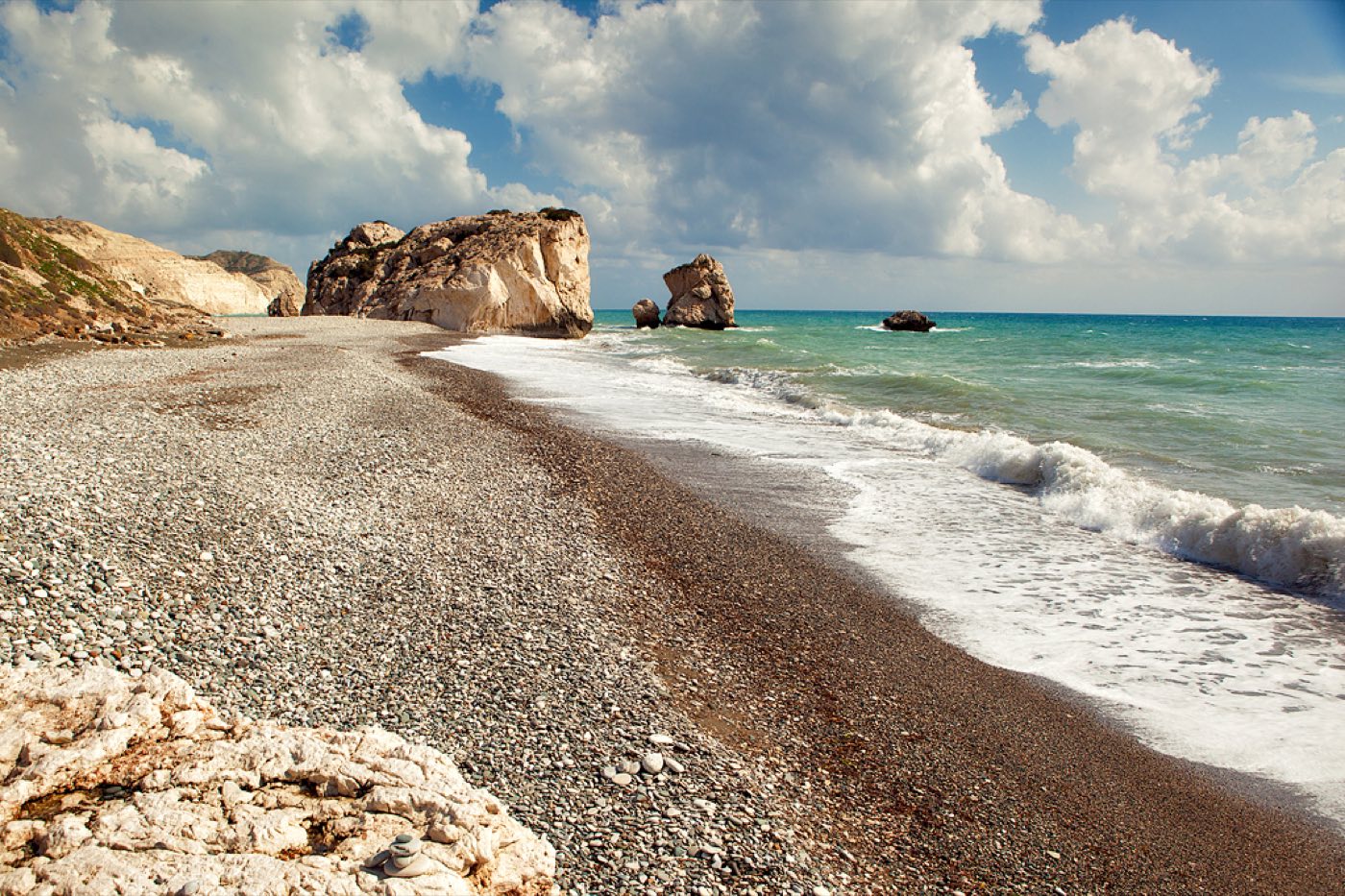
On the coastal road between Paphos and Limassol, a cluster of sea stacks stands offshore where, according to Hesiod, Aphrodite rose from the sea foam. The mythology aside, the setting is genuinely dramatic: pebble beach, turquoise water, limestone crags. Park at the clifftop overlook for the photograph, then descend to the beach for the swim — tradition holds you'll be granted eternal youth if you swim around the main rock. No one has verified this. Go at sunrise for the light.
Kourion ancient amphitheater
Between Paphos and Limassol, the ancient city of Kourion sits on a cliff 70 meters above the sea with a Greco-Roman theater still used for summer performances. The acoustics are extraordinary — a coin dropped on the stage is audible in the back row. Walk the site's House of Eustolios for more floor mosaics, then the early Christian basilica foundations, and finish with the beach below at Kourion Bay for an afternoon swim. Easy half-day from either end of the south coast.
Nicosia's divided old city
The last divided capital in Europe, Nicosia's walled Venetian old city is cut in half by the UN buffer zone — you can walk to the Ledra Street crossing, show your passport, and be on Turkish-Cypriot streets in ninety seconds. The Greek side holds the Archaeological Museum, Ledra's shopping, and a dense old-town lattice of Ottoman-era houses. The Turkish side (Lefkoşa) has the Büyük Han caravanserai, the Selimiye Mosque inside a Gothic cathedral, and better coffee. See both in one day.
Akamas Peninsula hiking and Blue Lagoon
The Akamas, a roadless peninsula at the island's northwest tip, is Cyprus's wildest corner — gorges, mountain sheep, monk seals offshore, and the turquoise cove at Blue Lagoon accessible only by 4x4, boat, or a hot hiking trail. The Avakas Gorge walk is the easier introduction: a three-kilometer path up a narrow limestone canyon that closes overhead in places. Boat trips from Latchi harbor to Blue Lagoon run daily May through October; book a late-afternoon one to dodge the crowds.
Bellapais Abbey in Northern Cyprus
Perched above Kyrenia in the Turkish-Cypriot north, Bellapais Abbey is a 13th-century Crusader Gothic monastery whose roofless cloister looks out over the Mediterranean. Lawrence Durrell lived in the village below and wrote Bitter Lemons about it. The drive across the buffer zone from the south takes an hour or two depending on crossing traffic — bring your passport, buy the required insurance at the checkpoint — and plan a full day that includes Kyrenia Castle and the harbor for grilled fish on the quay.
When to Go
April through June and September through early November are the sweet spots — warm days, sea temperatures that touch 70°F by May and stay swimmable through October, and long twilights. July and August are reliably hot (95°F is common inland) and crowded at the southern resorts, though the Troodos mountains stay ten to fifteen degrees cooler and host weekend refugees from the coast. December through February are mild on the coast (60s during the day, cool evenings) and genuinely wintry up in the mountains — there is skiing on Mount Olympus from January through mid-March. Easter is the big cultural moment and worth planning around if you can.
Getting Around
Renting a car is close to essential — the bus network covers the main south-coast cities (Paphos, Limassol, Larnaca, Nicosia, Ayia Napa) cheaply and reasonably well, but everything interesting outside those requires your own wheels. Cypriots drive on the left (British legacy), roads are generally excellent, and parking is easy outside of Nicosia and the Paphos marina area. To cross into the Turkish-Cypriot north, stop at a checkpoint (Ledra, Metehan, and Agios Dometios are the main ones), show your passport, and buy additional insurance — standard south-side rental policies don't cover the north. Within cities, taxis are metered and fair. There is no rail.
Cost & Currency
The Republic of Cyprus uses the euro; Northern Cyprus uses the Turkish lira but accepts euros and credit cards everywhere tourist-facing. Cyprus runs moderately cheaper than Greece and noticeably cheaper than the Côte d'Azur, though Paphos and Limassol hotels in high season push into standard Western European ranges. Expect €2.50–€3.50 for a freddo espresso, €14–€22 for a mezze lunch at a village taverna, and €90–€150 for a mid-range hotel in shoulder season. The north is meaningfully cheaper — a harborside dinner in Kyrenia runs half what you'd pay in Limassol. Cards work everywhere in the south; keep €30–€40 cash for rural tavernas and Troodos village shops. Tipping is modest: round up or leave 5–10% for good service.
Frequently Asked Questions
- Can I cross between the Greek and Turkish sides of Cyprus?
- Yes — the crossing is simple and open to foreign travelers with a passport. There are several checkpoints: Ledra Street and Agios Dometios in Nicosia for foot and car traffic, plus checkpoints at Metehan, Astromeritis, Dherynia, and Pergamos. You'll need to buy supplementary insurance at the checkpoint if driving a south-side rental (€20–€25 for a day, €25–€30 for a week), as standard policies don't extend north.
- Do I need a visa to visit Cyprus?
- Most Western travelers — EU citizens, Americans, Canadians, British, Australians — do not need a visa for stays up to 90 days in the Republic of Cyprus. The north (TRNC) is entered on the same passport but is not part of the Schengen Area or EU immigration rules. Cyprus is expected to join the Schengen Area in the coming years, which would change entry mechanics but not the visa-free allowance for those nationalities.
- Is Cyprus safe for travelers?
- Yes — Cyprus is one of the safest countries in the EU, with very low violent crime and well-patrolled tourist zones. The UN buffer zone is secure and the crossings are routine. Drive carefully on coastal roads, especially at night; moped and scooter accidents are the most common traveler incident. Respect swimming flag warnings on exposed beaches where currents can pick up quickly.
- Do people speak English in Cyprus?
- Yes, extensively — English is the second language of the island thanks to the 1878–1960 British administration, and you can operate entirely in English across the Republic. Menus, signs, and most service staff are fully bilingual. In the north, English is also widely spoken especially in Kyrenia, Famagusta, and Nicosia; a few Turkish phrases are appreciated but not required.
- How long should I plan for a first visit?
- Ten days to two weeks is ideal. A week of Paphos and the southwest (including a Troodos overnight) gives you the core, but Cyprus opens up properly when you add three or four days for Nicosia, the north (Kyrenia, Bellapais, Salamis), and slow afternoons on empty beaches. The island is compact — nothing is more than a three-hour drive — but the layers take time to settle.
Plan a Trip to Cyprus
Have you been to Cyprus?
Track 195 countries, 50 states & 63 national parks on your map