National Park · IN · Est. 2019
Indiana Dunes
Overview
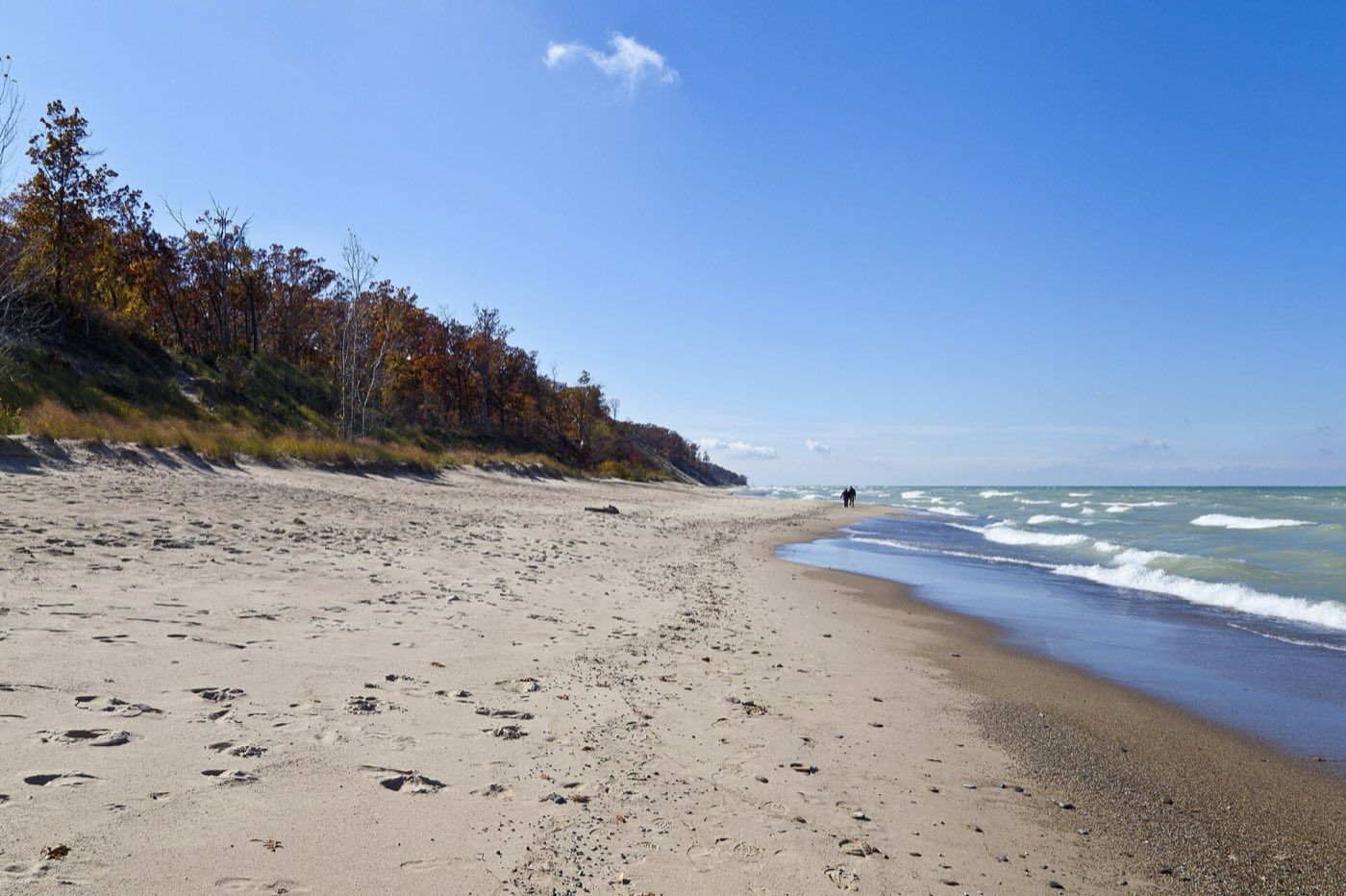
Indiana Dunes is the park most travelers underestimate before they arrive and then can't stop talking about afterward. On a 15-mile stretch of Lake Michigan shoreline between Gary and Michigan City, a set of 200-foot sand dunes — some forested, some bare and migrating — rises straight out of the freshwater. Behind the dunes, a tangle of bogs, oak savanna, prairie, and marsh compress an extraordinary number of ecosystems into a small footprint. Over 1,100 plant species grow here, more diversity per acre than in most western parks twice the size. The park shares its boundary with Indiana Dunes State Park, the working port of Burns Harbor, and the South Shore rail line to Chicago — a stitched-together neighborhood that gives the place its particular character. Commuter trains rumble past trailheads. The beaches themselves, once you're on them, are as clean and empty as you'd find anywhere on the lake, and the sunset views back across Lake Michigan toward the Chicago skyline — 30 miles off — are the photo most visitors take home. Come with curiosity and comfortable shoes, and you'll leave impressed.
What to See & Do
Indiana Dunes State Park's 3 Dune Challenge — Mount Tom, Mount Holden, and Mount Jackson
Just outside the national park, the three tallest dunes in Indiana Dunes State Park — a separate park with its own entrance fee — form a 1.5-mile loop that climbs a cumulative 552 feet, mostly in shifting sand that makes every step harder than it sounds. Mount Tom at 192 feet is first and steepest; the payoff at the top is the full sweep of Lake Michigan and the Chicago skyline on clear days. Register at the Nature Center (small fee) to get a completion sticker. Bring water, wear shoes you don't mind pouring sand out of, and go early — summer afternoons on the slopes are punishing.
West Beach swimming and Lake Michigan sunset views
West Beach is the developed end of the park's shoreline, with a bathhouse, lifeguards in summer, and a paved parking lot that makes it the easy pick for a swim day. The water stays cold through June but warms to comfortable 70s by mid-July. Climb the 350 wooden steps of the Dune Succession Trail behind the beach for the best sunset viewpoint anywhere in the park — Chicago's skyline floats on the horizon and the dunes catch the last light.
Cowles Bog Trail through diverse ecosystems to the beach
Cowles Bog is the classic Indiana Dunes hike — a 4.7-mile loop named for the botanist whose research here basically invented the field of ecology. The trail runs through black oak savanna, wetland, and interdunal swales before climbing the blowout dunes to a quiet stretch of beach, then looping back. Plan on three hours and expect to be alone for long stretches. Spring wildflowers and fall oak color are the peak seasons; avoid after heavy rain when the low sections flood.
Pinhook Bog — a rare quaking bog open on ranger-led walks
Pinhook Bog is a glacial kettle full of sphagnum moss and carnivorous plants that grew in after the last ice age — essentially a chunk of Canadian muskeg stranded in Indiana. The bog is so fragile it's gated and only accessible on ranger-guided walks offered a handful of Saturdays a year; reservations open in spring. You'll walk on a floating mat of vegetation that ripples underfoot, with pitcher plants and sundews at your feet and tamarack trees overhead. If you can get a slot, do.
Great Marsh bird watching for over 350 species
The Great Marsh is the largest remaining wetland along the southern Lake Michigan shore, and its location on a major migration flyway makes it one of the top birding spots in the Midwest. Over 350 species have been recorded — sandhill cranes, great blue herons, prothonotary warblers, and more ducks than you'll know what to do with. The boardwalk off Beverly Drive is the easy access point. Dawn in May during spring warbler migration is the single best window of the year.
Bailly Homestead and Chellberg Farm historic district
A quiet corner of the park preserves two centuries of northern Indiana settler history: the 1820s Bailly Homestead of a French Canadian fur trader and his Odawa wife, and the 1870s Chellberg Farm of Swedish immigrants. Both are open for self-guided walks, with interpretive signs and occasionally live demonstrations — maple sugaring in March, Swedish baking in summer. The half-mile trail between them passes through hardwood forest. Allow an hour and a half.
Dune Succession Trail showing ecological change in real time
Behind West Beach, the Dune Succession Trail climbs a wooden staircase up through the four classic stages of dune ecology — bare sand, beach grass, cottonwood, then oak forest — in a textbook-perfect half-mile loop. It's short, steep, and ranks as the most educational hike in the park. Read the interpretive signs on the way up; stop at the top for the view over the beach and out across the lake. Best at golden hour when the light rakes across the dune faces.
Getting There & When to Go
Indiana Dunes is roughly 50 miles from downtown Chicago on I-94 or I-90, about an hour's drive without traffic — which is a significant caveat on summer weekends. The South Shore commuter rail runs from Millennium Station in Chicago to Dune Park and Beverly Shores stations, and you can reach several trailheads on foot from the platform. May through September is beach season; water stays cold until late June but warms through August. April and May are the best birding weeks, with spring migration peaking around Mother's Day. October brings oak color and almost empty trails. Winter is underrated — the lake produces dramatic ice formations along the shore, and cross-country ski tracks run through the forest.
Where to Stay
The park and the adjacent state park both allow camping at Dunewood Campground (federal) and the larger state park campground (Indiana DNR), both open mid-April through October; state park sites book out early for summer weekends. For lodging inside the park boundaries, stay in Chesterton, Porter, or Michigan City — each within 10 minutes of a trailhead and offering chain hotels, bed and breakfasts, and vacation rentals at a range of prices. For a base with more to do at night, Chicago is one hour west and Michigan's Harbor Country beach towns (New Buffalo, Union Pier) are 30 minutes east with stronger food and wine options.
Frequently Asked Questions
- Is there an entrance fee for Indiana Dunes National Park?
- Yes — a $25 per-vehicle fee good for seven days, or the National Parks pass. The fee is only collected at West Beach during the peak season; most other trailheads are free. The adjacent Indiana Dunes State Park charges a separate fee and is a different park.
- Can I swim in Lake Michigan here?
- Yes — West Beach, Kemil Beach, Porter Beach, and Central Beach all permit swimming. Lifeguards are only posted at West Beach in summer. Water temperatures stay cold through June, warm to the 70s in July and August, and can generate strong rip currents during north winds — check the daily flag warnings before swimming.
- How does the national park differ from Indiana Dunes State Park?
- The state park is a smaller, concentrated three-mile chunk surrounded on three sides by the national park. It has the tallest dunes — Mount Tom, Mount Holden, and Mount Jackson — plus the main swimming pavilion and a separate entrance fee. Both are worth visiting; most travelers do them on the same trip.
- Is it worth the trip from Chicago for a day?
- Yes, and the South Shore train makes it easy without a car. Get off at Dune Park or Beverly Shores, walk to the beach or a trailhead, and you can reasonably do West Beach, the Dune Succession Trail, and a sunset all in one day. Allow two days if you want to add Cowles Bog and the historic farms.
Plan Your Visit
Book Nearby HotelsHave you visited Indiana Dunes?
Track all 63 national parks on your map