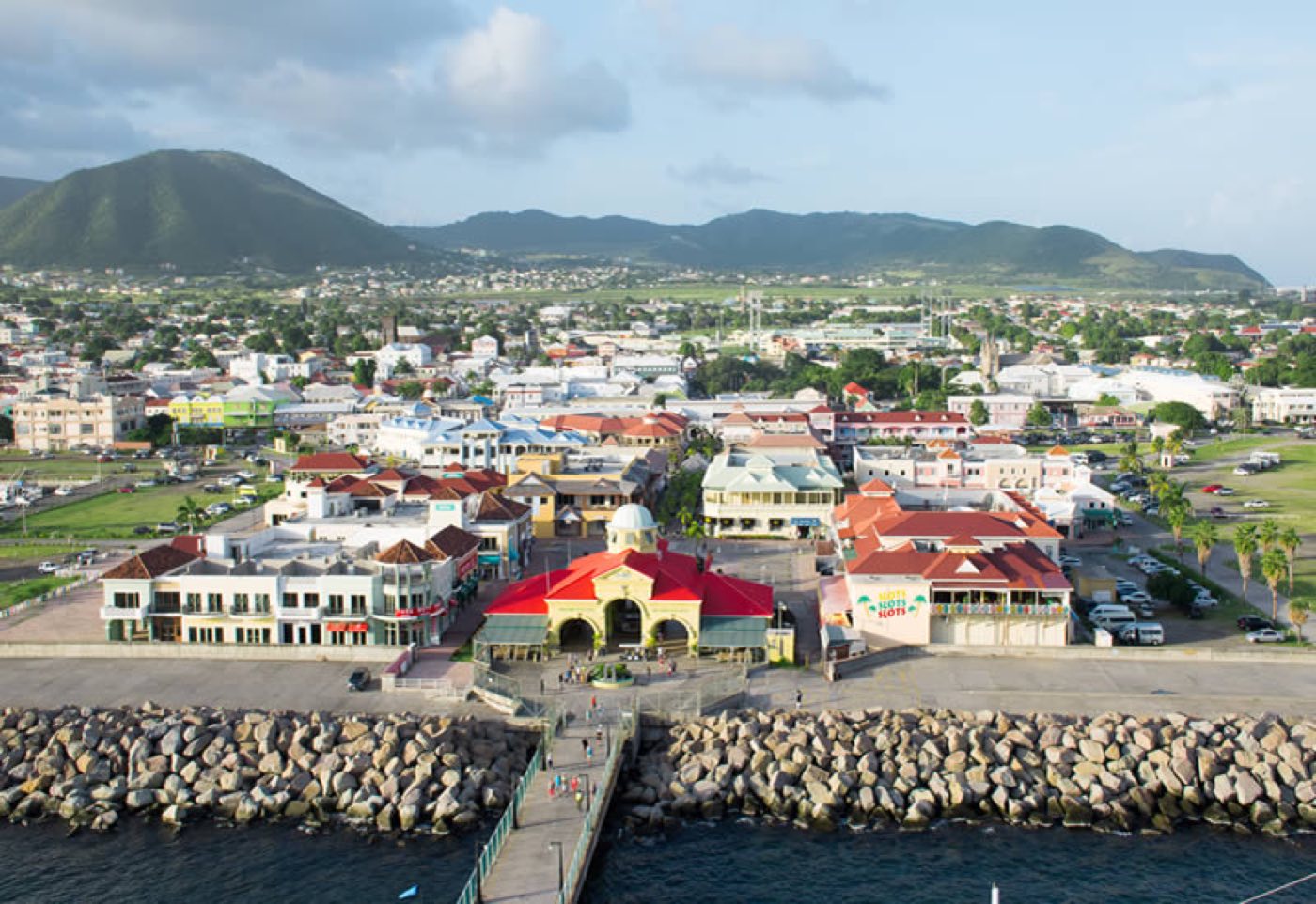
Saint Kitts and Nevis
- Capital
- Basseterre
- Population
- 48K
- Currency
- XCD
- Languages
- English
Overview
A twin-island federation in the Eastern Caribbean, Saint Kitts and Nevis is the smallest sovereign state in the Americas and one of the quieter Caribbean destinations that has not been overrun by mass tourism. Travelers come for Brimstone Hill Fortress on Saint Kitts, the narrow-gauge Sugar Train that loops the island's old plantations, rainforest hiking up the volcanic cone of Mount Liamuiga, and the even sleepier pace of Nevis next door. The two islands are separated by a two-mile channel called The Narrows, crossed in under an hour by passenger ferry or in fifteen minutes by water taxi. Saint Kitts is the bigger and livelier of the two — Basseterre has a cruise port, a scattering of bars, and the island's main beaches along Frigate Bay. Nevis is smaller, quieter, and circumnavigated by a single two-lane road, with a handful of plantation inns and restored sugar estates converted into the kind of hotels where you settle in for a week and read books on the veranda. It rewards travelers looking for Caribbean scenery without cruise-ship density, who want reasonable hiking alongside beach days and don't need nightlife past 11 PM. Expect warm English-speaking hospitality, locally-caught mahi-mahi and lobster, rum punches poured with a heavy hand, and an old-colonial graciousness that persists in the plantation inns. A week is generous, five days is plenty if you split your time between the two islands.
Things to Do
Brimstone Hill Fortress UNESCO site
Built by enslaved Africans for the British between 1690 and 1790, Brimstone Hill rises 230 meters above the western coast of Saint Kitts and is one of the best-preserved colonial fortresses in the Americas. The walls are volcanic stone cut and hauled from the slopes around it, earning it the nickname Gibraltar of the West Indies. The view from the Citadel ramparts takes in Sint Eustatius, Saba, and on clear days the silhouette of Montserrat to the south. Allow two hours and wear decent shoes — the paths between the outworks are steep.
St. Kitts Scenic Railway (Sugar Train)
The 30-inch narrow-gauge railway was built between 1912 and 1926 to haul cane from the estates to the sugar factory in Basseterre. When the sugar industry closed in 2005, the line was converted into a tourist circuit. A three-hour ride in open-air double-decker cars takes you through cane fields (now mostly regrown into scrub), along the north and east coasts, past ruined sugar mills, and back to the port. It runs mainly on cruise ship days; check the schedule if you're staying on-island.
Mount Liamuiga volcano crater hike
Saint Kitts' dormant volcano rises 1,156 meters over the center of the island, with a crater rim trail that climbs through rainforest loud with monkeys and birdsong. The full hike to the crater floor is a strenuous five to six hours round-trip; the rim viewpoint is more manageable at three to four. Go with a local guide — trail markings are thin and the cloud closes in fast in the afternoons. Start early, bring two liters of water per person, and expect to be muddy.
Nevis's Pinney's Beach
A four-mile crescent of pale sand and calm Caribbean water that runs along the western side of Nevis, anchored at its southern end by the Four Seasons and dotted along its length with beach bars. Sunshine's Beach Bar is the institution, famous for its Killer Bee rum punch and open-fire lobster lunches on the sand. The best section for swimming is in front of Lime Beach Bar, and if you walk far enough north, Mount Nevis rises directly behind you through the palms.
Romney Manor and Caribelle Batik
A 17th-century sugar plantation great house and the headquarters of Caribelle Batik, a small workshop that has been making wax-resist printed cotton since 1976. The grounds are the real draw — gardens planted with a 400-year-old saman tree whose canopy spreads more than 30 meters, and a working demonstration of the batik process you can watch step by step. Combine it with the Wingfield Estate ruins next door for a half-day mid-island stop.
Frigate Bay beaches
The narrow peninsula between Basseterre and the South East Peninsula has two distinct coasts within walking distance of each other: the Atlantic side, open and wind-swept with strong surf, and the Caribbean side, calmer and lined with the island's beach bars. The Strip, a stretch of shacks and bars on the Caribbean side, runs loud on weekend nights with karaoke, reggae, and the island's best conch fritters. Go to Mr. X's Shiggidy Shack or Buddies Beach Hut for the evening.
Nevis Peak hiking trail
The 985-meter volcanic peak at the center of Nevis is a genuinely demanding hike — four to five hours round-trip of scrambling up muddy, rope-assisted sections through cloud forest to a summit that is usually socked in with mist. The effort is the reward rather than the view. Go with a licensed guide (Top to Bottom Tours and Sunrise Tours both run it regularly), start at sunrise to avoid the afternoon cloud, and plan to eat and nap for the rest of the day afterward.
When to Go
December through April is the dry season with the most reliable sunshine, the warmest seas, and the highest prices — book three to six months ahead for mid-December through early April. The St. Kitts Music Festival in late June is the island's biggest event, pulling major regional and international acts to Warner Park over three nights. The green season from June to November brings afternoon rain showers, dramatically lower prices, and genuine Caribbean quiet; hurricane risk peaks from August to October but the islands sit slightly south of the main track compared to the Virgins and Puerto Rico.
Getting Around
On Saint Kitts, the main road loops the island and a taxi from Basseterre to Brimstone Hill runs about $25–$30; agree the fare before getting in. Car rental is straightforward ($50–$70/day plus a temporary local license for $25), drives are on the left, and the roads are mostly in decent shape. Public minibuses run a fixed circuit for about $2.50 a ride. Between the islands, a scheduled passenger ferry runs several times a day from Basseterre to Charlestown on Nevis ($12–$15 one way, 45 minutes), with water taxis as a faster private alternative. On Nevis, the single ring road makes driving simple and rentals are cheap.
Cost & Currency
Both islands use the Eastern Caribbean dollar (XCD), pegged at a fixed 2.70 to the US dollar, and US dollars are accepted almost everywhere at roughly that rate. Cards are widely taken at hotels, restaurants, and shops; carry $50–$100 EC in cash for taxis, beach bars, and market vendors. Expect $180–$350 per night for a mid-range hotel on Saint Kitts, $300–$600 on Nevis where plantation inns dominate the market, and upwards of $1,000 for the Four Seasons. A lobster lunch on the beach runs $30–$50, a rum punch $8–$10, and a sit-down dinner at a Frigate Bay restaurant $50–$80 per person. Tipping is 10–15%; some bills include a service charge so check.
Frequently Asked Questions
- Do I need a visa for Saint Kitts and Nevis?
- US, UK, Canadian, EU, and Australian citizens do not need a visa for stays up to 90 days. A valid passport with at least six months' validity and proof of onward travel is all you need. The entry form can be filled out online before arrival through the SKN Entry platform, which speeds up the airport process.
- How do I get between Saint Kitts and Nevis?
- A scheduled passenger ferry runs several times a day between Basseterre on Saint Kitts and Charlestown on Nevis, taking about 45 minutes and costing $12–$15 one way. Water taxis between the Reggae Beach area of Saint Kitts and Oualie Beach on Nevis cost around $20 per person and take 15 minutes — the faster option on weekends when the ferry can be busy.
- Which island should I stay on?
- Split your time if you can. Saint Kitts is livelier with more restaurants, bars, and activities — Brimstone Hill, the Sugar Train, Mount Liamuiga, and Frigate Bay nightlife. Nevis is quieter, smaller, and dominated by plantation inns and beach resorts. Three or four nights on Saint Kitts followed by three or four on Nevis works well for a week-long trip.
- Is Saint Kitts and Nevis safe?
- Yes, violent crime against tourists is very rare and the islands are among the safer Caribbean destinations. Petty theft from unattended belongings on beaches happens occasionally, so don't leave valuables unattended. Walking Basseterre after dark is generally fine in the main areas, though you might take a taxi back from The Strip at Frigate Bay to be cautious.
- How do I get there?
- Robert L. Bradshaw International Airport on Saint Kitts receives direct flights from Miami, New York (JFK), Charlotte, and Atlanta in the US, plus Toronto and London Gatwick seasonally. Nevis has its own smaller airport served by regional LIAT and Winair hops, but most travelers fly into Saint Kitts and take the ferry. Inter-island small plane flights to Nevis take about ten minutes.
Plan a Trip to Saint Kitts and Nevis
Have you been to Saint Kitts and Nevis?
Track 195 countries, 50 states & 63 national parks on your map