National Park · OH · Est. 2000
Cuyahoga Valley
Overview
Cuyahoga Valley is the easy-going park — Ohio's only national park, threading 33,000 acres of forest, pasture, ledges, and waterfalls between Cleveland and Akron along the Cuyahoga River. You can drive from downtown Cleveland to a trailhead in 25 minutes. That kind of access is what makes this park different: it's genuinely walkable from surrounding neighborhoods, crossed by a former canal towpath that runs its full length as a flat, accessible trail, and dotted with working farms, a scenic railroad, and a handful of small villages the park didn't tear down when it acquired the land. Spring is when the place shines hardest — waterfalls are running full, trilliums carpet the forest floor, and the canopy is that neon new-leaf green that lasts three weeks. Summer is shady and shot through with fireflies. Fall is the payoff for living in the Midwest: sugar maples light up orange along the Towpath Trail, and the railroad's fall foliage trains sell out weeks ahead. Winter draws in quietly with frozen waterfalls and cross-country skiers at Kendall Lake. You won't get alpine drama here — you'll get the surprise of how much there is to a landscape most people drive past on I-77 without looking down into the valley.
What to See & Do
Brandywine Falls — a 65-foot cascading bridal veil waterfall
Brandywine Falls is the park's most-photographed feature and the easiest to reach — a short boardwalk from a signed parking lot ends at two viewing platforms, upper and lower, with the 65-foot waterfall right in front of you. The falls cut through 400 million years of sandstone and shale layered like a giant slab cake. Go on weekday mornings or in winter when the falls freeze into a blue-green ice sculpture — weekend afternoons can be shoulder-to-shoulder. Extend the visit with the 1.5-mile Brandywine Gorge Loop trail below the falls.
Cuyahoga Valley Scenic Railroad through the valley
The scenic railroad runs vintage passenger cars 26 miles between Akron and Independence, with boarding stations at Peninsula and other points along the way. The single best value is the Bike Aboard! program — pedal the Towpath Trail one way, then flag down the train with your bike for a cheap $5 ride back. Regular scenic runs last about three hours round-trip. Fall foliage and December polar express trains book out weeks ahead. Tickets are sold through CVSR directly, not the park.
Towpath Trail along the historic Ohio & Erie Canal
The Towpath runs 20 flat miles through the park along the original mule-towed Ohio & Erie Canal route, and another 80-plus miles north and south outside park boundaries. It's crushed limestone, ADA-accessible in long sections, and ideal for long-distance biking, jogging, or a casual stroller walk. Interpretive signs and restored lock houses mark the canal's 19th-century heyday. Lock 29 in Peninsula is the most walkable trailhead, with food and coffee in town right at the path.
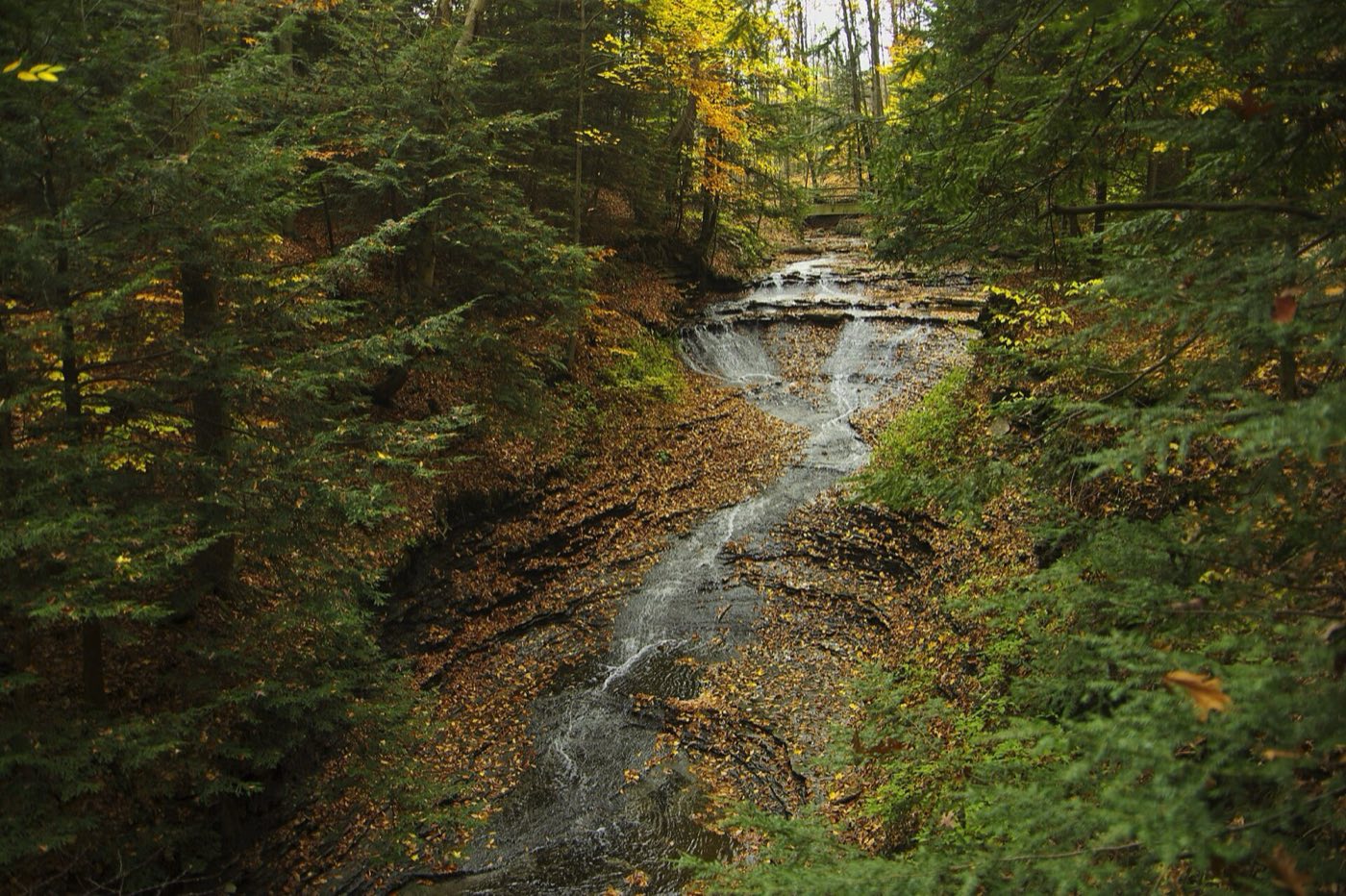
Blue Hen Falls via a short forest trail
Blue Hen Falls is the park's quieter waterfall experience: a 15-foot sandstone drop at the head of Spring Creek, reached by a half-mile forest walk with some stairs near the end. Keep going another mile past Blue Hen and you'll reach the smaller but lovelier Buttermilk Falls. The trailhead at Boston Mill Road was rerouted in the last few years after a slope failure — follow current signage, because older maps may send you wrong. Bring real shoes; the path gets muddy fast after rain.
Stanford Hostel and the Stanford Trail loop
Stanford House is a restored 1843 farmhouse operating as a Hostelling International property inside the park — a cheap, unusual overnight option a mile from Brandywine Falls. The Stanford Trail itself is a quiet 3-mile loop through meadows and forest that links the hostel to the Brandywine Gorge and back. Early morning you'll usually have it to yourself, walking past restored hedgerows and remnant orchards. Deer are so numerous here they're essentially ignored by locals.
Beaver Marsh boardwalk for wildlife watching
Beaver Marsh is a restored wetland on the Towpath Trail that was, as recently as the 1980s, an auto junkyard. Volunteers cleared the site, and within a few years beavers moved back in and re-engineered the place. A flat boardwalk loops right through the marsh. Morning and evening bring great blue herons, green herons, wood ducks, snapping turtles, and the beavers themselves, which are easiest to spot just before sunset in summer. Free parking at the Ira Trailhead a quarter mile north.
Ledges Trail through Ritchie Ledges rock formations
The Ledges is a 2.2-mile loop that threads between and on top of a horseshoe of 320-million-year-old sandstone cliffs honeycombed with narrow passages, caves, and moss-covered boulders. The light inside the passages is stained green by leaves overhead in summer, gold in fall, and the rock faces drip with ice in winter. Ice Box Cave, a cool narrow fissure that felt air-conditioned in summer, is now gated off due to white-nose syndrome in bats — admire it from outside. Parking fills on weekends; come before 10 a.m.
Getting There & When to Go
Cleveland Hopkins International Airport is 25 minutes northwest of the park; Akron-Canton Regional is 20 minutes south. Most visitors drive in from the Cleveland or Akron suburbs, and you can hit the major sights across two days without covering much mileage. Spring (April and May) delivers the best waterfalls and wildflowers; October is the unmissable window for fall color, especially along the Towpath and Ledges. The scenic railroad's fall and holiday runs sell out well ahead. Summer is hot but heavily shaded in the valley, with fireflies at dusk in Beaver Marsh. Winter brings frozen waterfalls, ice skating at Kendall Lake, and quieter trails. There's no entrance fee to the park, and roads stay plowed year-round.
Where to Stay
Inside the park, the Inn at Brandywine Falls is a restored 1848 farmhouse B&B with six rooms a two-minute walk from the waterfall; the Stanford House hostel offers a budget option. No car camping is available inside park boundaries. The villages of Peninsula and Boston Township have small guesthouses and a handful of vacation rentals worth looking into. For full hotel options, Cleveland to the north and Akron to the south both have every chain and a fast drive into the park. Hudson, Ohio — 15 minutes east — is an underrated small-town base with good food and historic architecture.
Frequently Asked Questions
- Is there an entrance fee?
- No — Cuyahoga Valley is one of the few U.S. national parks with no entrance fee. All trails and visitor centers are free to access year-round. The scenic railroad, guided programs, and lodging are operated by partners and have their own fees.
- What's the single best way to see the park in a day?
- Start at Brandywine Falls early in the morning, walk the Brandywine Gorge Loop, then drive to the Ledges Trail and hike the 2.2-mile loop. In the afternoon, rent a bike in Peninsula, ride the Towpath south to Beaver Marsh, and flag down the scenic railroad's Bike Aboard! service for the return. That's a full, varied day and hits almost every landscape type the park protects.
- Can I ride the scenic railroad with a bike?
- Yes — the Bike Aboard! program lets cyclists ride one way on the Towpath Trail and flag down the train at any marked stop for a $5 return. It operates on a regular summer and fall schedule; check CVSR's website for dates. This is genuinely the easiest car-free sightseeing in the park.
- Are dogs allowed on the trails?
- Yes, on leashes no longer than six feet, on nearly every trail in the park including the Towpath, Ledges, and Brandywine Gorge. Dogs are not allowed on the scenic railroad, at Kendall Lake beaches, or inside historic structures. Pack out waste — park staff confirm it's the single biggest visitor-impact problem here.
Plan Your Visit
Book Nearby HotelsHave you visited Cuyahoga Valley?
Track all 63 national parks on your map