National Park · SC · Est. 2003
Congaree
Overview
Congaree is the quietest of the East Coast national parks and, somehow, also the most humming with life. A floodplain forest 20 miles south of Columbia, South Carolina, it protects one of the largest intact old-growth bottomland hardwood stands left in North America — bald cypress, water tupelo, loblolly pine, and sweetgum trees that have been growing here since before the Revolutionary War. Several of the champion trees in the park are the tallest of their species on record. What surprises people is how sensory the place is. Walking the raised boardwalk in early spring, you'll hear barred owls calling in daylight, see prothonotary warblers flash yellow through the canopy, and watch water moccasins loaf on cypress knees. In late May for about two weeks, synchronous fireflies light up the forest floor in coordinated waves — one of only a handful of places in the world where this happens. The park is flat, and it floods about 10 times a year, reshuffling the trails and leaving mud lines on the trunks. Come in cool, dry weather if you can; come armed with bug spray if you can't.
What to See & Do
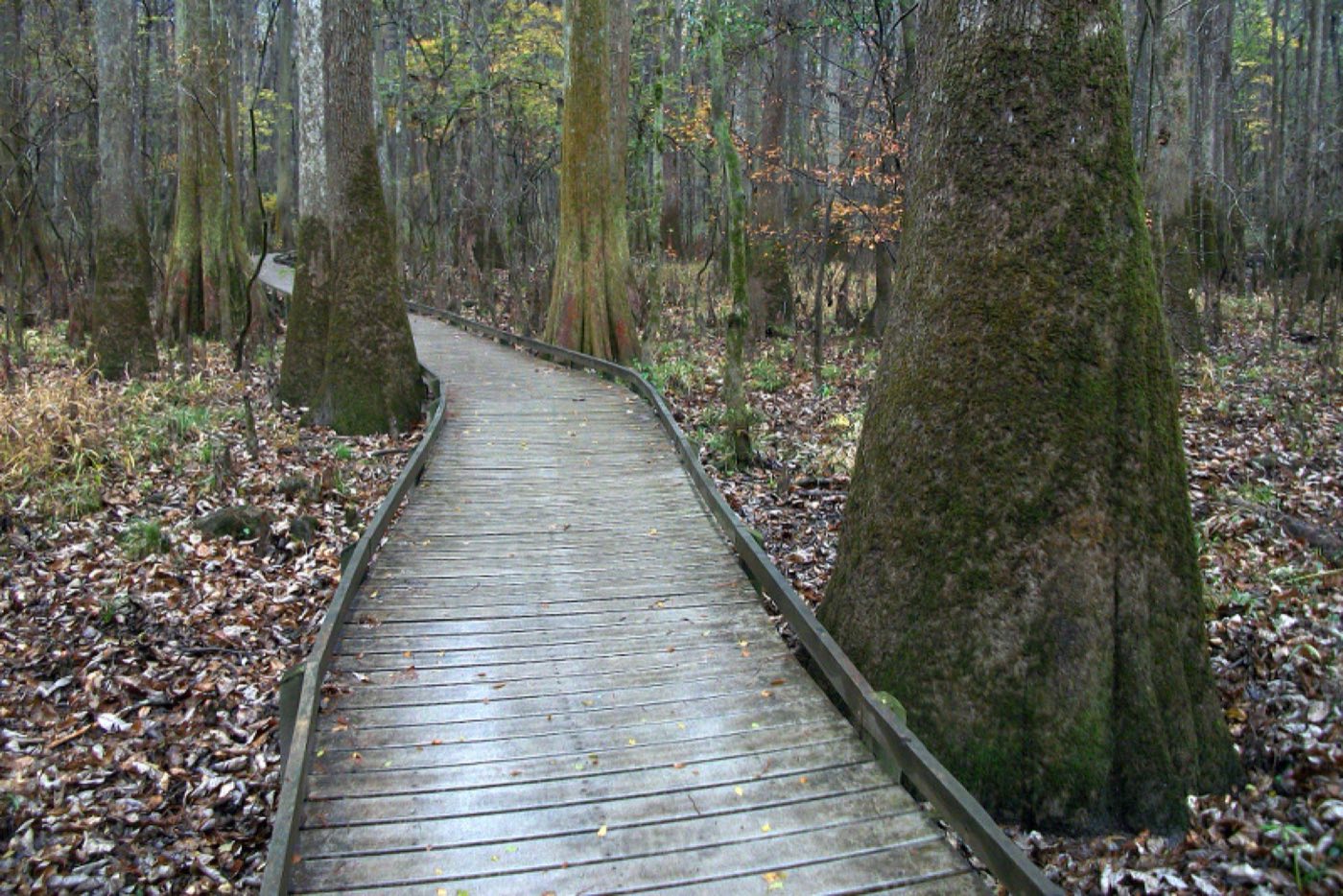
Boardwalk Loop Trail through towering old-growth cypress and tupelo
The 2.6-mile elevated Boardwalk Loop is the easiest way to be inside the old-growth forest without getting wet feet, and it's the park's signature experience. It starts at the Harry Hampton Visitor Center and runs at tree-knee level through some of the tallest deciduous trees in eastern North America. Allow 90 minutes to walk it slowly — you'll stop more than you think for herons, woodpeckers, and the occasional otter in Wise Lake. The boardwalk is wheelchair accessible except during flooding, which happens often enough that the park posts daily conditions.
Synchronous firefly viewing events in late May
For roughly two weeks each May, typically the last week of the month, the park's Photuris frontalis fireflies flash in coordinated waves of light across the forest floor after dark. It is one of only a few documented sites for this behavior on earth. The park runs a lottery for entry permits — apply weeks in advance on Recreation.gov — and you'll stand on the boardwalk in full darkness while the display builds and pulses. No white light allowed; red flashlights only. Dress for mosquitoes in a major way.
Canoe and kayak paddling Cedar Creek's blackwater channels
Cedar Creek winds for 15 miles through the park's interior, carrying tannin-stained water the color of strong tea. Put in at Bannister's Bridge for an out-and-back or arrange a shuttle for a 6-mile one-way down to the Kingsnake Landing takeout. Expect downed trees, tight turns, and long stretches where you're the only boat for miles. Rent boats from outfitters in Columbia; the park does not rent gear. Water levels matter — check the park website before going, because too-low or too-high conditions both end runs early.
Champion tree hunting — the park holds multiple state and national records
Congaree contains some of the tallest trees in eastern North America, including the current national-champion loblolly pine, sweetgum, and water hickory. Some are off-trail and require bushwhacking with a GPS; others are accessible via the Boardwalk and Weston Lake trails. Bring a printout of the park's champion tree locations from the visitor center. A 167-foot loblolly along the Weston Lake Loop is the easiest giant to find. Go slowly and look up — you'll have no sense of scale until something catches the light.
Owl prowl ranger programs after dark
On select weekend evenings, rangers lead 90-minute owl prowls on the boardwalk, calling for barred, screech, and great horned owls and often getting responses within a few hundred yards. It's free with park admission, but sign up at the visitor center earlier in the day to guarantee a spot — groups cap around 30. Bring a red-filtered flashlight and close-toed shoes. Owl prowl nights are also when you'll notice just how loud a cypress forest is at 9 p.m. in summer.
Weston Lake Loop Trail through the floodplain forest
A 4.5-mile loop off the Boardwalk, the Weston Lake Loop is the easiest way to get beyond the day-use crowd and into untouched old growth. The first mile runs alongside Cedar Creek, where you'll often spot river otters and basking turtles. Expect mud after rain, some short boardwalk sections, and one or two low bridges that occasionally get washed out. The loop takes most walkers two to three hours. Ticks are active March through October — treat pants and socks with permethrin before you come.
Getting There & When to Go
Congaree sits about 20 miles southeast of Columbia, South Carolina; the Columbia airport is 30 minutes away, and Charlotte is the bigger hub 90 minutes north. Most visitors drive in for the day. Spring, March through May, is the peak window — wildflowers, warblers, and the firefly event — followed by fall, October through November, with cooler hiking and golden canopy color. Summer is brutally hot, humid, and mosquito-heavy; if you come then, bring serious bug protection and start at sunrise. Winter is quiet and cool and actually one of the best times to see wildlife with the leaves down. Flooding can close the boardwalk any time of year — call the visitor center for conditions before driving out.
Where to Stay
There is no lodging in the park. Two primitive campgrounds — Longleaf and Bluff — are reservable through Recreation.gov and are the closest overnight option; both are walk-in only with pit toilets and no water. Backcountry camping by permit lets you set up deeper in the forest if you're ready to hang a bear bag. The nearest lodging is in Columbia, where you'll find the full range of chain hotels and Airbnbs about 30 minutes from the park entrance. For a quieter stay, look in the small towns of Eastover or Hopkins, or at lakeside cabins near Lake Marion 45 minutes south.
Frequently Asked Questions
- Is there an entrance fee?
- No — Congaree is one of the few U.S. national parks with no entrance fee. The visitor center, boardwalk, and trails are all free to access year-round. Camping permits and reservations have small fees through Recreation.gov.
- How do I see the synchronous fireflies?
- Entry to the May firefly display is lottery-only. Apply on Recreation.gov in late April for a nightly permit during the roughly two-week peak. If you don't get one, a free daytime visit followed by viewing from the park boundary is still possible — just not as immersive as being on the boardwalk.
- Are there alligators and snakes?
- Yes — alligators occur in the deeper lakes and are rarely visible; cottonmouths (water moccasins), copperheads, and several non-venomous water snakes are common in warm months. Stay on the boardwalk and trails, watch where you put your hands, and you'll be fine. Most visitors finish the day having seen more otters than snakes.
- Does the park really flood?
- Yes — the floodplain floods roughly 10 times per year, most often in winter and spring, and water can cover the boardwalk. The park posts current conditions online and on a whiteboard at the visitor center. When the boardwalk is flooded, you can still reach the forest by canoe or kayak on Cedar Creek, which is arguably a better experience.
Plan Your Visit
Book Nearby HotelsHave you visited Congaree?
Track all 63 national parks on your map